


Nepal yesterday briefly lifted a curfew imposed on the capital after widespread rioting in response to the slaying of 12 Nepalese in Iraq, as the death toll from the unrest rose to two.
The curfew was lifted for three and a half hours to allow the capital's people to buy food and other essential goods before coming back into force, a home ministry official said.
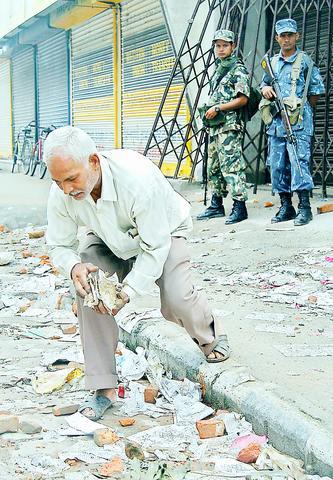
PHOTO: EPA
It was imposed Wednesday after thousands of people rampaged through Kathmandu, setting fire to the city's main mosque and several Arab businesses and ransacking employment agencies.
Police opened fire to disperse an angry crowd that tried to storm the Egyptian embassy, which represents Iraqi interests in the Himalayan kingdom.
One person was killed there and another in police action elsewhere in Katmandu, a home ministry official said.
"Two people were killed Wednesday in different security police action ... while scores of people were injured when police charged with batons to disperse the crowd who were pelting stones at the police," the official said.
There were no incidents overnight in Kathmandu or Lalitpur, which was also placed under a 24-hour curfew, he said.
The government has declared yesterday a day of national mourning for the 12 who were murdered by Islamic militants who had held them hostage for about 10 days.
Offices and schools were closed across the country and the flag flown at half mast.
The protests erupted late Tuesday after news that the 12, who left the impoverished nation in search of jobs as cooks and cleaners, had been murdered.
A mob made up mainly of youths broke windows of more than a dozen employment agencies blamed for sending Nepalese to Iraq and set fire to their vehicles, furniture and computers.
An employee at Qatar Airways, one of the main airlines used by Nepalese seeking jobs in the Middle East, said dozens of angry people stormed into their premises and smashed furniture before setting the building on fire.
Many protesters also demanded the resignation of Prime Minister Sher Bahadur Deuba, saying he should take responsibility for the failure to free the hostages.
The government had repeatedly stressed that Nepal, which is fighting a bloody Maoist rebellion, was not part of the US-led coalition in Iraq.
His government announced compensation of one million rupees (US$14,400) for the families of each of the 12 slain hostages, a handsome sum in the one of the world's poorest countries.
Hindus make up more than 86 percent of the population in Nepal, the world's only officially Hindu state. But the kingdom has experienced little of the inter-religious violence that has scarred neighboring India. Muslims account for 3.8 percent of the 27 million population.
A statement announcing the killings was posted on an Islamist website by an Al-Qaeda-linked group called the Army of Ansar al-Sunna.
It was accompanied by pictures of the grisly beheading of a blindfolded hostage, including one where his bloodied head was held up like a trophy by a hooded captor. A video showed the other Nepalese being shot.
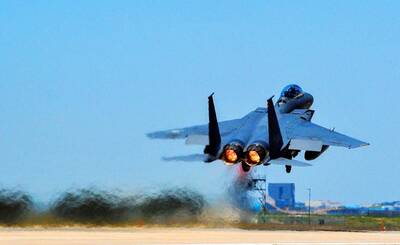
South Korea’s air force yesterday apologized for a 2021 midair collision involving two fighter jets, a day after auditors said the pilots were taking selfies and filming during the flight and held them responsible for the accident. “We sincerely apologize to the public for the concern caused by the accident that occurred in 2021,” an air force spokesman told a news conference, adding that one of the pilots involved had been suspended from flying duties, received severe disciplinary action and has since left the military. The apology followed a report released on Wednesday by the South Korean Board of Audit and Inspection,

Indonesian police have arrested 13 people after shocking images of alleged abuse against small children at a daycare center went viral, sparking outrage across the nation, officials said on Monday. Police on Friday last week raided Little Aresha, a daycare center in Yogyakarta on Java island, following a report from a former employee. CCTV footage circulating on social media showed children, most younger than two, lying on the floor wearing only diapers, their hands and feet bound with rags. The police have confirmed that the footage is authentic. Police said they also found 20 children crammed into a room just 3m by 3m. “So

About 240 Indians claiming descent from a Biblical tribe landed at Tel Aviv airport on Thursday as part of a government operation to relocate them to Israel. The newcomers passed under a balloon arch in blue and white, the colors of the Israeli flag, as dozens of well-wishers welcomed them with a traditional Jewish song. They were the first “bnei Menashe” (“sons of Manasseh”) to arrive in Israel since the government in November last year announced funding for the immigration of about 6,000 members of the community from the states of Manipur and Mizoram in northeast India. The community claims to descend from

‘TROUBLING’: The firing of Phelan, who was an adviser to a nonprofit that supported the defense of Taiwan, was another example of ‘dysfunction’ under Trump, a US senator said US Secretary of the Navy John Phelan has been fired, a US official and a person familiar with the matter said on Wednesday, in another wartime shakeup at the Pentagon coming just weeks after US Secretary of Defense Pete Hegseth ousted the Army’s top general. The Pentagon announced his departure in a brief statement, saying he was leaving the administration “effective immediately,” but it did not provide a reason or say whether it was his decision to go. The sources, who spoke on condition of anonymity, said Phelan was dismissed in part because he was moving too slowly to implement reforms to


 RSS
RSS