


A British prosecutor said on Wed-nesday that authorities seized 100 computers containing thousands of files and had issued 52 terrorism-related warrants in the investigation that led to charges against eight men for conspiracy to commit murder in an alleged terror plot.
The prosecutor, Sue Hemming, emphasized that investigators were at "the very early stages of a complex investigation," and described the inquiry to date as only the "tip of the iceberg."
In charges announced on Tuesday by Scotland Yard, all eight of the men were accused of conspiring together and with "other persons unknown" to use radioactive materials, toxic gases and chemicals or explosives to "cause disruption, fear or injury."
Two have been charged with possessing a reconnaissance plan of the Prudential Building in Newark, New Jersey, which was part of the terror alert announced by US officials this month. One of these men is Dhiren Barot, whom US officials have identified as Issa al-Hindi and have described as a senior al-Qaeda operative in the UK.
At a hearing at Belmarsh Prison in Southeast London, Hemming suggested that some defendants might have tried to obtain the dangerous materials described in the charges.
She told the judge, Timothy Workman, that documents had been found indicating that some of the accused "may have been sourcing" materials from shops or companies. Evidence collected so far, she said, suggested that the authorities might have uncovered at least one such attempt.
Yet the British authorities have not said whether they have uncovered any evidence of an active or specific plot against targets in the US, UK or elsewhere. Nor have they said that any of the suspects actually acquired materials that could be used in a terrorist act.
Arguing against bail, Hemming told the judge the men all had a "strong and deeply held ideology" and were "prepared to carry out dangerous acts." She said two of the men had past convictions -- one for resisting or obstructing the police in a case unrelated to the current charges and another for a driving-related offense six years ago.
Workman, citing the "nature and gravity" of the allegations and the risk the men might flee or interfere with witnesses, denied all of them bail. He ordered them held until Wednesday, when they are to appear at Old Bailey, the central criminal court in London.
In addition to Barot, 32, the other defendants are: Omar Abdul Rehman, 20; Mohammed Zia ul-Haq, 25; Abdul Aziz Jalil, 31; Nadeem Tarmohammed, 26; Mohammed Naveed Bhatti, 24; Quaisar Shaffi, 25; and Junade Feroze, 28. All face charges of conspiracy to murder and to use radioactive and other materials. Barot and Tarmohammed also face charges related to the reconnaissance plans, and Shaffi faces charges that he possessed an "extract of the Terrorist's Handbook" containing information on explosives and weapons.
Police in Birmingham yesterday arrested a 19-year-old man under the Terrorism Act 2000, West Midlands Police said.
The teenager was detained at an undisclosed address in the Selly Oak area of Birmingham, along with two other men, aged 24 and 36, who were arrested in relation to immigration matters, police said.
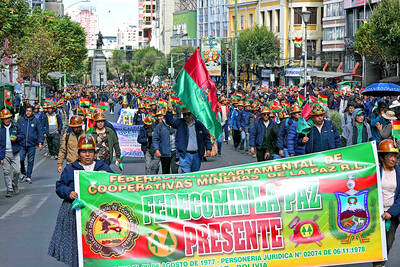
The Bolivian government on Friday struck a deal with protesting miners, but was still grappling with blockades and demonstrations by other workers across La Paz. Other groups are still blocking access roads into the city, which is also the seat of the government. Police on Thursday prevented the miners from entering the main square by using tear gas, while the demonstrators hurled stones and explosives with slingshots. Protests against the policies of Bolivian President Rodrigo Paz have convulsed the Andean nation since early this month, and roadblocks were choking routes into La Paz throughout Friday, the national road authority said. Miners demanded that Paz
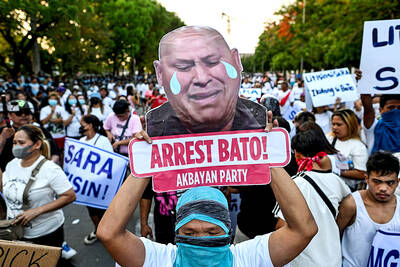
The Philippines said it has asked the country’s Supreme Court to allow it to arrest former Philippine president Rodrigo Duterte’s chief drug war enforcer to stand trial in an international tribunal. The International Criminal Court (ICC) last week unsealed an arrest warrant against Philippine Senator Ronald dela Rosa, accusing him along with Duterte and other “coperpetrators” of the “crime against humanity of murder.” Dela Rosa briefly sought refuge in the Philippine Senate last week while asking the Philippine Supreme Court to stop an ongoing attempt by government agents to arrest him. “By his own conduct, he has placed himself outside the protection of
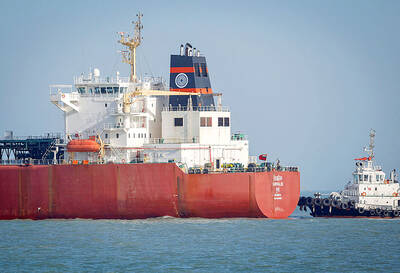
A ship anchored off the United Arab Emirates (UAE) was seized and taken toward Iran and another — a cargo ship near Oman — sank after being attacked, authorities said on Thursday, as tensions escalated near the Strait of Hormuz. It was not immediately clear who was behind these incidents, but they happened as a senior Iranian official reiterated his country’s claim of control over the waterway and another said it had a right to seize oil tankers connected to the US. The turmoil in the strait has been a sticking point for weeks in talks between the US and Iran to

Crowds in Bangladesh are flocking to snap photographs with an unlikely social media star — an albino buffalo with flowing blond hair nicknamed “Donald Trump” that is due to be sacrificed within days. Owner Zia Uddin Mridha, 38, said his brother named the 700kg bull over its flowing helmet of hair resembling the signature look of the US president. “My younger brother picked this name because of the buffalo’s extraordinary hair,” he said at his farm in Narayanganj, just outside the capital, Dhaka. Mridha said that a constant stream of curious visitors — social media fans, onlookers and children — have come throughout


 RSS
RSS