


Pakistan published photos yesterday of six terror suspects, including a top al-Qaeda operative accused of masterminding two attempts to assassinate the president, and offered a big reward for information leading to their arrests.
The advertisement published in the country's leading newspapers carried a photograph of Abu Faraj al-Libbi, a Libyan accused by President General Pervez Musharraf of being behind two failed attempts on the president's life last year.

PHOTO: AFP
Musharraf escaped unhurt in both attacks in December, when terrorists tried to blow up his motorcade on a road near the capital, Islamabad. The first attack did not injure anybody, but 17 people died in the second attack.
Since then, Pakistani police and security agencies have been looking for al-Libbi and other suspects believed responsible for the two attacks.
On Wednesday, Pakistan offered a reward of 20 million rupees (US$344,827) each for any information leading to the arrest of al-Libbi, believed to be a top al-Qaeda operative, and Amjad Hussain, who is best known as Amjad Farooqi, a Pakistani militant who also allegedly played key role in those two attacks.
Four other suspects whose photos were published in the newspapers were; Mati-ur-Rahman, Mansoor best knwon Chota Ibrahim, Qari Ehsan and Omar Aqdas. It was not immediately clear why those four were being sought.
The advertisement gave no details about the nature of charges against the men and only said they are "most wanted terrorists" who are "wanted for acts of terrorism."
The latest government move came a day after the father of an alleged al-Qaeda computer expert filed a lawsuit challenging what he called the illegal detention of his son, who was captured last month.
Mohammed Naeem Noor Khan was captured by Pakistani intelligence agents July 13 in the eastern city of Lahore, and a search of his computers uncovered surveillance documents of five financial institutions in the US, prompting a terror alert in three US cities.
Later, Khan led police to a hide-out of Ahmed Khalfan Ghailani, a Tanzanian al-Qaeda wanted for the 1998 bombings of two US embassies in east Africa. Ghailani was captured July 25 after a 12-hour shootout in eastern industrial city of Gujrat.
Babar Awan, a defense lawyer, told reporters on Tuesday that Khan's father has filed a lawsuit in a court at Rawalpindi, near the capital, Islamabad, "against illegal detention of his son."
"Whatever the allegation against the boy may be, he has a right to be defended through a counsel of his own choice," Awan said.
He said that Khan's family had learned about his detention only through the media.
"We don't know why and where he [Khan] is being held."
Awan said the court is yet to act on the petition of Khan's father, who is a flight attendant with Pakistan International Airlines.
Under Pakistani laws, such lawsuits are usually admitted for hearing, and the government is asked to explain reasons for holding any particular suspect. A law also gives the government the right to detain any terror suspect for up to one year.

Four contenders are squaring up to succeed Antonio Guterres as secretary-general of the UN, which faces unprecedented global instability, wars and its own crushing budget crisis. Chile’s Michelle Bachelet, Argentina’s Rafael Grossi, Costa Rica’s Rebeca Grynspan and Senegal’s Macky Sall are each to face grillings by 193 member states and non-governmental organizations for three hours today and tomorrow. It is only the second time the UN has held a public question-and-answer, a format created in 2016 to boost transparency. Ultimately the five permanent members of the UN’s top body, the Security Council, hold the power, wielding vetoes over who leads the
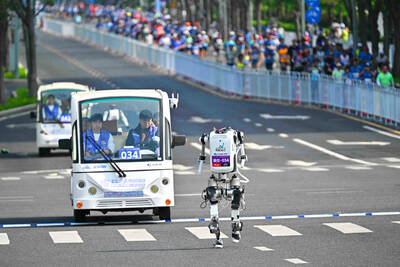
A humanoid robot that won a half-marathon race for robots in Beijing on Sunday ran faster than the human world record in a show of China’s technological leaps. The winner from Honor, a Chinese smartphone maker, completed the 21km race in 50 minutes and 26 seconds, said a WeChat post by the Beijing Economic-Technological Development Area, also known as Beijing E-Town, where the race began. That was faster than the human world record holder, Ugandan Jacob Kiplimo, who finished the same distance in about 57 minutes in March at the Lisbon road race. The performance by the robot marked a significant step forward

An earthquake registering a preliminary magnitude of 7.7 off northern Japan on Monday prompted a short-lived tsunami alert and the advisory of a higher risk of a possible mega-quake for coastal areas there. The Cabinet Office and the Japan Meteorological Agency said there was a 1% chance for a mega-quake, compared to a 0.1% chance during normal times, in the next week or so following the powerful quake near the Chishima and Japan trenches. Officials said the advisory was not a quake prediction but urged residents in 182 towns along the northeastern coasts to raise their preparedness while continuing their daily lives. Prime
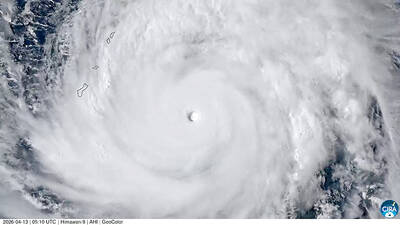
HAZARDOUS CONDITION: The typhoon’s sheer size, with winds extending 443km from its center, slowed down the ability of responders to help communities, an official said The US Coast Guard was searching for six people after losing contact with their disabled boat off the coast of Guam following Typhoon Sinlaku. The crew of the 44m dry cargo vessel, the US-registered Mariana, on Wednesday notified the coast guard that the boat had lost its starboard engine and needed assistance, Petty Officer 3rd Class Avery Tibbets said yesterday. The coast guard set up a one-hour communication schedule with the vessel, but lost contact on Thursday. A Coast Guard HC-130 Hercules aircraft was launched to search for the six people on board, but it had to return to Guam because of


 RSS
RSS