


US Secretary of Defense Donald Rumsfeld made an unannounced visit to Afghanistan yesterday to review preparations for the October presidential election and go over reconstruction and counternarcotics programs.
During a daylong visit, he planned consultations with Afghan and UN officials, as well as meetings with senior US military officials.
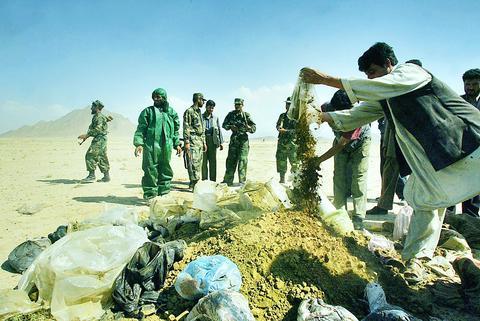
PHOTO: AP
Before flying to the Afghan capital, he said US-led coalition forces are preparing a coordinated effort to attack the narcotics trade in the country, recognizing that drug income could be used to fund insurgents and terrorists in the country.
He offered few specifics, but noted the British government previously has taken the lead in working with President Hamid Karzai's administration to address the drug trade in Afghanistan.
"There are plans being finished now," Rumsfeld said Tuesday, in Oman for the first of several visits to US allies in the region. "I don't want to get into whose troops will do what."
The cultivation of opium poppies has resumed and flourished since 2001 in Afghanistan. It was largely eliminated under the Taliban's religious policing, but farmers have resumed cultivating and harvesting the profitable crop in the chaos since the fall of the Taliban.
American military commanders in Afghanistan have said previously they don't have enough troops to go after the poppy trade and still hunt Taliban and al-Qaeda holdouts.
Rumsfeld seemed resigned that the poppy trade would continue to some degree, saying demand for the drug will always lead someone to create a supply. Heroin made from Afghan poppies generally reaches markets in Europe and Russia.
"All crops have been good the last two years," he said of Afghanistan's poppy cultivation. "It is a terrible thing. It produces great wealth for people who use it to harm society."
The criminal elements are naturally opposed to a strong, democratic government in Afghanistan, he said. He also suggested drug money had ties to Taliban or al-Qaeda, but provided no concrete information to back that up.
UN surveys estimate Afghanistan accounted for three quarters of the world's opium last year, and the trade brought in US$2.3 billion, more than half of the nation's GDP.
New surveys suggest even more has been planted this year, with Robert Charles, the US State Department's top counternarcotics official, saying Afghanistan may be on pace for a world record opium poppy crop this year.
Rumsfeld pointed to the drug war in Colombia as a partial model for efforts in Afghanistan. There, US-trained military forces attack narcotics smuggling routes while the Colombian government tries to eradicate coca growth in the farmlands through aerial spraying.
The costly Colombian campaign, a US$3.3 billion, five-year military aid package known as Plan Colombia, has provided Colombian forces with training, equipment and intelligence. It has led to a huge increase in drug seizures, and closer judicial cooperation between the countries has led to the extradition of 120 alleged drug traffickers to the US for trial in two years.
Despite the progress, cocaine prices on US streets remain unchanged, a sign that there is no shortage of the drug. And the program to fly crop dusters over Colombian coca fields and spray them with herbicides has drawn sharp criticism from environmental and other groups.
Meanwhile, Rumsfeld hailed Afghanistan's efforts to prepare for presidential elections in October, citing figures saying more than 9 million Afghans have registered to vote, including 3.5 million women.
"If those numbers prove out, that's an enormously successful registration process," he said.
Karzai is clearly the American favorite, but Rumsfeld and other officials have avoided endorsing him, saying the US government will work with whomever the Afghan voters choose.

Four contenders are squaring up to succeed Antonio Guterres as secretary-general of the UN, which faces unprecedented global instability, wars and its own crushing budget crisis. Chile’s Michelle Bachelet, Argentina’s Rafael Grossi, Costa Rica’s Rebeca Grynspan and Senegal’s Macky Sall are each to face grillings by 193 member states and non-governmental organizations for three hours today and tomorrow. It is only the second time the UN has held a public question-and-answer, a format created in 2016 to boost transparency. Ultimately the five permanent members of the UN’s top body, the Security Council, hold the power, wielding vetoes over who leads the

A humanoid robot that won a half-marathon race for robots in Beijing on Sunday ran faster than the human world record in a show of China’s technological leaps. The winner from Honor, a Chinese smartphone maker, completed the 21km race in 50 minutes and 26 seconds, said a WeChat post by the Beijing Economic-Technological Development Area, also known as Beijing E-Town, where the race began. That was faster than the human world record holder, Ugandan Jacob Kiplimo, who finished the same distance in about 57 minutes in March at the Lisbon road race. The performance by the robot marked a significant step forward

An earthquake registering a preliminary magnitude of 7.7 off northern Japan on Monday prompted a short-lived tsunami alert and the advisory of a higher risk of a possible mega-quake for coastal areas there. The Cabinet Office and the Japan Meteorological Agency said there was a 1% chance for a mega-quake, compared to a 0.1% chance during normal times, in the next week or so following the powerful quake near the Chishima and Japan trenches. Officials said the advisory was not a quake prediction but urged residents in 182 towns along the northeastern coasts to raise their preparedness while continuing their daily lives. Prime
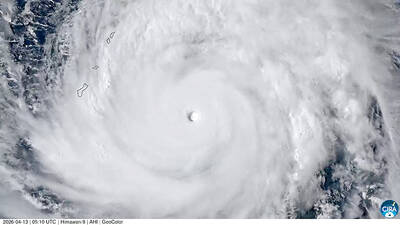
HAZARDOUS CONDITION: The typhoon’s sheer size, with winds extending 443km from its center, slowed down the ability of responders to help communities, an official said The US Coast Guard was searching for six people after losing contact with their disabled boat off the coast of Guam following Typhoon Sinlaku. The crew of the 44m dry cargo vessel, the US-registered Mariana, on Wednesday notified the coast guard that the boat had lost its starboard engine and needed assistance, Petty Officer 3rd Class Avery Tibbets said yesterday. The coast guard set up a one-hour communication schedule with the vessel, but lost contact on Thursday. A Coast Guard HC-130 Hercules aircraft was launched to search for the six people on board, but it had to return to Guam because of


 RSS
RSS