


China is celebrating the 15th century voyages of a Chinese eunuch admiral sailing as far west as the coast of Africa as evidence of its historical pursuit of peaceful relations with other countries and cultures.
Analysts say Zheng He's (
Festivities launched this week for the 600th anniversary of Zheng's voyages vaunt Beijing's benevolent diplomacy, remembering how the Muslim admiral led seven armadas through southeast Asia and beyond to spread Chinese influence from 1405 to 1433.
"Instead of occupying a single piece of land, building a fort or seizing treasure, Zheng He treated other countries with friendship," said Xu Zuyuan (徐祖遠), China's deputy minister of communications. "We think the legacy of Zheng He's seven voyages to the West is that a `peaceful rise' is the inevitable outcome of China's history."
Some China historians and maritime security experts take issue with Xu's assertion that Zheng's voyages bolstering the influence of the recently installed Ming dynasty were of a purely peaceful nature -- and not expansionist.
And a question mark hangs over the motives of Beijing's communist rulers as they slowly develop their coastal navy into a blue-water force capable of following in Zheng's wake and building relationships in southeast Asia.
"The current enhancement of the Chinese presence in the region is very much parallel to 600 years ago when Zheng He cruised through the region and tried to set foot in neighboring territory to extend Chinese influence," military expert Andrew Yang (楊念祖) said.
"The purpose is more or less identical -- to try to establish some kind of collaboration and cooperation conducive to China's long-term economic and national interests," said Yang, who is secretary-general of the Chinese Council of Advanced Policy Studies.
The goals of the 15th century admiral and his successors today have common features.
"They were military missions with strategic aims," writes scholar Geoff Wade of the National University of Singapore. "The military aspect of these voyages needs underlining, in part because of the stress placed on these missions in much current scholarship as `voyages of friendship.'"
Zheng wanted to not only spread imperial Ming influence but to develop trade. China's communist overlords want to have a say in regional diplomacy and also protect sea lanes that carry the oil to fuel their economy and their burgeoning exports.
"China's energy flows are very, very critical and will become more so in the years to come," said Prakash Metaparti, a former Indian navy commander and a naval expert at the Center for Asian Studies at the University of Hong Kong.
Several southeast Asian neighbors, and likely the US as well, worry about spreading Chinese influence and whether Chinese naval vessels will one day acquire the capability to sail into waters where Zheng's 62 warships and thousands of sailors conquered ports and gathered tribute.
Beijing may, for now, be more worried about ensuring an uninterrupted flow of oil imports through the Malacca Strait from the Middle East. It needs to guarantee that the industrial machine that has become the world's workshop provides a steady stream of jobs, boosts incomes and keeps the Communist Party in power.
"This is a long-term development strategy: to secure energy supplies in the surrounding sea area," Yang said. "Securing their maritime interests is vital for their economic and future survival."
Almost all of China's energy imports flow through the Malacca Strait, a narrow sea lane vulnerable to pirate attack. Terrorists have yet to strike there but security experts fear they may.
Oil accounts for 22 percent of China's total energy mix and a third comes from imports. The world's second-largest oil consumer will see oil accounting for 31 percent of its energy mix by 2020.
To protect those imports and expand the range of its influence, China takes a two-pronged strategy by spending on naval modernization and signing trade deals with neighbors.
But by 2020, it may only just be able to command a world-class navy. While Chinese submarines can now ply up to 500 nautical miles off shore, above the waves its ships still sail in a range little beyond 300 to 500 nautical miles from the coast.
"They will not be able to project their power anywhere beyond their immediate coast areas for at least 10 years, and maybe not for 15 to 20 years," Metaparti said.

Crowds in Bangladesh are flocking to snap photographs with an unlikely social media star — an albino buffalo with flowing blond hair nicknamed “Donald Trump” that is due to be sacrificed within days. Owner Zia Uddin Mridha, 38, said his brother named the 700kg bull over its flowing helmet of hair resembling the signature look of the US president. “My younger brother picked this name because of the buffalo’s extraordinary hair,” he said at his farm in Narayanganj, just outside the capital, Dhaka. Mridha said that a constant stream of curious visitors — social media fans, onlookers and children — have come throughout

It began as a satirical online project. Now millions of young people in India are flocking to it as an outlet for their frustration. A parody political party called the Cockroach Janta Party, with the insect as its symbol, has exploded across India’s social media by turning absurdist humor into protest. Memes and short videos mocking corruption, joblessness and political dysfunction have flooded social media sites, where millions of users are embracing the cockroach — known for its ability to survive harsh conditions — as a tongue-in-cheek symbol of endurance. The online movement’s rise has been unusually rapid. The Cockroach Janta Party (CJP)
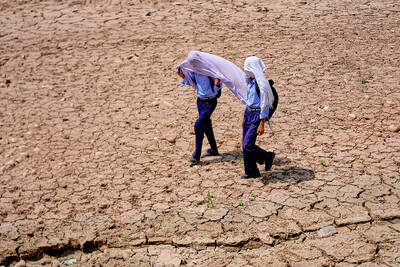
HOTTER: While Indians are accustomed to summer heat, climate change has caused northwestern India to warm faster than other parts of the country, an academic said Roads and markets have emptied during afternoons and some farmers have switched to nighttime work to avoid scorching temperatures as a heat wave grips large parts of India. The India Meteorological Department forecast maximum temperatures for yesterday of about 45°C in the capital, New Delhi, where authorities have opened temporary “cooling zones” to help people cope. The weather department warned that conditions would likely persist across several northern regions in the coming days, with temperatures staying well above seasonal averages. Authorities urged people to stay indoors during the hottest hours and take precautions against heat-related illnesses. India declares a heat wave whenever maximum temperatures

BIGGER ROLE: Beijing has said it maintains an impartial stance on the war in Ukraine, but by training Russian troops, China is far more involved than previously known China’s armed forces secretly trained about 200 Russian military personnel in China late last year, and some have since returned to fight in Ukraine, according to three European intelligence agencies and documents seen by Reuters. While China and Russia have held a number of joint military exercises since Moscow’s full-scale invasion of Ukraine in 2022, Beijing has repeatedly said that it is neutral in the conflict and presents itself as a peace mediator. The covert training sessions, which predominantly focused on the use of drones, were outlined in a dual-language Russian-Chinese agreement signed by senior Russian and Chinese officers in Beijing on


 RSS
RSS