


The Afghan government will send hundreds of troops to reassert central authority and disarm rebel militia in the capital of a central province overrun last week by forces of a renegade commander.
A battalion of troops would be sent to Chaghcharan, capital of Ghor province, from the western city of Herat today, said Defense Ministry spokesman General Zahir Azimy said.
It would be the third such deployment of the fledgling Afghan National Army (ANA) to restive provinces where commanders have resisted attempts to disarm their militia forces before elections due to be held in September.
Afghan President Hamid Karzai has struggled to impose the authority of his US-backed government across Afghanistan since he took over after US-led forces overthrew the Taliban in late 2001.
Instability caused by local power tussles has coincided with a growing Islamic insurgency blamed on Taliban guerrillas and their allies, raising serious doubts that the elections can be held as planned in September.
Azimy, who said on Sunday that no troops would be rushed to Ghor to deal with the unrest, explained that the battalion would provide security, prevent further clashes, assert central authority and help implement disarmament.
"The National Security Council has decided to send one ANA battalion from Herat," Azimy said. "The ANA are getting ready and tomorrow they will go to Ghor."
A battalion, or kandak, typically numbers between 500 and 850 soldiers. The ANA's total strength is around 10,000 troops.
Chaghcharan, capital of the remote central province of Ghor, was seized on Friday by forces of commander Abdul Salaam Khan, who have resisted the government's drive for militias to disarm.
Khan's forces pushed out Ghor police chief General Zaman and the head of the government military division, General Ahmad, who appealed to the central government to send troops to back them.
Ghor's governor, Ibrahim Malikzada, was forced last Thursday to flee the fighting in which 18 people were killed or wounded, but said at the weekend he was willing to work with Khan.
He headed back to the province after meeting the National Security Council in Kabul on Sunday, the government said.
The ANA troops preparing to leave for Ghor were deployed to Herat in March after the son of powerful local governor, Ismail Khan, was killed in a clash with a pro-government commander.
Ismail Khan has consistently resisted calls to disarm his private militia, saying it would create a security vacuum in the west of the country, a relatively stable region.
Jean Arnault, the UN Special Representative to Afghanistan, welcomed the deployment of forces to Ghor, where he described the situation as "still very unstable."
He called on factional leaders across Afghanistan to speed up disarmament of their militias.
ROCKET ATTACK
Meanwhile, attackers fired rocket-propelled grenades at a UN election office south of Kabul early yesterday, damaging several vehicles and underscoring risks to the September polls.
The attack in Logar, a province just south of Kabul, showed the need for the international community to do more to protect the electoral process, Arnault said.
"Again, so close to Kabul and so close to the security umbrella provided by the international community," he told a news briefing. No casualties were reported.
"We are now facing attacks -- direct attacks -- with fairly heavy weapons, against the office of the electoral process," he said.
UN spokesman Manoel de Almeida e Silva said four four-wheel-drive vehicles were damaged in the attack on the joint UN-Afghan electoral office at about 1.30am in which attackers fired three rocket-propelled grenades before escaping.
Arnault urged NATO to send more troops quickly.
NATO is due to hold a high-level meeting in Istanbul from June 28 to June 29 to consider the repeated appeals to expand its mainly Kabul-based peacekeeping force into the restive provinces.
NATO needed to send more troops by the end of next month if they were to be effective in protecting the electoral campaign and voting, he said.
Taliban and allied Islamic militants have vowed to disrupt the polls and the attack is just the latest on a provincial office working to register voters.
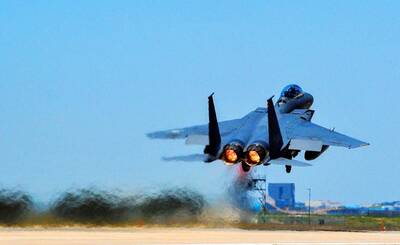
South Korea’s air force yesterday apologized for a 2021 midair collision involving two fighter jets, a day after auditors said the pilots were taking selfies and filming during the flight and held them responsible for the accident. “We sincerely apologize to the public for the concern caused by the accident that occurred in 2021,” an air force spokesman told a news conference, adding that one of the pilots involved had been suspended from flying duties, received severe disciplinary action and has since left the military. The apology followed a report released on Wednesday by the South Korean Board of Audit and Inspection,

Indonesian police have arrested 13 people after shocking images of alleged abuse against small children at a daycare center went viral, sparking outrage across the nation, officials said on Monday. Police on Friday last week raided Little Aresha, a daycare center in Yogyakarta on Java island, following a report from a former employee. CCTV footage circulating on social media showed children, most younger than two, lying on the floor wearing only diapers, their hands and feet bound with rags. The police have confirmed that the footage is authentic. Police said they also found 20 children crammed into a room just 3m by 3m. “So

About 240 Indians claiming descent from a Biblical tribe landed at Tel Aviv airport on Thursday as part of a government operation to relocate them to Israel. The newcomers passed under a balloon arch in blue and white, the colors of the Israeli flag, as dozens of well-wishers welcomed them with a traditional Jewish song. They were the first “bnei Menashe” (“sons of Manasseh”) to arrive in Israel since the government in November last year announced funding for the immigration of about 6,000 members of the community from the states of Manipur and Mizoram in northeast India. The community claims to descend from

‘TROUBLING’: The firing of Phelan, who was an adviser to a nonprofit that supported the defense of Taiwan, was another example of ‘dysfunction’ under Trump, a US senator said US Secretary of the Navy John Phelan has been fired, a US official and a person familiar with the matter said on Wednesday, in another wartime shakeup at the Pentagon coming just weeks after US Secretary of Defense Pete Hegseth ousted the Army’s top general. The Pentagon announced his departure in a brief statement, saying he was leaving the administration “effective immediately,” but it did not provide a reason or say whether it was his decision to go. The sources, who spoke on condition of anonymity, said Phelan was dismissed in part because he was moving too slowly to implement reforms to


 RSS
RSS