


Powerful winds and towering waves pummeled southern Japan yesterday as typhoon Dianmu headed north toward the country's more densely populated main islands. Officials said three people had died from accidents in stormy seas.
The typhoon had gusts of up to 162km per hour and sustained winds of more than 90km per hour, Japan's Meteorological Agency said.
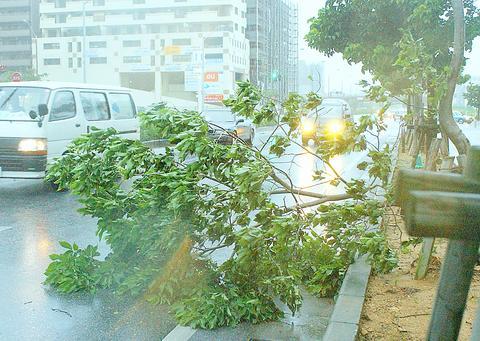
PHOTO: REUTERS
On Sunday afternoon, it was centered about 1,300km southwest of Tokyo.
The agency classified Dianmu -- "Mother of Lightning" in Mandarin -- as "large and very powerful," and said it could hit Japan's southernmost main island of Kyushu by this morning.
The typhoon had so far caused three deaths, and one person was reported missing near Tokyo.
Police in Shizuoka city, 150km west of Tokyo, found the bodies of two men washed up near the shore early yesterday.
Katsuhisa Kai, 20, and Shintaro Minato, 21 -- both students at the University of Shizuoka -- were believed to have been swept out by rough seas while having a barbecue on the beach Saturday afternoon, a Shizuoka prefectural police spokesman said on condition of anonymity.
Earlier, Japan Coast Guard officials said Noriyuki Shintani, 32, died Saturday while sailboarding in high waves off southern Okinawa island.
Tokyo resident Seiji Ikeda, 73, was missing since late Friday after he went fishing near Kozu island, about 120km south of Tokyo.
Overnight, Dianmu had passed through Okinawa's main island and stormy weather continued to disrupt dozens of flights and some ferry services in the area yesterday.
More than 75 flights in southern Japan had been canceled as well as most ferry services, public broadcaster NHK reported. The Meteorological Agency recorded waves as high as 12m in some areas.
The agency predicted up to 400mm of rain in parts of Kyushu. The typhoon was expected to head farther north in coming days.
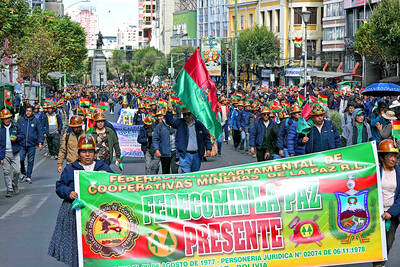
The Bolivian government on Friday struck a deal with protesting miners, but was still grappling with blockades and demonstrations by other workers across La Paz. Other groups are still blocking access roads into the city, which is also the seat of the government. Police on Thursday prevented the miners from entering the main square by using tear gas, while the demonstrators hurled stones and explosives with slingshots. Protests against the policies of Bolivian President Rodrigo Paz have convulsed the Andean nation since early this month, and roadblocks were choking routes into La Paz throughout Friday, the national road authority said. Miners demanded that Paz
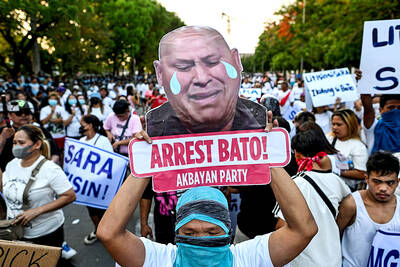
The Philippines said it has asked the country’s Supreme Court to allow it to arrest former Philippine president Rodrigo Duterte’s chief drug war enforcer to stand trial in an international tribunal. The International Criminal Court (ICC) last week unsealed an arrest warrant against Philippine Senator Ronald dela Rosa, accusing him along with Duterte and other “coperpetrators” of the “crime against humanity of murder.” Dela Rosa briefly sought refuge in the Philippine Senate last week while asking the Philippine Supreme Court to stop an ongoing attempt by government agents to arrest him. “By his own conduct, he has placed himself outside the protection of
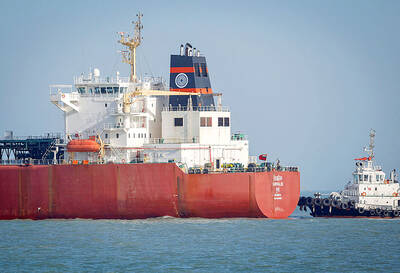
A ship anchored off the United Arab Emirates (UAE) was seized and taken toward Iran and another — a cargo ship near Oman — sank after being attacked, authorities said on Thursday, as tensions escalated near the Strait of Hormuz. It was not immediately clear who was behind these incidents, but they happened as a senior Iranian official reiterated his country’s claim of control over the waterway and another said it had a right to seize oil tankers connected to the US. The turmoil in the strait has been a sticking point for weeks in talks between the US and Iran to
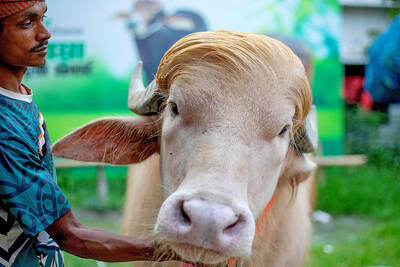
Crowds in Bangladesh are flocking to snap photographs with an unlikely social media star — an albino buffalo with flowing blond hair nicknamed “Donald Trump” that is due to be sacrificed within days. Owner Zia Uddin Mridha, 38, said his brother named the 700kg bull over its flowing helmet of hair resembling the signature look of the US president. “My younger brother picked this name because of the buffalo’s extraordinary hair,” he said at his farm in Narayanganj, just outside the capital, Dhaka. Mridha said that a constant stream of curious visitors — social media fans, onlookers and children — have come throughout


 RSS
RSS