


Gunmen killed a deputy foreign minister yesterday on his way to work as insurgents stepped up attacks in advance of the handover of power June 30. A radical cleric whose uprising killed hundreds pledged to support the new government if it works to end the US military presence.
Bassam Salih Kubba, Iraq's most senior career diplomat, was mortally wounded in Baghdad's Azimiyah district, Foreign Ministry spokesman Thamir al-Adhami said. The attack took place in a Sunni Muslim neighborhood where support for Saddam Hussein was strong.
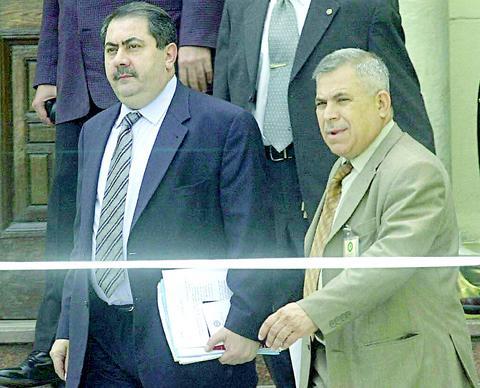
PHOTO: AFP
The attack was the second assassination of a senior Iraqi figure in the past month. The head of the now-disbanded Iraqi Governing Council, Izzadine Saleem, was killed in a suicide car-bombing May 17 at an entrance to the heavily guarded Green Zone headquarters of the US-run occupation authority.
Another Governing Council member, Salama al-Khafaji, escaped injury in a May 27 ambush south of Baghdad but her son and chief bodyguard were killed. Council member Aquila al-Hashemi, also a career diplomat, was assassinated last September.
US officials had feared a major upsurge of violence in the run-up to the power transfer and although those predictions have so far not panned out, attacks on infrastructure and security installations suggest a campaign to undermine public confidence in the new Iraqi leadership.
On Friday, gunmen blew up a police station in Yusufiyah, 20km south of Baghdad, after driving off outgunned policemen in a hail of small arms and rocket-propelled grenade fire. It was the fourth such attack on a police station in the past week.
Elsewhere, the US military said it was investigating the May 17 fatal shooting of an Iraqi male by an American soldier in Baghdad. A statement said the Iraqi was an "anti-Iraqi forces operative" who bragged that he had killed a 1st Cavalry Division soldier.
During a raid to apprehend him, the Iraqi tried to grab the weapon of a US soldier "who shot and killed the subject," the command said.
Last week, the command said it was investigating a May incident in Kufa in which an Iraqi was shot dead at close range by an American following a shooting at a checkpoint.
According to the Foreign Ministry spokesman, Kubba and his driver were headed for his office when gunmen drove up behind him and opened fire. The assailants then passed the stricken vehicle and fired a second burst, the spokesman said.
Both Kubba and his driver were wounded, and the deputy minister died later in hospital, the spokesman said.
Kubba, 60, held a Master's degree in international relations from St. John's University in New York, was one of several deputy foreign ministers. He had served as acting chief the Iraqi mission to the United Nations in New York and as Iraq's ambassador to China. Kubba also served on the committee which ran the ministry after the fall of Saddam's regime.
Elsewhere, two roadside bombs exploded yesterday in Baqouba, 60km northeast of Baghdad, wounding two coalition soldiers and two Iraqi policemen, the US military said.
Despite the violence, the government received an endorsement Friday from an unlikely source -- radical Shiite cleric Muqtada al-Sadr. In a sermon read to his followers by an aide, al-Sadr said he was ready for a dialogue with the new government if it works to end the US military presence.
"I support the new interim government," al-Sadr said. "Starting now, I ask you that we open a new page for Iraq and for peace."
US officials said they were encouraged by al-Sadr's remarks but noted he has made contradictory statements on the issue in recent weeks. The young cleric is under strong pressure from the mainstream Shiite clerical hierarchy to soften his stand against the new government of Prime Minister Iyad Allawi.
At the same time, he wants to maintain his reputation as one of the few Iraqi leaders who stood up publicly to the Americans.
In an interview Friday night with Al Arabiya television, al-Sadr's spokesman, Ahmed al-Shibani, said the cleric was ready for a dialogue with the government "on condition that it works to end the occupation and clearly announces to the Iraqi people and to the world that it rejects the occupation."
"It has to put a timetable for the end of the occupation," al-Shibani said. "This is the main and principled way to recognize this government and cooperate with it."

South Korea’s air force yesterday apologized for a 2021 midair collision involving two fighter jets, a day after auditors said the pilots were taking selfies and filming during the flight and held them responsible for the accident. “We sincerely apologize to the public for the concern caused by the accident that occurred in 2021,” an air force spokesman told a news conference, adding that one of the pilots involved had been suspended from flying duties, received severe disciplinary action and has since left the military. The apology followed a report released on Wednesday by the South Korean Board of Audit and Inspection,

Indonesian police have arrested 13 people after shocking images of alleged abuse against small children at a daycare center went viral, sparking outrage across the nation, officials said on Monday. Police on Friday last week raided Little Aresha, a daycare center in Yogyakarta on Java island, following a report from a former employee. CCTV footage circulating on social media showed children, most younger than two, lying on the floor wearing only diapers, their hands and feet bound with rags. The police have confirmed that the footage is authentic. Police said they also found 20 children crammed into a room just 3m by 3m. “So

About 240 Indians claiming descent from a Biblical tribe landed at Tel Aviv airport on Thursday as part of a government operation to relocate them to Israel. The newcomers passed under a balloon arch in blue and white, the colors of the Israeli flag, as dozens of well-wishers welcomed them with a traditional Jewish song. They were the first “bnei Menashe” (“sons of Manasseh”) to arrive in Israel since the government in November last year announced funding for the immigration of about 6,000 members of the community from the states of Manipur and Mizoram in northeast India. The community claims to descend from

‘TROUBLING’: The firing of Phelan, who was an adviser to a nonprofit that supported the defense of Taiwan, was another example of ‘dysfunction’ under Trump, a US senator said US Secretary of the Navy John Phelan has been fired, a US official and a person familiar with the matter said on Wednesday, in another wartime shakeup at the Pentagon coming just weeks after US Secretary of Defense Pete Hegseth ousted the Army’s top general. The Pentagon announced his departure in a brief statement, saying he was leaving the administration “effective immediately,” but it did not provide a reason or say whether it was his decision to go. The sources, who spoke on condition of anonymity, said Phelan was dismissed in part because he was moving too slowly to implement reforms to


 RSS
RSS