


Police in France, Spain, Italy and Belgium launched raids on suspected Islamic militants, arresting at least two men accused of playing a role in the Madrid train bombings in March, Italian judicial sources said yesterday.
The sources, confirming reports carried by Italian daily Corriere della Sera, said one man was arrested late on Monday in Milan. A second suspected militant was also detained by Italian police, they said.
The sources said that the cross-border operation involved police in France, Spain and Belgium, as well as in Italy.
"It is coordinated at the European level," one source said.
Belgian federal prosecutor Eric Van Der Sypt confirmed Brussels was working with the authorities in Italy.
Italian news agency ANSA said one man was arrested in Belgium, and about a dozen others were detained for checks but not arrested.
Italian police were acting on a Spanish arrest warrant when they seized one of the suspects late on Monday in connection with the Madrid bombings that killed 191 people, a Spanish court said.
A court official identified the man arrested in Milan as Rabei Osman Sayed Ahmed, also known as "Mohamed the Egyptian". The court will now seek his extradition, the official said.
High Court Judge Juan del Olmo, who has been leading the investigation into the train attacks, issued the arrest warrant Monday.
Corriere della Sera, in a front-page report, said "Mohamed the Egyptian" was suspected of playing a central role in planning the March 11 train attacks. The man, arrested after a joint three-month investigation by Italy's anti-terrorist unit and Italian intelligence, was thought to be the head of a Moroccan radical Islamist cell, the paper said.
Corriere reported that the landlord of the man's apartment in Milan, believed to be a north African, was also arrested.
La Repubblica newspaper reported that three or four men had been arrested in raids in three northern Italian towns, including Milan. The paper said the men had planned an attack in Italy.
Italy, long seen as a target for militant Islamic groups after its support for the US-led campaign in Iraq, has stepped up security since the Madrid bombs.
Italian police have made a number of arrests, in the north especially, since the Sept. 11 attacks in the US. Last month in Florence, anti-terror police arrested five suspected members of a militant Islamic group who were believed to be recruiting suicide bombers to carry out attacks in Iraq.
An Algerian imam and four Tunisians were detained in Florence as part of a year-long investigation into alleged "terrorist" cells there and in the port city of Genoa, according to officials working on the probe.
Those men were suspected of giving logistical support to al-Qaeda, the network headed by Osama bin Laden and blamed for Sept. 11, and of belonging to Ansar al-Islam, which America describes as its main "terrorist adversary" in postwar Iraq. Police believe at least one of the suspects planned to carry out a suicide attack in Iraq himself.
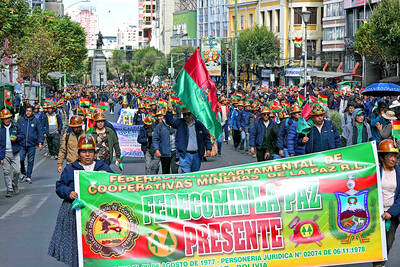
The Bolivian government on Friday struck a deal with protesting miners, but was still grappling with blockades and demonstrations by other workers across La Paz. Other groups are still blocking access roads into the city, which is also the seat of the government. Police on Thursday prevented the miners from entering the main square by using tear gas, while the demonstrators hurled stones and explosives with slingshots. Protests against the policies of Bolivian President Rodrigo Paz have convulsed the Andean nation since early this month, and roadblocks were choking routes into La Paz throughout Friday, the national road authority said. Miners demanded that Paz
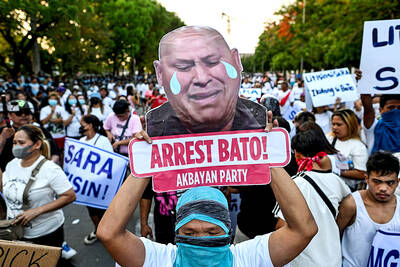
The Philippines said it has asked the country’s Supreme Court to allow it to arrest former Philippine president Rodrigo Duterte’s chief drug war enforcer to stand trial in an international tribunal. The International Criminal Court (ICC) last week unsealed an arrest warrant against Philippine Senator Ronald dela Rosa, accusing him along with Duterte and other “coperpetrators” of the “crime against humanity of murder.” Dela Rosa briefly sought refuge in the Philippine Senate last week while asking the Philippine Supreme Court to stop an ongoing attempt by government agents to arrest him. “By his own conduct, he has placed himself outside the protection of
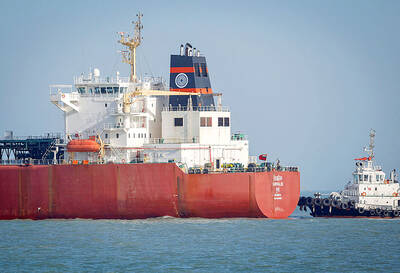
A ship anchored off the United Arab Emirates (UAE) was seized and taken toward Iran and another — a cargo ship near Oman — sank after being attacked, authorities said on Thursday, as tensions escalated near the Strait of Hormuz. It was not immediately clear who was behind these incidents, but they happened as a senior Iranian official reiterated his country’s claim of control over the waterway and another said it had a right to seize oil tankers connected to the US. The turmoil in the strait has been a sticking point for weeks in talks between the US and Iran to

Crowds in Bangladesh are flocking to snap photographs with an unlikely social media star — an albino buffalo with flowing blond hair nicknamed “Donald Trump” that is due to be sacrificed within days. Owner Zia Uddin Mridha, 38, said his brother named the 700kg bull over its flowing helmet of hair resembling the signature look of the US president. “My younger brother picked this name because of the buffalo’s extraordinary hair,” he said at his farm in Narayanganj, just outside the capital, Dhaka. Mridha said that a constant stream of curious visitors — social media fans, onlookers and children — have come throughout


 RSS
RSS