


Israeli troops stormed homes in this Palestinian refugee camp yesterday in an ongoing search for militants and illegal weapons, confining tens of thousands of residents to houses without electricity or water.
The invasion, launched on Tuesday, knocked out electricity in the Rafah refugee camp, home to an estimated 90,000 people, local Palestinian officials said. By yesterday, water service had been halted as well, they said.
Twenty Palestinians -- the highest single-day death toll in more than two years -- were killed on Tuesday, the first day of the army's "Operation Rainbow" offensive. Among the dead were a 16-year-old girl and her 13-year-old brother.
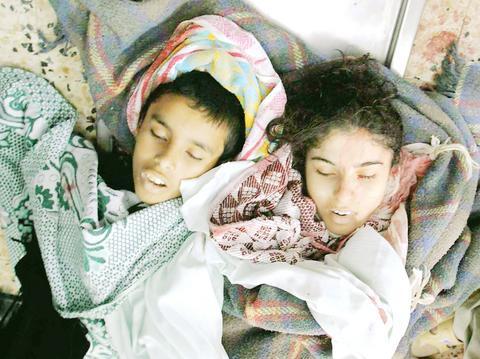
PHOTO: EPA
International condemnation mounted against the operation, and the US said it was asking Israel for "clarification." The UN and the EU demanded an end to the incursion, which Israeli security officials said would last at least a week.
The massive invasion, the largest in the Gaza Strip in years, came less than a week after Palestinian militants killed 13 soldiers -- seven in the Rafah area.
Israel said it was targeting armed militants, but Palestinians said many of Tuesday's casualties were civilians.
Palestinians said the teenage brother and sister were killed by an Israeli sniper as they gathered laundry from their rooftop.
But the military said an initial investigation found no Israeli soldiers had fired in that area at the time of the shootings. The military said the two had apparently been killed by a Palestinian bomb aimed at troops.
Early yesterday, the army said it demolished the home of Ibrahim Ahmed, an Islamic Jihad militant it said was responsible for a shooting attack earlier this month that killed a pregnant Israeli woman and her four daughters near a Gaza settlement. Palestinian witnesses said at least three homes were demolished overnight.
Ali Bayomi, a 55-year-old resident of Rafah, said soldiers had arrested two of his cousins and were using the men as human shields as they conducted home searches. He said the soldiers had disguised themselves as Hamas militants before arresting the men. The army did not comment.
Salwa Abu Jazar, a 33-year-old mother of four, said her family got almost no sleep overnight because of the sound of combat helicopters and shooting that echoed through the camp.
"There is no water, no electricity and it is very hard to move inside the house using candles because snipers in the building next door will shoot you," Abu Jazar said.
The army said it had shot and hit two armed men overnight in Rafah. Palestinian residents said one man had been hit in the head and stomach, and the other in the leg. They said ambulances were having difficulty evacuating dead and wounded to the hospitals due to the intense fighting.
The facades of Rafah buildings were riddled with holes from Israeli machine guns. Residents said they sheltered from rocket and gun fire in the innermost rooms of their homes.
Saleem Katib, 25, said his father went to morning prayers early Tuesday and still had not returned. Unable to maneuver back to his house due to the fighting and the military curfew, Katib said his father -- an elderly, sick man -- was holed up near the mosque with other worshippers.
"How can you believe that a man can't reach his home when he is only 20 meters away?" Katib said.
In all, 19 Palestinians were killed on Tuesday by Israeli fire -- 10 in two separate missile strikes and nine by machine-gun fire, said Moawiya Hassanain, a senior Palestinian Health Ministry official. A 20th man was killed while handling explosives.
Palestinian President Yasser Arafat denounced the incursion as a "planned massacre."
"What is happening in Rafah is an operation to destroy and to transfer the local Palestinian population, and this must not be accepted, not by the Palestinians, nor the Arabs, nor by the international community," an angry Arafat told reporters at his West Bank compound.
The Israeli Supreme Court on Tuesday rejected a petition by 46 Rafah residents against demolition of their homes, giving the army the right to tear down buildings that could be used for attacking troops.
US President George W. Bush said the violence was "troubling," but said Israel had the right to defend itself from terrorism.

PHISHING: The con might appear convincing, as the scam e-mails can coincide with genuine messages from Apple saying you have run out of storage For a while you have been getting messages from Apple saying “your iCloud storage is full.” They say you have exceeded your storage plan, so documents are no longer being backed up, and photos you take are not being uploaded. You have been resisting Apple’s efforts to get you to pay a minimum of £0.99 (US$1.33) a month for more storage, but it seems that you cannot keep putting off the inevitable: You have received an e-mail which says your iCloud account has been blocked, and your photos and videos would be deleted very soon. To keep them you need
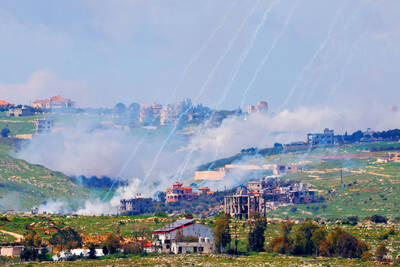
The Israeli military has demolished entire villages as part of its invasion of south Lebanon, rigging homes with explosives and razing them to the ground in massive remote detonations. The Guardian reviewed three videos posted by the Israeli military and on social media, which showed Israel carrying out mass detonations in the villages of Taybeh, Naqoura and Deir Seryan along the Israel-Lebanon border. Lebanese media has reported more mass detonations in other border villages, but satellite imagery was not readily available to verify these claims. The demolitions came after Israeli Minister of Defense Israel Katz called for the destruction of

A US YouTuber who caused outrage for filming himself kissing a statue commemorating Korean wartime sex slaves has been sentenced to six months in prison, a court in Seoul said yesterday. Johnny Somali, 25, gained notoriety several years ago for recording himself doing a series of provocative stunts in South Korea and Japan, and streaming them on platforms such as YouTube and Twitch. South Korean authorities indicted Somali — whose real name is Ramsey Khalid Ismael — in 2024 on public order violations and obstruction of business, and banned him from leaving the country. “The court has sentenced him to six months in
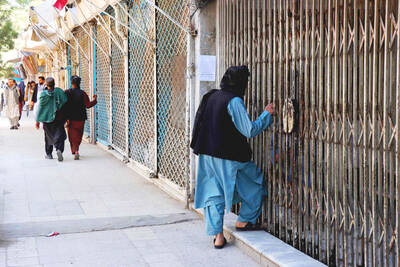
The death toll from a shooting in western Afghanistan rose to 11 on Saturday, after gunmen targeted civilians at a picnic spot in Herat, the provincial authority said. Bullet marks were visible on a wall of the Sayed Mohammad Agha Shia shrine, while bloodstains marked a blanket abandoned at the scene. “Eleven people have been recorded dead and eight others wounded from Friday’s incident, with the condition of two of the wounded reported as critical,” Herat’s information office said in a statement. The update raises a toll of seven killed provided on Friday by the Afghan Ministry of Interior Affairs


 RSS
RSS