


The head of Japan's biggest opposition party resigned yesterday as his wounded party struggled to repair its image ahead of a parliamentary election just two months away.
Calls for Democratic Party chief Naoto Kan to step down from the top post had mounted since he admitted late last month that he -- like seven members of Prime Minister Junichiro Koizumi's cabinet -- had skipped payments into the state pension scheme.
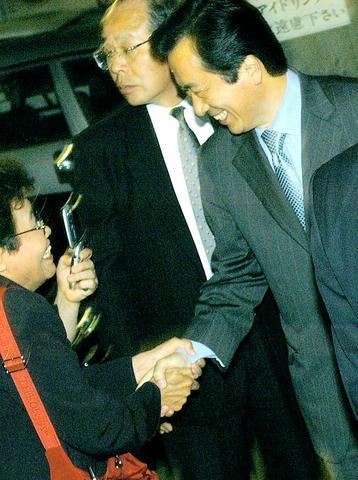
PHOTO: EPA
"My failure to pay into the pension system increased mistrust and created huge headaches for the public and for members of our party, and for that my responsibility is huge," Kan told a meeting of Democratic Party members of parliament.
"So, in front of all of you, I want to take responsibility and resign as party leader," said Kan, a once-popular grassroots activist whose image has long suffered by comparison with the more telegenic, politically adept Koizumi.
Reform of the pension system, straining under the burden of Japan's rapidly ageing population, has been a hot topic of debate ahead of elections for parliament's Upper House in July.
Media surveys had showed a hefty majority of voters felt Kan should resign, especially since top government spokesman Yasuo Fukuda, one of the most powerful members of Koizumi's cabinet, had quit on Friday after making a similar confession.
Attention had already shifted to Kan's successor even before his announcement that he was stepping down.
Media have floated the party's number two, veteran lawmaker Ichiro Ozawa, as a candidate along with Democratic Secretary-General Katsuya Okada, a soft-spoken former bureaucrat.
Analysts say it is almost impossible for Koizumi's Liberal Democratic Party (LDP) and its coalition partner to lose their majority in the Upper House in that election.
But a poor showing for the LDP itself would weaken Koizumi's clout in his fourth and probably final year in office, and a rejuvenated Democratic Party would pose a bigger threat.
Kan, who had harshly criticized Koizumi cabinet members for failing to make pension payments, came under fire within his own party after admitting he had been similarly remiss for 10 months when he was health minister in 1996.
The pressure mounted after Fukuda's surprise resignation.
The Democratic leader's departure could put the spotlight back on the other six members of Koizumi's cabinet -- including Finance Minister Sadakazu Tanigaki and Economics Minister Heizo Takenaka -- who have admitted skipping pension payments.
His resignation, however, may not end his party's woes.
The Democrats boosted their presence in an election for the powerful Lower House last November, but suffered a setback when they lost all three by-elections held last month.
How Ozawa, 61, would be received by voters is as yet unclear.
Once a ruling party heavyweight, he quit the conservative Liberal Democratic Party in 1993, setting off a chain reaction that ended its four-decade rule, albeit briefly.
Admired by some as a forceful advocate of reform, he has also been criticized as a Machiavellian backroom wheeler-dealer.

School bullies in Singapore are to face caning under new guidelines, but the education minister on Tuesday said it would be meted out only as a last resort with strict safeguards. Human rights groups regularly criticize Singapore for the use of corporal punishment, which remains part of the school and criminal justice systems, but authorities have defended it as a deterrent to crime and serious misconduct. Caning was discussed in the parliament after legislators asked how it would be used in relation to bullying in schools. The debate followed stricter guidelines on serious student misconduct, including bullying, unveiled by the Singaporean Ministry of

As evening falls in Fiji’s capital, a steady stream of people approaches a makeshift clinic that is a first line of defense against one of the world’s fastest-growing HIV epidemics. In the South Pacific nation — a popular tourist destination of just under a million people — more than 2,000 new HIV cases were recorded last year, a 26 percent increase from 2024. The government has declared an HIV outbreak and described it as a national crisis. “It’s spreading like wildfire,” said Siteri Dinawai, 46, who came to be tested. The Moonlight Clinic, a converted minibus parked in a suburban cul-de-sac in Suva, is

A MESSAGE: Japan’s participation in the Balikatan drills is a clear deterrence signal to China not to attack Taiwan while the US is busy in the Middle East, an analyst said The Japan Self-Defense Forces yesterday fired a Type 88 anti-ship missile during a joint maritime exercise with US, Australian and Philippine forces, hitting a decommissioned Philippine Navy ship in waters facing the disputed South China Sea, in drills that underscore Tokyo’s rising willingness to project military power on China’s doorstep. The drill took place as Manila and Tokyo began talks on a potential defense equipment transfer, made possible by Japan’s decision to scrap restrictions on military exports. The discussions include the possible early transfer of Abukuma-class destroyers and TC-90 aircraft to the Philippines, Japanese Minister of Defense Shinjiro Koizumi said. Philippine Secretary of
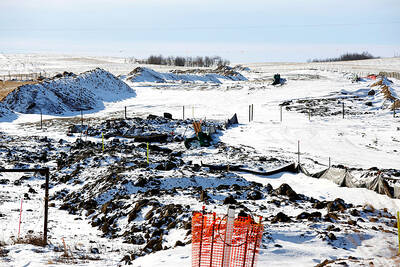
Separatists in Alberta are preparing to submit a petition tomorrow that they said has enough signatures to force a referendum on independence for the oil-rich Canadian province. Polls indicate the pro-independence camp remains a minority among Alberta’s 5 million people, but has hit a historic high of roughly 30 percent. Alberta separatists are also closer than ever to forcing a referendum, riding momentum fueled by intensifying grievances over Ottawa’s control of the provincial oil industry. They have also undeniably gotten a boost from the return to power of US President Donald Trump. After launching a petition in January, Stay Free Alberta, the group


 RSS
RSS