


Palestinians reacted angrily Saturday after US President George W. Bush threw into doubt a target date of next year for their promised state, while Israel echoed the US president's open questioning of the timetable set out in an international peace roadmap.
Meanwhile, at least six people were injured, three seriously, when a blast destroyed a convenience store just outside the walls of Jerusalem's Old City, medics said.
Three people, all Arab residents of the area, were said to be in serious condition, while at least three others were lightly injured in the explosion.
It was not immediately clear what caused the blast, but Israeli public radio, citing police, suggested it might have been a gas explosion.
Meanwhile, Palestinian negotiations minister Saeb Erakat accused Bush of torpedoing the Mideast peace roadmap drawn up by the EU, Russia the UN and the US.
"President Bush's position removes any substance from the roadmap by calling into question the timetable for its implementation, which is an essential element of it," Erakat said.
Palestinian leader Yasser Arafat was more measured, telling reporters here that any delay to statehood was "unrealistic."
"[A state] ought already to have been proclaimed in 1998-99" under the terms of peace agreements already signed with Israel, he said.
`No longer realistic'
Bush's comments were aired in an interview published Saturday by the Egyptian daily Al-Ahram.
"Well, 2005 may be hard, since 2005 is right around the corner," Bush told the government-owned daily.
"I think the timetable of 2005 isn't as realistic as it was two years ago," Bush said.
Israel welcomed the comments but went further, ruling out any possibility of Palestinian statehood next year.
"The target date of 2005 has become an impossibility because we are still at the starting point of the roadmap as a result of the Palestinian Authority's refusal to combat terrorism," said Zalman Shoval, foreign policy advisor to Israeli Prime Minister Ariel Sharon.
"Under these conditions, it's clear that the 2005 target is no longer realistic," Shoval said.
But the aide was less welcoming of the US administration's announcement that both National Security Advisor Condoleezza Rice and Secretary of State Colin Powell will meet Palestinian officials in the coming weeks.
The White House said Rice would meet Palestinian prime minister Ahmed Qorei in Berlin on May 17, and the State Department said Powell would meet unspecified Palestinian officials in Jordan several days earlier.
The talks will mark the first time Qorei has met with such senior US officials since taking office last autumn.
Rejected
The renewal of contacts came as Powell said he detected more sympathy in the region for US policy toward the peace process following the anger generated by Bush's endorsement of a unilateral Israeli disengagement plan after meeting with Sharon last month.
Arab states had reacted with fury to Bush's comments in which he backed the plan for an Israeli withdrawal from Gaza, but also affirmed Israel's right to retain parts of the West Bank while denying the Palestinian refugees' the right of return to lands inside Israel.
Sharon's proposals have since been roundly rejected in a referendum of his right-wing Likud party, but Sharon has vowed to press ahead with the plan.
The plan was to be discussed at the weekly meeting of the cabinet yesterday.
"I have asked the government to discuss the plan and I have several options in mind for its implementation," said Justice Minister Yossi Lapid, whose centrist Shinui party is a strong supporter.
Meanwhile, violence on the ground continued, with a local leader of the Al Aqsa Martyrs Brigades moderately wounded during fierce clashes with Israeli troops in a northern West Bank refugee camp.
Israeli troops were on high alert Saturday at the outset of the daylong Jewish festival of Lag Baomer, which started at sundown.

School bullies in Singapore are to face caning under new guidelines, but the education minister on Tuesday said it would be meted out only as a last resort with strict safeguards. Human rights groups regularly criticize Singapore for the use of corporal punishment, which remains part of the school and criminal justice systems, but authorities have defended it as a deterrent to crime and serious misconduct. Caning was discussed in the parliament after legislators asked how it would be used in relation to bullying in schools. The debate followed stricter guidelines on serious student misconduct, including bullying, unveiled by the Singaporean Ministry of

As evening falls in Fiji’s capital, a steady stream of people approaches a makeshift clinic that is a first line of defense against one of the world’s fastest-growing HIV epidemics. In the South Pacific nation — a popular tourist destination of just under a million people — more than 2,000 new HIV cases were recorded last year, a 26 percent increase from 2024. The government has declared an HIV outbreak and described it as a national crisis. “It’s spreading like wildfire,” said Siteri Dinawai, 46, who came to be tested. The Moonlight Clinic, a converted minibus parked in a suburban cul-de-sac in Suva, is

A MESSAGE: Japan’s participation in the Balikatan drills is a clear deterrence signal to China not to attack Taiwan while the US is busy in the Middle East, an analyst said The Japan Self-Defense Forces yesterday fired a Type 88 anti-ship missile during a joint maritime exercise with US, Australian and Philippine forces, hitting a decommissioned Philippine Navy ship in waters facing the disputed South China Sea, in drills that underscore Tokyo’s rising willingness to project military power on China’s doorstep. The drill took place as Manila and Tokyo began talks on a potential defense equipment transfer, made possible by Japan’s decision to scrap restrictions on military exports. The discussions include the possible early transfer of Abukuma-class destroyers and TC-90 aircraft to the Philippines, Japanese Minister of Defense Shinjiro Koizumi said. Philippine Secretary of
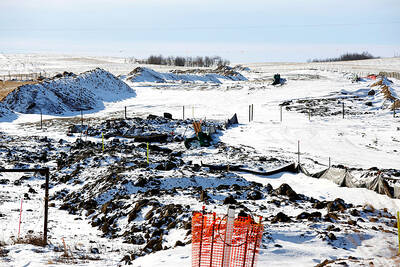
Separatists in Alberta are preparing to submit a petition tomorrow that they said has enough signatures to force a referendum on independence for the oil-rich Canadian province. Polls indicate the pro-independence camp remains a minority among Alberta’s 5 million people, but has hit a historic high of roughly 30 percent. Alberta separatists are also closer than ever to forcing a referendum, riding momentum fueled by intensifying grievances over Ottawa’s control of the provincial oil industry. They have also undeniably gotten a boost from the return to power of US President Donald Trump. After launching a petition in January, Stay Free Alberta, the group


 RSS
RSS