


British Prime Minister Tony Blair is to push for Muslim troops from Pakistan to be deployed in Iraq in a desperate attempt to shore up the reputation of the coalition forces following the widely-condemned images of abuse of Iraqi detainees.
Blair and Defense Minister Geoff Hoon, have called for "channels to be opened" with Pakistan and India, which have said they will consider sending forces only if a UN resolution on the future of Iraq can be passed.
The move comes as the coalition faced fresh criticism last night and British soldiers were involved in the first major combat operations across southern Iraq since the end of the war to remove former Iraqi president Saddam Hussein.
In an interview, Hoshyar Zebari, the Iraqi foreign minister, launched a scathing attack on the US and British governments, accusing them of an ideological approach that had led to a series of grave errors. Speaking in his office in the Ministry of Foreign Affairs in Baghdad, Zebari, who was appointed to his post in September last year, said that an application of Western ideology and standards to the complicated and violent reality in Iraq had been a big mistake.
"The situation is very serious," he said.
"The aim of the insurgents is to defeat the coalition, to defeat what is seen as American and British colonialism and to deter them from repeating their project in Iraq elsewhere.They are settling scores with the US.
"They want to make life hell for them and we are paying in Iraqi blood," he said.
The British government wants to see rapid progress on a new UN resolution. US and British officials at the UN's headquarters in New York are working on wording of a new resolution likely to be placed before the security council over the next few weeks.
British officials said they expected a resolution to be passed before the official hand-over of sovereignty to the Iraqis on June 30. Pakistan is currently head of the UN Security Council, whose approval would be necessary for a resolution's passage.
Military sources said that no final decision had yet been taken on sending further British troops, although there had been an informal request from the US for the British to "extend their sphere of influence" outside the confines of the southern sector of the country. The dangerous situation in Iraq was emphasized yesterday with fighting involving British troops.
Four British soldiers were injured, none seriously, and two Iraqis killed as British patrols and government buildings were attacked in Basra, the southern port city controlled by UK forces for over a year.
The violence began early Saturday morning after hundreds of fighters took to Basra's streets in an attempt to seize strategic points in the city. They opened fire on British patrols, sparking a fierce gunbattle in the center of the city.
British military spokesmen said Saturday evening that calm had returned to Basra, though pockets of violence remained.

School bullies in Singapore are to face caning under new guidelines, but the education minister on Tuesday said it would be meted out only as a last resort with strict safeguards. Human rights groups regularly criticize Singapore for the use of corporal punishment, which remains part of the school and criminal justice systems, but authorities have defended it as a deterrent to crime and serious misconduct. Caning was discussed in the parliament after legislators asked how it would be used in relation to bullying in schools. The debate followed stricter guidelines on serious student misconduct, including bullying, unveiled by the Singaporean Ministry of

As evening falls in Fiji’s capital, a steady stream of people approaches a makeshift clinic that is a first line of defense against one of the world’s fastest-growing HIV epidemics. In the South Pacific nation — a popular tourist destination of just under a million people — more than 2,000 new HIV cases were recorded last year, a 26 percent increase from 2024. The government has declared an HIV outbreak and described it as a national crisis. “It’s spreading like wildfire,” said Siteri Dinawai, 46, who came to be tested. The Moonlight Clinic, a converted minibus parked in a suburban cul-de-sac in Suva, is
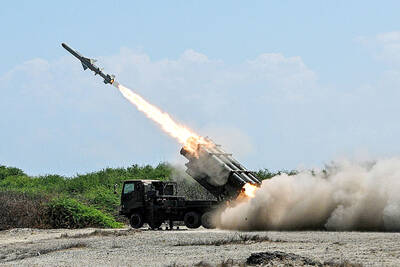
A MESSAGE: Japan’s participation in the Balikatan drills is a clear deterrence signal to China not to attack Taiwan while the US is busy in the Middle East, an analyst said The Japan Self-Defense Forces yesterday fired a Type 88 anti-ship missile during a joint maritime exercise with US, Australian and Philippine forces, hitting a decommissioned Philippine Navy ship in waters facing the disputed South China Sea, in drills that underscore Tokyo’s rising willingness to project military power on China’s doorstep. The drill took place as Manila and Tokyo began talks on a potential defense equipment transfer, made possible by Japan’s decision to scrap restrictions on military exports. The discussions include the possible early transfer of Abukuma-class destroyers and TC-90 aircraft to the Philippines, Japanese Minister of Defense Shinjiro Koizumi said. Philippine Secretary of

A South Korean judge who last week more than doubled former South Korean first lady Kim Keon-hee’s prison sentence was found dead yesterday, police said. Shin Jong-o was found unconscious at about 1am at the Seoul High Court building, an investigator at the Seocho District Police Station in Seoul said. Shin was taken to a hospital and pronounced dead, he said. “There is no sign of foul play in the death,” the investigator added. Local media reported that Shin had left a suicide note, but the investigator said there was none. On Tuesday last week, Shin presided over 53-year-old Kim’s appeal trial, finding her guilty


 RSS
RSS