


Clamping down further on Hong Kong's autonomy, Beijing warned the territory's Legislative Council (Legco) yesterday that it had no right to criticize the central government's decision to rule out full democracy in the near future.
The state-run Xinhua news agency quoted a top official with China's liaison office in Hong Kong as saying local lawmakers would be acting unconstitutionally if they consider any motions that express "discontent with" or "condemn" China's ruling on democratic reform.
The Chinese official quoted by Xinhua, who was not identified by name, said Legco must hold its fire against the democracy ruling.
"The moves are against the Constitution and the Hong Kong Basic Law," Xinhua quoted the official as saying. "They do not accord with the Legco's constitutional status as a local legislature and go beyond the limit of its duty and authority."
The official called the ruling against full democracy "lawful, rational, reasonable and just," and said Legco has no right to attack the top Chinese organ that issued it, the Standing Committee of the National People's Congress.
Elsewhere, Standing Committee Vice-Chairman Cheng Siwei (
"This is clearly unpatriotic and goes against the central government," Cheng was quoted by the Hong Kong newspaper Ming Pao as telling the students during a school visit on Friday.
Cheng also branded the democracy advocates "bananas" -- yellow-skinned Chinese on the outside but with Western beliefs inside.
"These people, who badmouth China and Hong Kong, are sinners of the Chinese nation," Cheng was quoted as saying. "They are just like bananas, yellow outside but white inside."
The statement came shortly after Hong Kong Legislative Council (Legco) President Rita Fan (
Pro-democracy forces charge that Beijing unilaterally rewrote the territory's mini-constitution, the Basic Law, when it ruled out direct elections of Hong Kong's next leader in 2007 and all lawmakers in 2008.
They accused the central government of rolling back freedom of speech, one of the Western-style civil liberties guaranteed to this former British colony when it returned to Chinese rule in 1997.
"It's trying to curtail our right of free speech, step by step, from the legislature, the media and eventually the public at large," said Albert Ho (
Another opposition lawmaker, Lee Cheuk-yan (
Hong Kong's Basic Law holds out the possibility of full democracy in the next few years, but China's top legislative panel ruled on April 26 that the move must be delayed because it would create the risk of bringing social or economic instability to the territory.
Hong Kong people have been clamoring for the right to choose the successor to Chief Executive Tung Chee-hwa (
Beijing has viewed the push for democracy with great suspicion. The central government has been alarmed by the political situation in Hong Kong since last July 1, when 500,000 people marched to show opposition to an anti-subversion bill they viewed as a threat to freedoms. Tung was forced to withdraw the measure.
Ordinary voters will be allowed to choose 30 of 60 Legco seats in September, up from 24 last time.
Although the other 30 seats will be chosen by special interest groups -- such as businessmen, bankers and doctors -- who tend to side with Beijing, the central government is worried that Hong Kong could elect a legislature that won't back Tung.
Hong Kong's pro-democracy lawmakers frequently introduce motions attacking the territory's government and they invariably fail -- as have recent efforts to formally criticize Beijing's ruling on democracy.
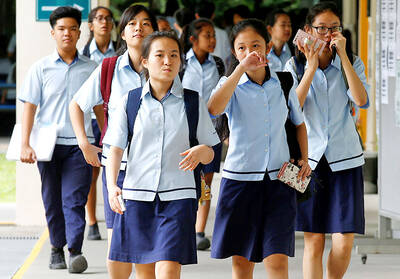
School bullies in Singapore are to face caning under new guidelines, but the education minister on Tuesday said it would be meted out only as a last resort with strict safeguards. Human rights groups regularly criticize Singapore for the use of corporal punishment, which remains part of the school and criminal justice systems, but authorities have defended it as a deterrent to crime and serious misconduct. Caning was discussed in the parliament after legislators asked how it would be used in relation to bullying in schools. The debate followed stricter guidelines on serious student misconduct, including bullying, unveiled by the Singaporean Ministry of

As evening falls in Fiji’s capital, a steady stream of people approaches a makeshift clinic that is a first line of defense against one of the world’s fastest-growing HIV epidemics. In the South Pacific nation — a popular tourist destination of just under a million people — more than 2,000 new HIV cases were recorded last year, a 26 percent increase from 2024. The government has declared an HIV outbreak and described it as a national crisis. “It’s spreading like wildfire,” said Siteri Dinawai, 46, who came to be tested. The Moonlight Clinic, a converted minibus parked in a suburban cul-de-sac in Suva, is

A MESSAGE: Japan’s participation in the Balikatan drills is a clear deterrence signal to China not to attack Taiwan while the US is busy in the Middle East, an analyst said The Japan Self-Defense Forces yesterday fired a Type 88 anti-ship missile during a joint maritime exercise with US, Australian and Philippine forces, hitting a decommissioned Philippine Navy ship in waters facing the disputed South China Sea, in drills that underscore Tokyo’s rising willingness to project military power on China’s doorstep. The drill took place as Manila and Tokyo began talks on a potential defense equipment transfer, made possible by Japan’s decision to scrap restrictions on military exports. The discussions include the possible early transfer of Abukuma-class destroyers and TC-90 aircraft to the Philippines, Japanese Minister of Defense Shinjiro Koizumi said. Philippine Secretary of
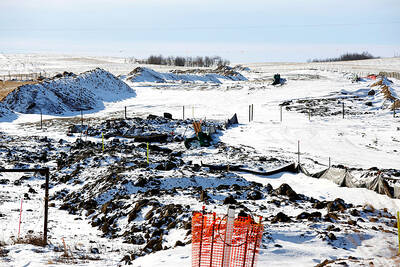
Separatists in Alberta are preparing to submit a petition tomorrow that they said has enough signatures to force a referendum on independence for the oil-rich Canadian province. Polls indicate the pro-independence camp remains a minority among Alberta’s 5 million people, but has hit a historic high of roughly 30 percent. Alberta separatists are also closer than ever to forcing a referendum, riding momentum fueled by intensifying grievances over Ottawa’s control of the provincial oil industry. They have also undeniably gotten a boost from the return to power of US President Donald Trump. After launching a petition in January, Stay Free Alberta, the group


 RSS
RSS