


An audio recording attributed to Osama bin Laden offered rewards in gold for the killing of top US and UN officials in Iraq or of the citizens of any nation fighting there, including Japan and Italy.
The 20-minute recording, dated Thursday, appeared on two Web sites known for militant Islamic messages. The voice sounded like that of bin Laden and the words were laden with Koranic verse, but the authenticity of the recording could not immediately be verified.
The CIA is looking into the statement, a spokesman said, speaking on the condition of anonymity.
"You know that America promised big rewards for those who kill mujahedeen," the speaker said. "We in al-Qaeda organization will guarantee, God willing, 10,000 grams of gold to whoever kills the occupier Bremer, or the American chief commander or his deputy in Iraq."
He was referring to Paul Bremer, the chief US administrator in Iraq, and top military officials.
"For security reasons, the rewards will be given as soon as conditions permit, God willing," the voice said. "As for those who die while killing an occupying solider, the great prize will be for us and for him when God grants him martyrdom, and the smaller prize [the gold] will be for his family."
The US has offered rewards of its own for information leading to the captures or deaths of bin Laden and his top lieutenants, as well as for top figures in the former Iraqi government of Saddam Hussein. The price on bin Laden's head now stands at US$50 million -- far more than the nearly US$125,000 that 10,000 grams of gold is worth.
The recording promised the same reward for the deaths of UN Secretary-General Kofi Annan and his envoy to Iraq, Lakhdar Brahimi.
"The United Nations is nothing but a Zionists' tool, even if it worked under the cover of providing humanitarian aid," the voice said. "Whoever kills Kofi Annan or the head of his commission in Iraq or a representative like Lakhdar Brahimi, he will be awarded the same prize of 10,000 grams of gold."
The speaker promised a lesser prize -- 1,000 grams of gold -- to anyone killing a citizen of countries he called "the masters of the veto like Americans and Britons" -- a reference to nations with veto power on the U.N. Security Council.
And he offered 500 grams of gold to anyone killing citizens of countries he called "slaves of the Security Council who are in Iraq, like Japan and Italy."
The context indicated the rewards applied to citizens of those countries who are in Iraq.
With gold selling Thursday on London exchanges for US$387.60 a troy ounce, 10,000 grams of gold was valued at US$124,630, 1,000 grams at US$12,463, and 500 grams at US$6,231.
It appeared to be the first publicized offer by Bin Laden for rewards for the deaths of his enemies. However, a US joint congressional intelligence panel said in a report two years ago that bin Laden had agreed in 1998 to allocate US$9 million in reward money for the assassination of top US intelligence agency officers.
Bin Laden had never been known to offer rewards for missions he had described as followers' religious duty to carry out.
The recordings appeared on Web sites for the Ansar Islam Forum and the Islamic Research Center. Both are clearing-houses for statements by al-Qaeda and other Islamic militant groups. The forum also has a bulletin board on which extremists chat and comment on the statements.
The speaker denounced US plans to hand sovereignty to Iraqis on June 30, calling them a trick to end the resistance that has killed hundreds of US soldiers.

School bullies in Singapore are to face caning under new guidelines, but the education minister on Tuesday said it would be meted out only as a last resort with strict safeguards. Human rights groups regularly criticize Singapore for the use of corporal punishment, which remains part of the school and criminal justice systems, but authorities have defended it as a deterrent to crime and serious misconduct. Caning was discussed in the parliament after legislators asked how it would be used in relation to bullying in schools. The debate followed stricter guidelines on serious student misconduct, including bullying, unveiled by the Singaporean Ministry of
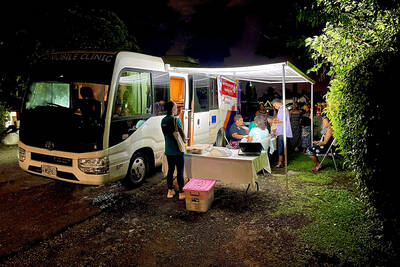
As evening falls in Fiji’s capital, a steady stream of people approaches a makeshift clinic that is a first line of defense against one of the world’s fastest-growing HIV epidemics. In the South Pacific nation — a popular tourist destination of just under a million people — more than 2,000 new HIV cases were recorded last year, a 26 percent increase from 2024. The government has declared an HIV outbreak and described it as a national crisis. “It’s spreading like wildfire,” said Siteri Dinawai, 46, who came to be tested. The Moonlight Clinic, a converted minibus parked in a suburban cul-de-sac in Suva, is
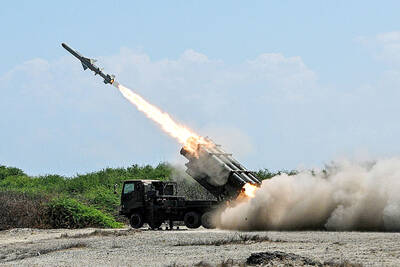
A MESSAGE: Japan’s participation in the Balikatan drills is a clear deterrence signal to China not to attack Taiwan while the US is busy in the Middle East, an analyst said The Japan Self-Defense Forces yesterday fired a Type 88 anti-ship missile during a joint maritime exercise with US, Australian and Philippine forces, hitting a decommissioned Philippine Navy ship in waters facing the disputed South China Sea, in drills that underscore Tokyo’s rising willingness to project military power on China’s doorstep. The drill took place as Manila and Tokyo began talks on a potential defense equipment transfer, made possible by Japan’s decision to scrap restrictions on military exports. The discussions include the possible early transfer of Abukuma-class destroyers and TC-90 aircraft to the Philippines, Japanese Minister of Defense Shinjiro Koizumi said. Philippine Secretary of
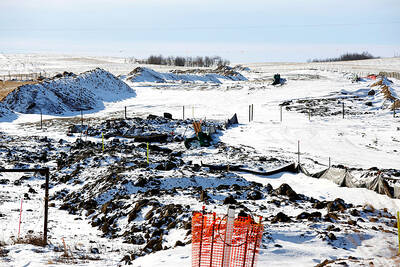
Separatists in Alberta are preparing to submit a petition tomorrow that they said has enough signatures to force a referendum on independence for the oil-rich Canadian province. Polls indicate the pro-independence camp remains a minority among Alberta’s 5 million people, but has hit a historic high of roughly 30 percent. Alberta separatists are also closer than ever to forcing a referendum, riding momentum fueled by intensifying grievances over Ottawa’s control of the provincial oil industry. They have also undeniably gotten a boost from the return to power of US President Donald Trump. After launching a petition in January, Stay Free Alberta, the group


 RSS
RSS