


Georgian President Mikhail Saakashvili arrived in Adzhara early yesterday and thanked welcoming crowds for forcing the region's rebel leader from power.
From the former residence of Aslan Abashidze, who fled Adzhara on Wednesday after running it as a personal fiefdom for more than a decade, Saakashvili praised those whose defiant mass protests had helped bring down Abashidze.
"I'd like to say thank you to all of you, for your bravery," he said in a brief speech. "Thank you for everything you did."
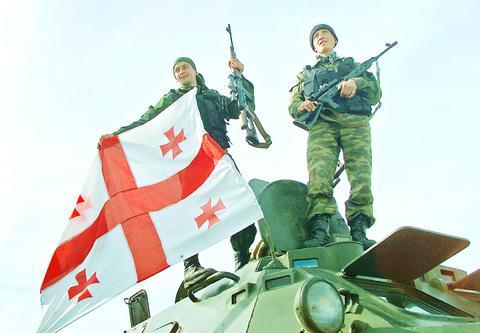
PHOTO: AP
Celebrations erupted in Adzhara's main town Batumi after Abashidze left the region, apparently to exile in Russia, following talks with Russia's former foreign minister Igor Ivanov.
Saakashvili, elected in January after leading a bloodless revolution to oust veteran leader Eduard Shevardnadze last year, has vowed to bring Adzhara and other unruly regions of the former Soviet republic back under central control.
"I congratulate everyone on this victory, on the beginning of Georgia's unification. Georgia will be united," he said in Tbilisi before flying to Batumi.
In an interview with reporters soon after his arrival in Batumi, Saakashvili said Abashidze had been "some kind of mini-Saddam Hussein".
"But people went out and people destroyed him, and that's the force of democracy," he added.
"Georgia has two peaceful revolutions within the last months without any bloodshed. This is a very unique chance."
Unruly crowds converged on Abashidze's luxurious abandoned residence and briefly began seizing furniture before officials restored order. Supporters of Saakashvili swept through the town, shouting "Victory, victory!"
Georgian Prime Minister Zurab Zhvania appealed for calm on television, urging residents to turn in weapons within a week.
Bringing back to the central government fold two other regions -- Abkhazia and South Ossetia -- is likely to prove much more difficult.
Adzhara, whose residents are ethnic Georgians, had only sought autonomy. The other areas have different ethnic compositions and declared full independence a decade or more ago after wars costing thousands of lives.
Abashidze had in recent weeks ignored calls for his resignation and imposed a state of emergency. He spent Wednesday evening in talks with Ivanov, who launched his mission after months of confrontation threatened to spill over into bloodshed.
In the event, Abashidze and Ivanov slipped quietly away from the Adzharan leader's residence in the Adzharan capital Batumi. Reporters who raced to the airport found the Adzharan leader's aircraft gone and his guards saying he had left.
Georgian parliament speaker Nino Burdzhanadze, speaking in Tbilisi, said Abashidze had apparently left for Russia -- which has in the past given tacit support for rebellious Adzhara as well as South Ossetia and Abkhazia.
Saakashvili had set the stage for the 65-year-old leader's flight by offering him safe passage if he stepped down and left.

PHISHING: The con might appear convincing, as the scam e-mails can coincide with genuine messages from Apple saying you have run out of storage For a while you have been getting messages from Apple saying “your iCloud storage is full.” They say you have exceeded your storage plan, so documents are no longer being backed up, and photos you take are not being uploaded. You have been resisting Apple’s efforts to get you to pay a minimum of £0.99 (US$1.33) a month for more storage, but it seems that you cannot keep putting off the inevitable: You have received an e-mail which says your iCloud account has been blocked, and your photos and videos would be deleted very soon. To keep them you need
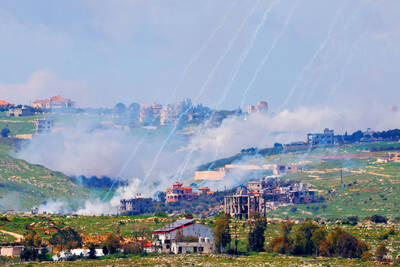
The Israeli military has demolished entire villages as part of its invasion of south Lebanon, rigging homes with explosives and razing them to the ground in massive remote detonations. The Guardian reviewed three videos posted by the Israeli military and on social media, which showed Israel carrying out mass detonations in the villages of Taybeh, Naqoura and Deir Seryan along the Israel-Lebanon border. Lebanese media has reported more mass detonations in other border villages, but satellite imagery was not readily available to verify these claims. The demolitions came after Israeli Minister of Defense Israel Katz called for the destruction of

A US YouTuber who caused outrage for filming himself kissing a statue commemorating Korean wartime sex slaves has been sentenced to six months in prison, a court in Seoul said yesterday. Johnny Somali, 25, gained notoriety several years ago for recording himself doing a series of provocative stunts in South Korea and Japan, and streaming them on platforms such as YouTube and Twitch. South Korean authorities indicted Somali — whose real name is Ramsey Khalid Ismael — in 2024 on public order violations and obstruction of business, and banned him from leaving the country. “The court has sentenced him to six months in
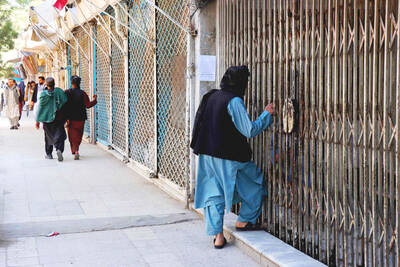
The death toll from a shooting in western Afghanistan rose to 11 on Saturday, after gunmen targeted civilians at a picnic spot in Herat, the provincial authority said. Bullet marks were visible on a wall of the Sayed Mohammad Agha Shia shrine, while bloodstains marked a blanket abandoned at the scene. “Eleven people have been recorded dead and eight others wounded from Friday’s incident, with the condition of two of the wounded reported as critical,” Herat’s information office said in a statement. The update raises a toll of seven killed provided on Friday by the Afghan Ministry of Interior Affairs


 RSS
RSS