


Israel is building a mock Arab town at a military base in southern Israel for millions of dollars -- part of a new sales pitch to foreign armies to teach them how to fight insurgencies.
Later this month, the Israeli military is hosting an arms show and seminar on "low-intensity conflict" for defense officials from 20 countries.
The campaign comes as the country moves into the 42nd month of its current round of fighting with the Palestinians.
However, some experts wondered how Israel could market "success," since it has failed to halt attacks by Palestinian militants and is considering withdrawing unilaterally from parts of the West Bank and most of the Gaza Strip.
In recent years, Israel has emerged as one of the largest exporters of weapons and defense systems in the world. Israeli security sales reached US$4 billion in 2002 before falling to US$2.8 billion last year, Defense Ministry Director General Amos Yaron told a Cabinet meeting Sunday.
Captain Jacob Dallal, an army spokesman, said the Israeli military has learned valuable lessons the Palestinian uprising, or intifadeh.
"We think this [experience] is interesting for other countries because it has become the main method of warfare in our time," Dallal said. "For better or worse, Israel has been a pioneer in the field in terms of methods and doctrine in dealing with a prolonged conflict fighting terrorists."
The mock Arab town is going up at the Tseelim army base in southern Israel, Dallal said.
Security officials say it will contain four distinct neighborhoods -- a complex of high-rise buildings, a crowded commercial district, a marketplace, and a low-rise, agricultural-type environment. They say the neighborhoods are designed to replicate conditions in a typical Middle Eastern setting.
The officials, speaking on condition of anonymity, say the town will be fitted with laser technology and video cameras to analyze soldiers' performances, including firing guided missiles from helicopters and checking the trajectory of tank shells.
Construction should be completed within two years, the officials say.
Later this month, Israel's military will sponsor an international conference on intifadeh lessons and an arms show.
Items on sale will include early-warning systems, bomb discovery and removal devices and night-vision scopes.
Thirty-eight lectures are to be delivered at the three-day conference, including on "protecting roads and settlements" and "deception, communications and intelligence operations in low-intensity conflict."
The event will be attended by defense officials and academics from 20 countries in North America, Asia and Europe, Dallal told a news conference Monday.
"It's a new world out there in terms of combat operations, and there is a lot for foreign armies to learn to adopt," he said.
Methods Israel has adopted include vastly expanded use of snipers, use of drone aircraft to present field commanders with real time intelligence, and deployment of state of the art radar to identify enemy firing positions.
Some military analysts don't think Israel has much to offer.
Military historian Martin Van Creveld of the Hebrew University in Jerusalem said that instead of winning the conflict -- as Israel's army chief claimed last July -- Prime Minister Ariel Sharon's recent announcement that Israel will unilaterally withdraw from the Gaza Strip proves the opposite.
"I can't understand if they're so successful why they're going to get out of the Gaza Strip," he said.
He said Israel's continuing in-ability to stop Palestinian suicide bombers was a clear indication of the shortcoming of Israeli military tactics, despite the Israeli military's seeming success in dealing with day-by-day missions. Since September 2000, the conflict has claimed 2,688 lives on the Palestinian side and 930 lives on the Israeli side.

The Bolivian government on Friday struck a deal with protesting miners, but was still grappling with blockades and demonstrations by other workers across La Paz. Other groups are still blocking access roads into the city, which is also the seat of the government. Police on Thursday prevented the miners from entering the main square by using tear gas, while the demonstrators hurled stones and explosives with slingshots. Protests against the policies of Bolivian President Rodrigo Paz have convulsed the Andean nation since early this month, and roadblocks were choking routes into La Paz throughout Friday, the national road authority said. Miners demanded that Paz
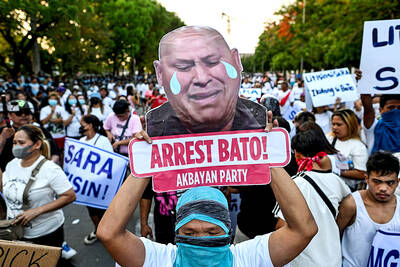
The Philippines said it has asked the country’s Supreme Court to allow it to arrest former Philippine president Rodrigo Duterte’s chief drug war enforcer to stand trial in an international tribunal. The International Criminal Court (ICC) last week unsealed an arrest warrant against Philippine Senator Ronald dela Rosa, accusing him along with Duterte and other “coperpetrators” of the “crime against humanity of murder.” Dela Rosa briefly sought refuge in the Philippine Senate last week while asking the Philippine Supreme Court to stop an ongoing attempt by government agents to arrest him. “By his own conduct, he has placed himself outside the protection of

A ship anchored off the United Arab Emirates (UAE) was seized and taken toward Iran and another — a cargo ship near Oman — sank after being attacked, authorities said on Thursday, as tensions escalated near the Strait of Hormuz. It was not immediately clear who was behind these incidents, but they happened as a senior Iranian official reiterated his country’s claim of control over the waterway and another said it had a right to seize oil tankers connected to the US. The turmoil in the strait has been a sticking point for weeks in talks between the US and Iran to

Crowds in Bangladesh are flocking to snap photographs with an unlikely social media star — an albino buffalo with flowing blond hair nicknamed “Donald Trump” that is due to be sacrificed within days. Owner Zia Uddin Mridha, 38, said his brother named the 700kg bull over its flowing helmet of hair resembling the signature look of the US president. “My younger brother picked this name because of the buffalo’s extraordinary hair,” he said at his farm in Narayanganj, just outside the capital, Dhaka. Mridha said that a constant stream of curious visitors — social media fans, onlookers and children — have come throughout


 RSS
RSS