


Iran's largest reformist student movement denounced President Mohammad Khatami on Sunday for giving in to hard-line demands to hold a legislative election he himself has called unfair.
The Office for Fostering Unity called on Iranians to boycott Friday's election, from which about 2,400 reformist candidates were barred by hard-liners. Liberal lawmakers and academics have dubbed the election a sham, reformist parties have boycotted the polls and hundreds of approved candidates withdrew their names in protest.
"Through accepting to hold this sham election ... Khatami effectively gives priority to implementing illegal demands of unelected conservatives at the cost of slaughtering justice, freedom and people's rights," the office said in a statement.
A reluctant Khatami gave in to an order from Iran's supreme leader, Ayatollah Ali Khamenei, to hold the vote but said it would be unfair and give people little motivation to participate.
"Dialogue to reform the establishment in the way Khatami has defined has reached a dead end," the statement said.
"The absolute power of appointed institutions and their resistance against the voted reform movement has revealed the inefficiency of reforms under the existing structure of the establishment," the statement said.
Meanwhile, prominent jailed reformer Hashem Aghajari called on the nation to send a message to the ruling establishment by boycotting the polls.
"The sham election is the end of reforms within the establishment. The Iranian nation has learned now that there is no hope of a democratic change under the ruling system," Aghajari wrote in a letter from Evin prison, where he is serving a four-year term for questioning clerical rule.
The letter was made available by Aghajari's wife, Zahra Behnoodi.
Aghajari said the solution to the deadlock was "referendum, amending the constitution and bringing fundamental changes in the ruling system."
Iran's biggest political crisis in years was triggered when clerics of the Guardian Council -- an unelected hard-line body that vets candidates -- last month banned more than 3,600 candidates, nearly all of them supporters of efforts to expand Western-style democracy and loosen strict interpretations of Islamic codes in areas such as social activities and the media.
About 130 members of parliament resigned in protest and almost all reformist parties, including the largest -- the Islamic Iran Participation Front -- have announced a boycott of the elections.
The Guardian Council, whose members are hand-picked by Khamenei, reinstated about 1,200 candidates in stages after sit-ins and protests by liberal politicians and backers. The rest remained blackballed -- all leading reformists, including 80 sitting lawmakers.
Since campaigning began Thursday, more than 607 candidates have withdrawn from the race, the Interior Ministry said. Some apparently pulled out to protest the disqualifications, while others hoped to increase chances of hard-line candidates running under the new name of "Developers of Islamic Iran."
Prominent hard-liners Habibollah Asgaroladi and Assadollah Badamchian said they withdrew because "we consider Developers of Islamic Iran as ourselves."
The group consists of extremists within the hard-line camp; reformers charge that the group's 30 candidates were chosen by Khamenei.
A government survey predicted that only about 30 percent of 46 million eligible voters would take part in the polls.
A low voter turnout would be widely interpreted as a powerful sign of support for the nation's reformist politicians.
Still, in the absence of rivals, conservatives are expected to easily win.
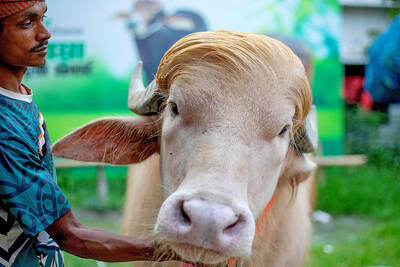
Crowds in Bangladesh are flocking to snap photographs with an unlikely social media star — an albino buffalo with flowing blond hair nicknamed “Donald Trump” that is due to be sacrificed within days. Owner Zia Uddin Mridha, 38, said his brother named the 700kg bull over its flowing helmet of hair resembling the signature look of the US president. “My younger brother picked this name because of the buffalo’s extraordinary hair,” he said at his farm in Narayanganj, just outside the capital, Dhaka. Mridha said that a constant stream of curious visitors — social media fans, onlookers and children — have come throughout

It began as a satirical online project. Now millions of young people in India are flocking to it as an outlet for their frustration. A parody political party called the Cockroach Janta Party, with the insect as its symbol, has exploded across India’s social media by turning absurdist humor into protest. Memes and short videos mocking corruption, joblessness and political dysfunction have flooded social media sites, where millions of users are embracing the cockroach — known for its ability to survive harsh conditions — as a tongue-in-cheek symbol of endurance. The online movement’s rise has been unusually rapid. The Cockroach Janta Party (CJP)
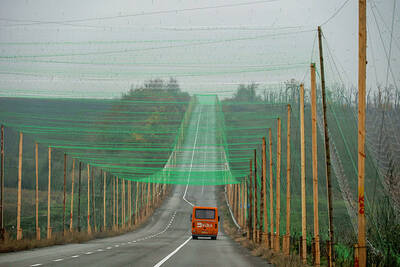
BIGGER ROLE: Beijing has said it maintains an impartial stance on the war in Ukraine, but by training Russian troops, China is far more involved than previously known China’s armed forces secretly trained about 200 Russian military personnel in China late last year, and some have since returned to fight in Ukraine, according to three European intelligence agencies and documents seen by Reuters. While China and Russia have held a number of joint military exercises since Moscow’s full-scale invasion of Ukraine in 2022, Beijing has repeatedly said that it is neutral in the conflict and presents itself as a peace mediator. The covert training sessions, which predominantly focused on the use of drones, were outlined in a dual-language Russian-Chinese agreement signed by senior Russian and Chinese officers in Beijing on
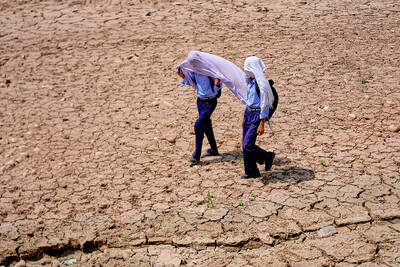
HOTTER: While Indians are accustomed to summer heat, climate change has caused northwestern India to warm faster than other parts of the country, an academic said Roads and markets have emptied during afternoons and some farmers have switched to nighttime work to avoid scorching temperatures as a heat wave grips large parts of India. The India Meteorological Department forecast maximum temperatures for yesterday of about 45°C in the capital, New Delhi, where authorities have opened temporary “cooling zones” to help people cope. The weather department warned that conditions would likely persist across several northern regions in the coming days, with temperatures staying well above seasonal averages. Authorities urged people to stay indoors during the hottest hours and take precautions against heat-related illnesses. India declares a heat wave whenever maximum temperatures


 RSS
RSS