


In one of Iraq's deadliest days this year, five American soldiers and seven Iraqis were killed in a series of bombings and drive-by shootings on Saturday that clouded the start of a two-man UN security mission in Iraq.
Another US soldier died of wounds sustained in a rocket-propelled grenade attack on his vehicle on Sunday in the town of Beiji, north of Baghdad.
The latest US deaths brought to 240 the number of US soldiers killed in hostile action since US President George W. Bush declared major combat over last May.
Saturday's attacks happened near the western city of Fallujah, a stronghold of the Sunni Muslim elite that once ruled the country.
Two US pilots were killed late Friday when their helicopter came down near the northern city of Kayyarah, but it was not immediately clear whether hostile fire was involved.
A car laden with explosives ploughed into a military checkpoint west of Baghdad and exploded, killing three US soldiers and wounding six, the US military and witnesses said.
Three US soldiers "were killed and six were wounded when a vehicle-borne IED [improvised explosive device] detonated at Khaldiyah," 95km west of Baghdad, a US military spokesman said.
Khaldiyah lies between Fallujah and Ramadi, an axis of insurgency against the US-led occupation.
The attacks came as a two-man UN security team began a mission to Iraq, ending a general withdrawal of UN personnel three months ago ordered by Secretary General Kofi Annan after a spate of deadly bomb attacks on UN headquarters in Baghdad.
Efforts to lure the UN into a renewed role in the planned transfer of power from the US-led occupiers to Iraqis had been boosted earlier by a call from top Shiite cleric Ali al-Sistani to halt protests against the plans.
The UN team was charged only with opening up channels of communication with the coalition, a spokesman said.
A separate security assessment would be needed if UN chief Kofi Annan announces the dispatch of a mission to assess the viability of immediate elections, as he is widely speculated to do next week.
Despite the violence, Japanese Defense Agency officials told ruling party lawmakers Saturday that the situation in the southeastern Iraqi city of Samawa was "relatively stable," setting the stage for the final deployment of Japanese ground troops, Kyodo news agency said.
Prime Minister Junichiro Koizumi was expected today to give the final go-ahead for the dispatch of the core group of ground troops making up Japan's 600-strong force in Iraq.
Last Monday, a 39-strong advance team of Japanese troops arrived in Samawa, marking the country's first military deployment in a hostile region since World War II.
The US-led coalition said it would be very difficult to hold the direct elections demanded by the Shiite Muslim hierarchy before a planned June 30 deadline for the transfer of sovereignty.
"We Americans feel strongly about direct elections ... the only issue is timing," said Dan Senor, the senior advisor to US civilian administrator Paul Bremer.
"There is no electoral structure in this country ... there has not been a census in this country for some 20 years ... there is no constituent boundaries, no voter rolls," he told a press conference.
"We consulted with a number of independent experts who voiced the view that it is very difficult to produce all those things, to create an environment where direct elections can be held freely and fairly and legitimately and credibly in a matter of three or four months."

SPEAKING OUT: After Siranudh Scott’s allegations surfaced, celebrities and public figures took to social media to share their own experiences of sexual misconduct and abuse A high-profile alleged sexual abuse case within a wealthy Thai beer brewing family has prompted a wave of painful accounts from survivors of unconnected abuse in the conservative nation. Siranudh Scott, a member of the billionaire Thai family that founded the ubiquitous Singha beer brand, posted an emotional video this month accusing his elder brother Sunit of repeatedly abusing him when he was a teenager. Sunit, who is in his 30s, later denied the allegations in a video posted online, but Singha parent Boonrawd dismissed him from his executive role with the company on Tuesday last week. “I felt I needed to speak

SEEKING ORDER: Rodrigo Paz said that ‘anyone who wants to destroy the nation will have to deal with this president and the full force of the constitution’ Bolivian President Rodrigo Paz on Wednesday said that the nation was at a “breaking point” after nearly a month of protests that have caused shortages of food, fuel and medicine. Paz, who took office six months ago amid the worst economic crisis there in four decades, is battling a groundswell of fury over his policies. The political capital, La Paz, has been besieged by low-income workers and members of the indigenous majority calling for his resignation. “The country needs order and is reaching breaking point,” the 58-year-old said at a public event in La Paz, renewing his appeal for dialogue. On Tuesday, the Bolivian
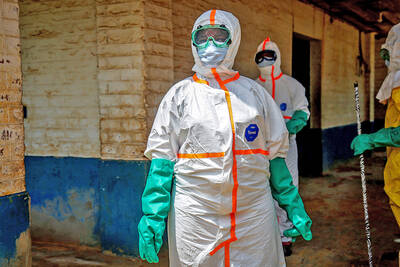
COMMUNITY CONFLICT: Concerns about disease spread from corpses has run up against friends and families’ desire to bury their dead as infection spreads in the area Angry residents of a town at the epicenter of the Ebola outbreak in the Democratic Republic of the Congo (DR Congo) attacked and burned a tent that was part of a health center where people are being treated for the virus, the staff there said Saturday. It was the second such attack in the region in a week. No one was hurt in the attack, according to reports but as patients ran out to escape the fire, 18 people with suspected Ebola infections fled the facility and are unaccounted for, a hospital director said. Angry residents arrived at the clinic in the

Forecasters in Europe yesterday warned of exceptional heat as record temperatures driven by a “heat dome” push temperatures well above seasonal norms across the continent. The surge follows a record-breaking Monday, with France logging its hottest day in the month of May on record, its weather agency said, and the UK also posting unprecedented highs. A so-called “heat dome” of warm air from northern Africa trapped under a high-pressure system over western Europe is behind the high temperatures not usually seen until high summer. Restrictions on outdoor work were imposed in parts of Italy, beaches in southwest France filled earlier than usual and


 RSS
RSS