


In China's Communist heyday, when Chairman Mao (
But Maoism has since been supplanted by an unswerving faith in market economics, and drab Mao suits by haute couture, and the country is now nuts for supermodels and beauty queens.
Next month, China hosts the 2003 Miss World competition, putting the world's most populous country officially on the beauty pageant map.

PHOTO: AP
The 110 beauties vying for the Miss World tiara flew in to Beijing on Tuesday for a few days of photo ops on the Great Wall and in the Forbidden City ahead of the Dec. 6 contest in Sanya, a resort on the semi-tropical island of Hainan.
"Miss World in China. Why not?" a Chinese commentator under the pseudonym "100 percent Cantonese" said on an online message board.
"I am going to beautiful tropical Hainan island for that event, I hope to meet one of those queens on the beach and invite her to a Cantonese dinner," the person wrote.
Until recently, beauty pageants were banned in China as heretical expressions of bourgeois decadence.
During the 1966-1976 Cultural Revolution, women who used make-up could be branded counter-revolutionaries. Now, body image is a preoccupation of choice among urban youth.
Fashion-show catwalks have popped up in malls and in front of department stores nationwide. Billboards advertising beauty products and name-brand fashions are everywhere.
Calling this year "the first pageant year in China," the Web site of the Communist Party's sober-minded mouthpiece, the People's Daily, said the Miss International competition would be held in China next year.
"The craze in pageants is, on one hand, due to people's nature to pursue beauty, and social and economic development makes it possible for this pursuit and enriches its contents," the Web site said. "On the other hand, under the market economy, pageants become a medium, and the beauty economy is prospering."
It said 75 percent of online respondents to a questionnaire by popular Web sites Sina.com and Sohu.com supported China's participation in international pageants. Twenty-seven percent saw them as "a demand for the development of the market economy."
The People's Daily Web site, www.people.com.cn, even said pageants were part of China's history, but stopped short of saying it invented them -- like gunpowder, compasses and noodles.
"Beauty contests among common Chinese people originated from the prostitution circle. There was `flower board' evaluating prostitutes dating back to the Xining period (1068-1077) of North Song Dynasty (960-1127)," it said.
But after the Communists took power in 1949, pageants were banned and China did not enter the Miss World competition, which started two years later, until 2001.
Even with official sanction, the transition to a beauty-contest-friendly China has not been all smooth.
Last year, police in southern China raided an auditorium during the Miss China contest saying the organizers did not have a permit.
The pageant was quietly allowed to continue and the winner, Zhuo Ling, went on to become second runner-up at the Miss Universe finals in Puerto Rico.
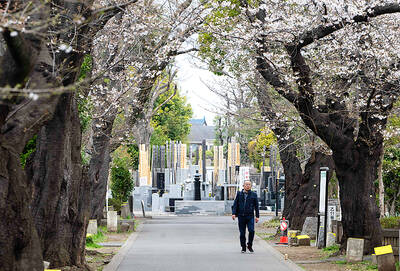
ROCKY RELATIONS: The figures on residents come as Chinese tourist numbers drop following Beijing’s warnings to avoid traveling to Japan The number of Chinese residents in Japan has continued to rise, even as ties between the two countries have become increasingly fractious, data released on Friday showed. As of the end of December last year, the number of Chinese residents had increased by 6.5 percent from the previous year to 930,428. Chinese people accounted for 22.6 percent of all foreign residents in Japan, making them by far the largest group, Japanese Ministry of Justice data showed. Beijing has criticized Tokyo in increasingly strident terms since Japanese Prime Minister Sanae Takaichi last year suggested that a military conflict around Taiwan could

A retired US colonel behind a privately financed rocket launch site in the Dominican Republic sees the project as a response to China’s dominance of the space race in Latin America. Florida-based Launch on Demand is slated to begin building a US$600 million facility in a remote region near the border with Haiti late this year. The project is designed to meet surging demand for the heavy-lift rockets needed to put clusters of satellites into orbit. It is also an answer to China’s growing presence in the region, said CEO Burton Catledge, a former commander of the US Air Force’s 45th Operations

Germany is considering Australia’s Ghost Bat robot fighter as it looks to select a combat drone to modernize its air force, German Minister of Defense Boris Pistorius said yesterday. Germany has said it wants to field hundreds of uncrewed fighter jets by 2029, and would make a decision soon as it considers a range of German, European and US projects developing so-called “collaborative combat aircraft.” Australia has said it will integrate the Ghost Bat, jointly developed by Boeing Australia and the Royal Australian Air Force, into its military after a successful weapons test last year. After inspecting the Ghost Bat in Queensland yesterday,
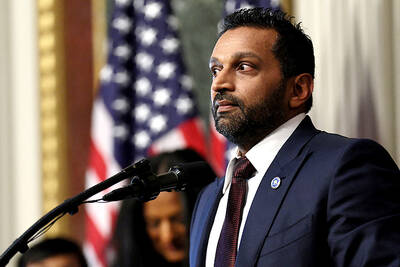
A pro-Iran hacking group claimed to breach FBI Director Kash Patel’s personal e-mail inbox and posted some of the contents online. The e-mails provided by the hacking group include travel details, correspondence with leasing agents in Washington and global entry, and loyalty account numbers. The e-mail address the hackers claim to have compromised has been previously tied to Patel’s personal details, and the leaked e-mails contain photos of Patel and others, in addition to correspondence with family members and colleagues. “The FBI is aware of malicious actors targeting Director Patel’s personal email information,” the agency said in a statement on


 RSS
RSS