


A Jewish man is taking on France's educational establishment, defending his two teenage daughters' right to wear the Islamic headscarf in school.
Laurent Levy, a Paris lawyer who describes himself as an atheist, has become a champion for the freedom of religious expression since Lila, 18, and Alma, 16, were barred from their lycee (high school) in the northern suburb of Aubervilliers last week.
The girls -- whose mother is a non-observant Algerian Moslem -- were told the manner in which they wore the headscarf was "ostentatious" and unsuitable for sports lessons. The school authorities also accused them of taking part in a demonstration by around a hundred fellow students in their defense.
They have been forbidden access to the Henri Wallon lycee and are pursuing their studies at home pending a decision by the local education authority's disciplinary board.
"They are stigmatizing the religion of reference of millions of French people. Even if not all of them practice Islam, they feel the insult," Levy said in an interview.
"At my daughters' school three-quarters of the pupils are from immigrant families. Perhaps half are of Muslim origin. Saying to them that just by practicing the religion of their ancestors they are doing something ugly is a sure-fire way of creating an explosion," he said.
The drive to keep religious insignia out of the classroom in France is led by fervent disciples -- on both sides of the political spectrum -- of the country's secular constitution, which was confirmed in a 1905 law separating church and state.
Levy said the instigators of his daughters' exclusion were staff members from the hard-left Workers' Struggle party, but he also accused the center-right government of Prime Minister Jean-Pierre Raffarin of using the headscarf issue to divert teachers from other grievances.
His strongest words were for what he termed the "Ayatollahs of secularism" -- who by their intolerance towards those who chose to show their religious identity were breeding a resurgence of rejection and anger. There is such incredible rigidity, such inflexibility here. That the land of Voltaire could show such intolerance!"
Lila and Alma are also furious, accusing the school authorities of fabricating reasons to bar them. They point out that they were wearing the same head gear for much of last year, but it was only this term that the school objected.
"They told us we have to show the roots of our hair, the lobes of our ears and our necks. But if we do that we might as well not wear a headscarf at all," said Lila.
Levy said he was not exactly happy with his daughters' religious outlook, but that he respected their choice in the same way they respected his atheism -- and that they remained as tolerant as they were brought up to be.
"It annoys me a little -- the choice they have made. I think it is a mistake. I think it is a misunderstanding of the world ... And I worry that the life of a woman in Islam may not lead to self-fulfilment," he said.
"We took this decision ourselves. No one forced us to do it. And if Islam did not allow us to fulfil ourselves, it would not have been our choice," said Alma.

Through the noise of rushing papers and whirring belts at a print factory in Kyoto, two creators watch their photo essay come to life in broadsheet form — part of an effort to win new audiences in the age of artificial intelligence (AI). Despite the decline of the publishing industry, self-publication and handmade “zine” magazines are growing in popularity in Japan, reflecting the nation’s enduring love of paper in the digital era. While speaking to Agence France-Presse at the plant, his hands black with ink, one of the creators, Kazuma Obara, said: “I think [paper] is a medium that engages all five
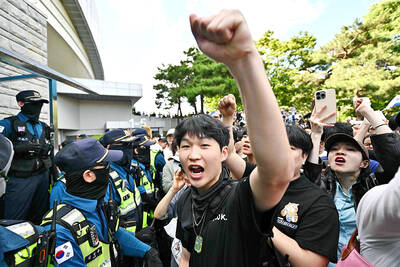
‘ABSURD MISTAKE’: The election commission said that there had been a failure to anticipate turnout after 14 polling stations ran short of ballot papers South Korean riot police yesterday cleared protesters from a Seoul polling station after a 35-hour blockade sparked by a shortage of ballot papers during local elections earlier this week. Wednesday’s election was the first nationwide vote since South Korean President Lee Jae-myung took office following the ouster of Yoon Suk-yeol over his short-lived martial law declaration. Lee’s ruling Democratic Party swept most races, but failed to flip the crucial Seoul mayoral seat. The South Korean National Election Commission apologized, blaming a failure to anticipate turnout after 14 polling stations in Seoul ran short of ballot papers. Some polling stations stayed open until 10pm to

Australian researchers have trained lab-grown brain cells on a silicon computer chip to play the 1990s shooter game Doom and said they are just scratching the surface of what the neurons could be capable of doing. It is the science-fiction work of biotech boffins at Cortical Labs, who researched and developed the technology that harnesses the workings of the brain’s networking system. Each so-called “biological computer” contains about 200,000 living human brain cells, grown from stem cells that were harvested from blood donations. Having mastered the simple computer game Pong, where a paddle is moved up and down to send a ball

France experienced its hottest spring on record, the French weather service said on Tuesday, after an exceptional early heat wave that also broke highs for the season in England and Wales. Meteo-France said the average nationwide temperature over March to May was 13.8°C — about 1.7°C above the norm, and surpassing records set in 2011 and 2020. “The warmest spring since records began in 1900,” it said in a bulletin. All three months were warmer than average, but the onset of an “unprecedented heatwave” late last month pushed the mercury to highs typically seen at the height of the summer. “Our country had never


 RSS
RSS