


■ Australia
Don't answer nature's call
Doctors criticized an Australian call center that obliged employees to make up for toilet breaks at the end of their shift. RSL COM had e-mailed its staff stating that "personal time" had to be made up after work, the Sun-Herald reported yesterday. "Making people log on and off when they go to the toilet so you can keep tabs on them is not a good public-health approach to the problem," Sydney urologist David Golovsky said. A spokesman for RSL COM said a "clarification of the policy will be made."
■ China
Moderate quake kills two
Two people were killed and at least 56 injured in a moderate earthquake that hit northern China, the government said yesterday. The magnitude 5.9 quake struck at 6:58pm Saturday in eastern Inner Mongolia between the towns of Bairin Zuoqi and Ar Horqin qi, northeast of Beijing, where several people also reported feeling minor tremors. More than 60 aftershocks have been felt since, the strongest with a magnitude of 4.4, the official Xinhua News Agency said. It was the most serious quake to hit Chifeng in 700 years, Xinhua said.
■ Pakistan
India seen as enemy
Most Pakistanis view India as an enemy and 47 percent feel that Indian Prime Minister Atal Behari Vajpayee's recent peace initiative is a gimmick, according to an opinion poll. The poll published in the Indian newsweekly Outlook, which hit the stands yesterday, showed 79 percent of people in Pakistan felt the Kashmir issue needed to resolved for better ties between the two nuclear-capable neighbors. The survey was conducted by Gallup-Business Research Bureau, a Pakistan affiliate of Gallup International and polled 1,338 people on August 3 and 4 in all four provinces of Pakistan. The poll showed 54 percent saw India as an enemy.
■ China
Mafia man gets reprieve
A former legislator was given a reprieve on a death sentence for a mafia case that toppled the government of China's fifth-largest city, while his right-hand man was executed, state press said yesterday. The high court in Liaoning province on Saturday gave former legislator Liu Rong a two-year reprieve on the death sentence handed down to him in April last year for involvement in the affair in Shenyang city, Xinhua news agency said. In China a death sentence with a two-year reprieve is generally commuted to life imprisonment. Liu's top assistant in running mafiaoso rackets, Song Jianfei, was meanwhile executed Saturday immediately after the high court issued an execution order, the report said.
■ India
Moon mission planned
A day after India's prime minister announced plans to send a spacecraft to the moon before 2008, the nation's space agency said Saturday that the lunar trip was just the "forerunner of more ambitious planetary missions." "This mission [to the moon] will provide a unique opportunity for frontier scientific research," Indian Space Research Organization spokesman C.S. Ramachandran said in a statement. It is "expected to be the forerunner of more ambitious planetary missions in the years to come, including landing robots on the moon and visits by Indian spacecraft to other planets in the solar system." He did not elaborate.
■ Jordan
Iraqi Chalaby faces charges
A parliamentary campaign for the extradition of Iraqi politician Ahmad Chalaby, on charges of embezzlement dating back to 1990, gathered momentum in Jordan yesterday, a leading MP told local newspapers. Chalaby, chairman of the US appointed Iraq Governing Council, was sentenced in absentia by a Jordanian court in 1992 to 22 years in jail for his role in the collapse of the Petra Bank two years earlier. The extradition move is led by a prominent MP, Mahmoud Kharabshe, who told local media that he had so far collected the signatures of 21 deputies of the Lower House's 110 lawmakers urging the government "to seek Chalaby's extradition through Interpol and with the help of the US administration and Congress."
■ United States
Erika peters out
Tropical Storm Erika petered out as it made landfall short of hurricane strength, shaving palm trees and shattering a few car windows but doing little significant damage. The storm struck Saturday about 48km south of Brownsville, on the edge of the Mexican border city of Matamoros. Downed trees and roof damage were reported in Mexico, but after bringing high winds and heavy rain in the pre-dawn hours Saturday, Erika was expected to break up over the Mexico's high inland terrain by yesterday morning.
■ France
Party animals check emotions
France's most popular techno music festival, the Teknival, remained only half true to its reputation as thousands of young party-goers lived it up without going wild. Since Thursday some 35,000 young people have been raving virtually round the clock on a motorway site on the Larzac plateau in southern central France. The freewheeling consumption of alcohol and assorted drugs that is a defining feature of the event seemed to have abated this year as no violent behavior was reported, local medical sources said. Between Thursday night and Saturday morning, 200 to 300 ravers required light medical assistance, 20 spent a few hours in hospital and 10 stayed there, mostly for drug-related problems.
■ Mexico
Drug `backbone' broken
The Mexican authorities announced on Saturday that they had arrested eight drug traffickers considered to be "the backbone" of a violent cartel responsible for smuggling some 30 percent of the cocaine, heroin and marijuana sold in the US. Armando Valencia Cornelio, who has also eluded the US authorities since 1999, was arrested along with seven other men at a bar in Tlajomulco de Zuniga in Jalisco State in a joint operation by prosecutors and the military, the authorities said. The men were arrested in what officers described as a "surgical" strike in which no shots were fired.
■ United States
Bush, Mandela repair ties
US President George W. Bush and revered South African statesman Nelson Mandela on Saturday took a step towards mending fences by speaking for the first time since the Iraq war, the White House said. Bush, enjoying a month-long vacation at his ranch near this flyspeck Texas town, "welcomed a call from president Mandela," spokesman Scott McClellan told reporters in a conference call. The leaders broke sharply over Iraq's invasion.
■ Germany
Police detain 71 neo-Nazis
German police detained 71 neo-Nazis Saturday during a march in memory of Adolf Hitler's deputy Rudolf Hess in the Bavarian town where he was buried after his 1987 suicide. Police said they deployed some 1,000 officers to prevent trouble at the march, which drew 2,600 neo-Nazis to Wunsiedel. Demonstrators were detained for displaying outlawed Nazi symbols like the swastika, or for carrying weapons such as knives, tear gas spray and a baseball bat, police spokesman Klaus Bernhardt said. All 71 were released without charges by Saturday evening, by which time the marchers had dispersed without incident, he said. Police said they also confiscated neo-Nazi music CDs from some marchers.
■ United Kingdom
Critics attack screening plan
Plans for every baby in the UK to be genetically screened at birth came under fierce attack yesterday from the British Government's advisory watchdog on the new science. Ministers unveiled a genetics strategy earlier this summer, including proposals for the DNA of every newborn to be stored on a database. It could form a vast reservoir of knowledge about their future health, enabling doctors to tailor treatment to each individual. But Baroness Kennedy, chair of the Human Genetics Commission -- set up to advise Government on complex ethical issues -- warned there was a risk of the information being used to discriminate against those found to carry certain genes.
■ South Africa
Rich tribe crowns 36th king
South Africa's richest tribe crowned its 36th king on Saturday in a colorful ceremony watched by thousands of cheering onlookers in the country's mineral-rich Northwest Province. Under the gaze of Africa's elder statesman Nelson Mandela and the wife of South African President Thabo Mbeki, the new king, Leruo Molotlegi, wearing a dark suit, was wrapped in a leopard skin and presented with a traditional wooden scepter and a shield made of cow hide. In his coronation speech Molotlegi, a trained architect, vowed to improve the living standards of the Bafokeng and urged the government of Africa's most powerful economy to view tradition as an ally of Western-style development.
■ United Kingdom
Traffic improves in London
Six months after its launch, London mayor Ken Livingstone's "congestion charge," an ambitious plan to cut the British capital's notorious traffic jams, has been hailed as a success by its supporters. "It's still early days, but so far it has reduced congestion by 32 percent, so we're pleased it's achieving what it ought to do and even a bit more," said Ruth Excell, a spokeswoman for Transport for London, the body responsible for transport in the capital. Under the charging scheme, launched exactly half a year ago yesterday, it costs motorists 5 to drive into central London.
■ United Kingdom
Two prisoners plead guilty
Two Britons held by the US at Guantanamo Bay will admit to supporting al-Qaeda in a plea bargain deal to secure short sentences, according to Britain's Independent on Sunday newspaper. Feroz Abbasi, 23, and Moazzam Begg, 35, were named by US President George W. Bush last month on a list of the first six prisoners to face military trial. The fate of Britons held at the US naval base in Cuba has become a tense political issue, and this week Britain's attorney general, Lord Goldsmith, sought assurances from the US that the pair would receive fair trials.

Through the noise of rushing papers and whirring belts at a print factory in Kyoto, two creators watch their photo essay come to life in broadsheet form — part of an effort to win new audiences in the age of artificial intelligence (AI). Despite the decline of the publishing industry, self-publication and handmade “zine” magazines are growing in popularity in Japan, reflecting the nation’s enduring love of paper in the digital era. While speaking to Agence France-Presse at the plant, his hands black with ink, one of the creators, Kazuma Obara, said: “I think [paper] is a medium that engages all five
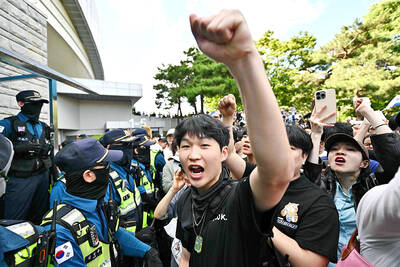
‘ABSURD MISTAKE’: The election commission said that there had been a failure to anticipate turnout after 14 polling stations ran short of ballot papers South Korean riot police yesterday cleared protesters from a Seoul polling station after a 35-hour blockade sparked by a shortage of ballot papers during local elections earlier this week. Wednesday’s election was the first nationwide vote since South Korean President Lee Jae-myung took office following the ouster of Yoon Suk-yeol over his short-lived martial law declaration. Lee’s ruling Democratic Party swept most races, but failed to flip the crucial Seoul mayoral seat. The South Korean National Election Commission apologized, blaming a failure to anticipate turnout after 14 polling stations in Seoul ran short of ballot papers. Some polling stations stayed open until 10pm to

Australian researchers have trained lab-grown brain cells on a silicon computer chip to play the 1990s shooter game Doom and said they are just scratching the surface of what the neurons could be capable of doing. It is the science-fiction work of biotech boffins at Cortical Labs, who researched and developed the technology that harnesses the workings of the brain’s networking system. Each so-called “biological computer” contains about 200,000 living human brain cells, grown from stem cells that were harvested from blood donations. Having mastered the simple computer game Pong, where a paddle is moved up and down to send a ball

France experienced its hottest spring on record, the French weather service said on Tuesday, after an exceptional early heat wave that also broke highs for the season in England and Wales. Meteo-France said the average nationwide temperature over March to May was 13.8°C — about 1.7°C above the norm, and surpassing records set in 2011 and 2020. “The warmest spring since records began in 1900,” it said in a bulletin. All three months were warmer than average, but the onset of an “unprecedented heatwave” late last month pushed the mercury to highs typically seen at the height of the summer. “Our country had never


 RSS
RSS