

China Airlines Co (
China Airlines President Chris-tine Tsung (宗才怡) will travel to the US to sign the agreement, she said at the carrier's 42nd anniversary ceremony in Taipei.
The alliance with Delta will help China Airlines raise sales by allowing passengers to use China Airlines tickets to transfer onto Delta feeder services to US destinations on one ticket.
Taiwan's airlines are struggling as Taiwan's economy heads for its first full-year contraction and after demand for air travel and cargo services fell following the Sept. 11 attacks, in which hijacked commercial aircraft were slammed into the World Trade Center in New York and the Pentagon in Washington.
"This has been a tough year following the Sept. 11 terrorist attacks and the slowing economy," said China Airlines Chairman Lee Yun-ning (李雲寧) at the ceremony. "We expect next year to continue to be challenging as Taiwan's entry to the World Trade Organization brings more competition."
Tsung reiterated that the carrier expects to post a profit this year, helped by cost-cutting measures and lower fuel prices.
China Airlines said in October it expects a profit this year of NT$1.37 billion (US$40 million), a reduction from a previous target of NT$3 billion because of a slump in demand after the terrorist attacks in the US.
China Airlines' shares dropped NT$0.20, or 1.5 percent, to NT$13.15. Delta shares fell 3.6 percent to US$29.75 in the US yesterday.
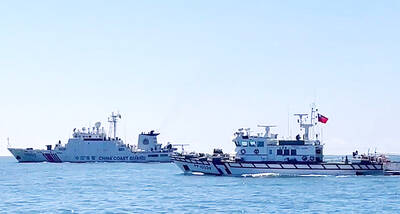
China deployed a record number of coast guard, scientific research and other ships near Taiwan’s waters last month, the Coast Guard Administration (CGA) said, as Beijing dials up pressure on Taipei. The coast guard warned of an increasingly severe situation, as analysts say the increased activity is part of China’s bid to map the region for submarine warfare. The number of Chinese ships detected around Taiwan proper soared to a record 244 last month — an average of nearly eight every day, official data showed. That compares with 55 ships detected in June and 30 in May, and 58 in July last year. In
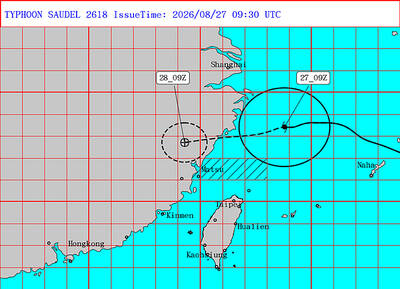
Taiwan is bracing for heavy rain in the south and rough seas around outlying Lienchiang County (Matsu), as Typhoon Saudel passes north toward eastern China, with forecasters yesterday warning of localized flooding over the next two days. Saudel is expected to pass closest to Taiwan today, when its outer rain bands are forecast to brush past Matsu, before making landfall at about noon in China’s Zhejiang Province and weakening significantly, the Central Weather Administration said. The storm’s outer bands, combined with strengthening southwesterly winds, are expected to bring heavy rain to southern and southeastern Taiwan today, it said. As the storm approaches Matsu,

LIMITED: The bill’s NT$40bn annual spending cap would prevent Taiwan from effectively building up its drone combat capabilities, National Defense Minister Wellington Koo said The legislature yesterday rejected the Executive Yuan’s NT$210 billion (US$6.62 billion) special budget proposal to buy military drones and instead passed its own plan, which earmarks NT$40 billion per year over six consecutive years. The Executive Yuan said its plan to buy about 210,000 drones by 2031 could not wait, as the wars in Ukraine and Iran showed the importance of uncrewed systems in modern warfare amid a rising threat from China. However, the Chinese Nationalist Party (KMT) and Taiwan People’s Party (TPP) used their opposition majority to pass a bill providing NT$240 billion through annual budgets over six years, with annual

INCREASING IMBALANCE: The percentage of working-age people is expected to shrink to 42.3% of the population, while older people would comprise 52.9%, the agency said Taiwan’s population is projected to shrink by almost half over the next five decades, intensifying labor shortages and placing a growing drag on economic growth as the technology-intensive economy confronts a rapidly aging workforce. The population is expected to fall to 12.15 million by 2075, a 48 percent decline from this year, National Development Council projections released yesterday showed. The decline would fundamentally alter Taiwan’s workforce. From 2037, more than half of the working-age population is projected to be aged between 45 and 64, signaling the end of an era when the economy could rely on a relatively large labor force. The shift


 RSS
RSS