


Disputes between the US and China would not grow out of control in the near future, and Taiwan’s leadership should pursue institutionalization of US-Taiwan relations and ameliorate cross-strait relations, academics said yesterday.
The Association of Strategic Foresight hosted academics at a seminar in Taipei to discuss current and future relations among Washington, Taipei and Beijing.
Addressing concerns over China’s rising influence, the US would continue to implement its Indo-
Pacific strategy and policies that are friendly to Taiwan, which would not change no matter who wins in the Jan. 11 presidential election, National Chengchi University associate professor of diplomacy Lu Yeh-chung (盧業中) said.
The US’ Taiwan Travel Act, National Defense Authorization Act for Fiscal Year 2020 and increased military sales to Taiwan are symbolic indicators of its continued friendliness toward Taiwan, but it remains to be seen whether their practical effects would be greater, he said.
The primary goal after the elections is to institutionalize Taiwan-US interaction and ensure that it would not change with the rotation of political parties in power, Lu said.
On US-China relations, Washington currently views Beijing as a strategic competitor and a revisionist power rather than a friend or an enemy, Tamkang University associate professor of international affairs and strategic studies Li Da-jung (李大中) said.
The US and China have not completely decoupled, and they are several steps away from outright competition for global hegemony, he said.
The worst Taiwan could do right now is to go into full alert mode, he added.
“That’s like running in front of the US and then asking why it isn’t ready,” he said.
The anti-China sentiment in Taiwan now is greater than even during the Qiandao Lake incident in 1994 and the Sunflower movement in 2014, National Taiwan University political science professor Chang Teng-chi (張登及) said.
In the Qiandao Lake incident, 24 Taiwanese tourists and eight Chinese were kidnapped and murdered by three men in Zhejiang Province, China.
During the Sunflower movement, protesters occupied the Legislative Yuan’s main chamber in March and April 2014 to protest the government’s handling of the Cross-Strait Service Trade Agreement.
If the Democratic Progressive Party (DPP) succeeds in winning a second term, it must consider how to handle the US-Taiwan-China trilateral relations in a more refined manner, Chang said.
If the Chinese Nationalist Party (KMT) wins, it must make an effort to meet the expectations of the public, he added.
After reaching a “phase one” trade agreement, the US and China have temporarily ceased their trade conflict, he said.
This is a critical period and Taiwan should emulate Japan, India and other important Indo-Pacific nations by staying calm and avoiding risks, he said.

US climber Alex Honnold is to attempt to scale Taipei 101 without a rope and harness in a live Netflix special on Jan. 24, the streaming platform announced on Wednesday. Accounting for the time difference, the two-hour broadcast of Honnold’s climb, called Skyscraper Live, is to air on Jan. 23 in the US, Netflix said in a statement. Honnold, 40, was the first person ever to free solo climb the 900m El Capitan rock formation in Yosemite National Park — a feat that was recorded and later made into the 2018 documentary film Free Solo. Netflix previewed Skyscraper Live in October, after videos

Starting on Jan. 1, YouBike riders must have insurance to use the service, and a six-month trial of NT$5 coupons under certain conditions would be implemented to balance bike shortages, a joint statement from transportation departments across Taipei, New Taipei City and Taoyuan announced yesterday. The rental bike system operator said that coupons would be offered to riders to rent bikes from full stations, for riders who take out an electric-assisted bike from a full station, and for riders who return a bike to an empty station. All riders with YouBike accounts are automatically eligible for the program, and each membership account

A classified Pentagon-produced, multiyear assessment — the Overmatch brief — highlighted unreported Chinese capabilities to destroy US military assets and identified US supply chain choke points, painting a disturbing picture of waning US military might, a New York Times editorial published on Monday said. US Secretary of Defense Pete Hegseth’s comments in November last year that “we lose every time” in Pentagon-conducted war games pitting the US against China further highlighted the uncertainty about the US’ capability to intervene in the event of a Chinese invasion of Taiwan. “It shows the Pentagon’s overreliance on expensive, vulnerable weapons as adversaries field cheap, technologically
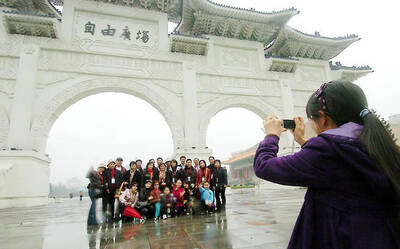
NUMBERs IMBALANCE: More than 4 million Taiwanese have visited China this year, while only about half a million Chinese have visited here Beijing has yet to respond to Taiwan’s requests for negotiation over matters related to the recovery of cross-strait tourism, the Tourism Administration said yesterday. Taiwan’s tourism authority issued the statement after Chinese-language daily the China Times reported yesterday that the government’s policy of banning group tours to China does not stop Taiwanese from visiting the country. As of October, more than 4.2 million had traveled to China this year, exceeding last year. Beijing estimated the number of Taiwanese tourists in China could reach 4.5 million this year. By contrast, only 500,000 Chinese tourists are expected in Taiwan, the report said. The report


 RSS
RSS