


One of three tropical depressions in the Pacific strengthened into a typhoon yesterday afternoon, while two others are expected to become typhoons by today, Central Weather Administration (CWA) forecaster Lee Ming-hsiang (李名翔) said yesterday.
The outer circulation of Tropical Depression No. 20, now Typhoon Mitag, has brought light rain to Hualien, Taitung and areas in the south, Lee said, adding that as of 2pm yesterday, Mitag was moving west-northwest at 16kph, but is not expected to directly affect Taiwan.
It was possible that Tropical Depression No. 21 would become a typhoon as soon as last night, he said.
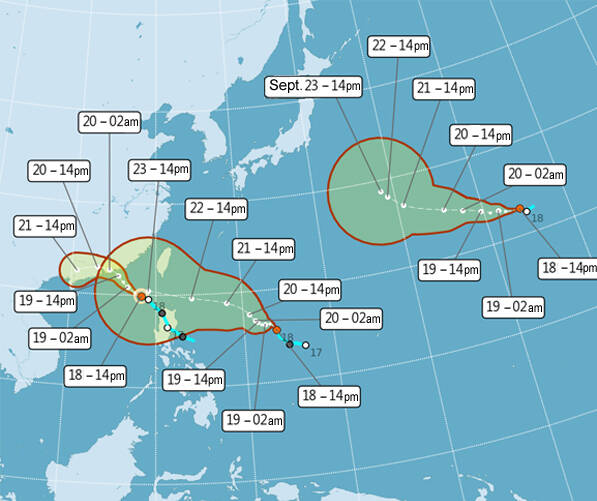
Photo courtesy of the Central Weather Administration
It was moving in a northwesterly direction at 18kph as of 2pm yesterday and is expected to pass through the Bashi Channel next week, he said, adding that it has the potential to become a moderate typhoon.
Lee said he expects the outer circulation of Tropical Depression No. 21 to affect Taiwan by Monday.
It is expected to be the closest to Taiwan on Tuesday, so the nation should be prepared for inclement weather on Wednesday and Thursday, he said, adding that eastern Taiwan and Pingtung County would be most affected.
The path of the system is still uncertain and should be closely monitored, Lee said.
Tropical Depression No. 22, as of 2pm yesterday, was moving westward at 29kph and is expected to move toward southeastern Japan, Lee said, adding that it would not affect Taiwan significantly.
Meanwhile, CWA statistics from 1958 to last year showed that an average of 25 to 27 typhoons formed in the northwest Pacific and the South China seas annually, most of which occurred between July and October.
These typhoons accounted for 70 percent of all typhoons formed each year, the agency said.
On average, one typhoon is formed annually between April and May, and two per month starting in June, the data showed.
July to October were peak typhoon formation months, with an average of 5.39 typhoons formed in August and 5.04 in September, it said.
About four typhoons form per month in July and October, it added.
The statistics reflect the average rate over a long period and should not be taken to represent the number of typhoons formed every year, the agency said, adding that historically, 1964 had the most typhoons at 37, while 2010 had the fewest at 14.

Kenting National Park service technician Yang Jien-fon (楊政峰) won a silver award in World Grand Prix Photography Awards Spring Season for his photograph of two male rat snakes intertwined in combat. Yang’s colleagues at Kenting National Park said he is a master of nature photography who has been held back by his job in civil service. The awards accept entries in all four seasons across six categories: architectural and urban photography, black-and-white and fine art photography, commercial and fashion photography, documentary and people photography, nature and experimental photography, and mobile photography. Awards are ranked according to scores and divided into platinum, gold and

More than half of the bamboo vipers captured in Tainan in the past few years were found in the city’s Sinhua District (新化), while other districts had smaller catches or none at all. Every year, Tainan captures about 6,000 snakes which have made their way into people’s homes. Of the six major venomous snakes in Taiwan, the cobra, the many-banded krait, the brown-spotted pit viper and the bamboo viper are the most frequently captured. The high concentration of bamboo vipers captured in Sinhua District is puzzling. Tainan Agriculture Bureau Forestry and Nature Conservation Division head Chu Chien-ming (朱健明) earlier this week said that the

The Chinese Nationalist Party (KMT) caucus yesterday said it opposes the introduction of migrant workers from India until a mechanism is in place to prevent workers from absconding. Minister of Labor Hung Sun-han (洪申翰) on Thursday told the Legislative Yuan that the first group of migrant workers from India could be introduced as early as this year, as part of a government program. The caucus’ opposition to the policy is based on the assessment that “the risk is too high,” KMT caucus secretary-general Lin Pei-hsiang (林沛祥) said. Taiwan has a serious and long-standing problem of migrant workers absconding from their contracts, indicating that

TRADE-OFF: Beijing seeks to trade a bowl of tempura for a Chinese delicacy, an official said, while another said its promises were attempts to interfere in the polls The government must carefully consider the national security implications of building a bridge connecting Kinmen County and Xiamen, China, the Public Construction Commission (PCC) said yesterday. PCC Commissioner Derek Chen (陳金德), who is also a minister without portfolio, made the remarks in a meeting of the legislature’s Transportation Committee, after Democratic Progressive Party Legislator Hsu Fu-kuei (徐富癸) asked about China’s proposal of new infrastructure projects to further connect Kinmen and Lienchiang (Matsu) counties with Xiamen. China unveiled the bridge plan, along with nine other policies for Taiwan, on Sunday, the last day of Chinese Nationalist Party (KMT) Chairwoman Cheng Li-wun’s (鄭麗文) visit


 RSS
RSS