


The Taiwan Railway Union yesterday said that the Taipei Railway Station is short-staffed, requiring some employees to work up to 12 hours per shift.
“Long lines at the ticket windows are an ongoing problem that has led to a great number of customer complaints and constant overworking of employees,” union president Wang Chieh (王傑) told a news conference in Taipei.
“Often, we have just a half an hour, if any time at all, to eat lunch or dinner, and hardly enough time to take bathroom breaks,” said Wang, who works at the station’s customer service center.
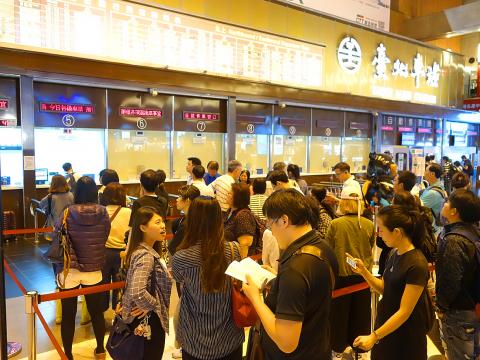
Photo: Cheng Wei-chi, Taipei Times
The most overworked staff are those at window 12, where they are responsible for selling time-limited passes, unlocking cards and handling machine repairs, he said.
If one of the two personnel at the window takes time off, the other must work 12 hours straight to cover it, he added.
The station has 161 personnel, which is 27 fewer than it had in 2008, even though the number of passengers passing through the station has grown by 4 million over the past decade, Wang said.
In contrast, personnel at other major stations, such as Shulin (樹林), Songshan (松山), Banciao (板橋), Jhongli (中壢) and Hsinchu (新竹), have all increased or maintained about the same amount of staff since 2008, he added.
While the Taiwan Railways Administration (TRA) said that it would recruit 18 people next year, that would only fill the vacancies of the 18 people who left earlier this year, he said.
“To ensure that the station can function properly, it would need a total of 215 personnel,” Wang said.
The problem of long lines at the Taipei Railway Station is made worse by poorly designed signs, which are rarely helpful, he said.
Often, foreigners spend 10 to 20 minutes waiting in line before realizing that they are at the wrong window, he said.
At the news conference, New Power Party Chairman Hsu Yung-ming (徐永明) also said that the TRA should hire more people to staff the station.
“It is not that the TRA does not have the money, but that it has been wasting it,” he said. “If it can spend NT$44 billion [US$1.4 billion] to buy new intercity trains [last month], why does it not have the money to hire enough people? We hope the TRA will invest its money in the right place.”
The agency said it completed a personnel review of the Taipei Railway Station on Oct. 25, adding that it promised in a meeting at Hsu’s office on Oct. 31 that 21 new recruits would begin working at the station.
Of the 21 new employees, 11 have started working as apprentices, while the other 10 would begin the apprenticeship program on Dec. 26, the agency said.
In light of the problems caused by the personnel shortage, it said that it would periodically review staffing levels at the station.
The station would adjust job assignments based on changing service demands, it added.
The Taipei Railway Station has been asked to address problems caused by inadequate signage, the agency said, adding that station crew would walk around the station more frequently to offer directions to passengers.
“We will invite experts, as well as advocates for the rights of the disabled, to inspect the station facilities and propose measures to help us improve,” the agency said.
The suggestions would be incorporated into a program designed to improve signage at the station, which would be implemented next year, it added.
Additional reporting by Shelley Shan
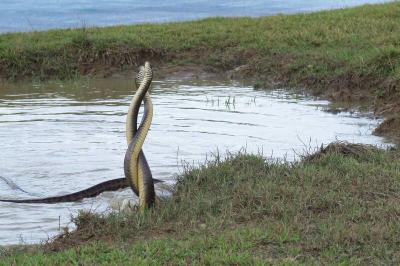
Kenting National Park service technician Yang Jien-fon (楊政峰) won a silver award in World Grand Prix Photography Awards Spring Season for his photograph of two male rat snakes intertwined in combat. Yang’s colleagues at Kenting National Park said he is a master of nature photography who has been held back by his job in civil service. The awards accept entries in all four seasons across six categories: architectural and urban photography, black-and-white and fine art photography, commercial and fashion photography, documentary and people photography, nature and experimental photography, and mobile photography. Awards are ranked according to scores and divided into platinum, gold and
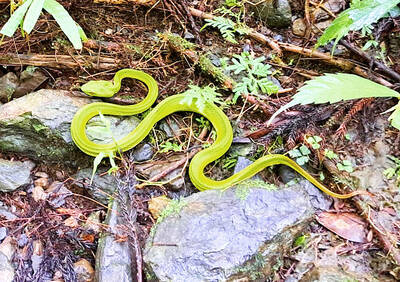
More than half of the bamboo vipers captured in Tainan in the past few years were found in the city’s Sinhua District (新化), while other districts had smaller catches or none at all. Every year, Tainan captures about 6,000 snakes which have made their way into people’s homes. Of the six major venomous snakes in Taiwan, the cobra, the many-banded krait, the brown-spotted pit viper and the bamboo viper are the most frequently captured. The high concentration of bamboo vipers captured in Sinhua District is puzzling. Tainan Agriculture Bureau Forestry and Nature Conservation Division head Chu Chien-ming (朱健明) earlier this week said that the

The Chinese Nationalist Party (KMT) caucus yesterday said it opposes the introduction of migrant workers from India until a mechanism is in place to prevent workers from absconding. Minister of Labor Hung Sun-han (洪申翰) on Thursday told the Legislative Yuan that the first group of migrant workers from India could be introduced as early as this year, as part of a government program. The caucus’ opposition to the policy is based on the assessment that “the risk is too high,” KMT caucus secretary-general Lin Pei-hsiang (林沛祥) said. Taiwan has a serious and long-standing problem of migrant workers absconding from their contracts, indicating that

SPACE VETERAN: Kjell N. Lindgren, who helps lead NASA’s human spaceflight missions, has been on two expeditions on the ISS and has spent 311 days in space Taiwan-born US astronaut Kjell N. Lindgren is to visit Taiwan to promote technological partnerships through one of the programs organized by the US for its 250th national anniversary. Lindgren would be in Taiwan from Tuesday to Saturday next week as part of the US Bureau of Educational and Cultural Affairs’ US Speaker Program, organized to celebrate the 250th anniversary of the signing of the Declaration of Independence, the American Institute in Taiwan (AIT) said in a statement yesterday. Lindgren plans to engage with key leaders across the nation “to advance cutting-edge technological partnerships and inspire the next generation of scientists and engineers,”


 RSS
RSS