


The first government-hosted forum on LGBT in the Asian region took place yesterday in Taipei, with participants discussing the progress, challenges and experiences of promoting same-sex marriage in European and Asian countries, ahead of the annual gay pride parade scheduled for tomorrow in Taipei.
The two-day “EU-Taiwan LGBTI Human Rights Conference” is a collaboration between the Ministry of Foreign Affairs, the Executive Yuan and the European Economics and Trade Office (EETO) in Taiwan, with foreign representatives in Taiwan and nearly 260 delegates from European and Asian countries attending.
EETO head Filip Grzegorzewski opened his talk by lauding Taiwan on becoming the first country in Asia to legalize same-sex marriage.
The Legislative Yuan in May passed the Enforcement Act of the Judicial Yuan Constitutional Interpretation No. 748 (司法院釋字第748號解釋施行法), setting the legal foundation for same-sex marriage.
The act is the culmination of many years of hard work by human rights and LGBT rights activists, as well as demonstrating courage and resolve on the part of the Taiwanese government, Grzegorzewski said.
However, there is still room for improvement in the act, especially regarding issues such as joint adoption of children, international marriages and promoting equality at schools and workplaces, he said, urging experts to come up with solutions to the issues at the forum.
Vice President Chen Chien-jen (陳建仁) promised that recognition and acceptance of the LGBT community would continue to be the goal of future policies.
The issue had stirred intense public debate over the years, but the government, after much debate and review, accomplished its goal of offering legal guarantees to same-sex couples, he said.
This should serve as a model as to how Taiwan can face and overcome divisive issues, Chen said.
The passage of the act shows that Taiwanese are willing to learn to respect the choices others make, he said, adding that the legal guarantees offered by the act can make others understand that love is equal for all people.
The act is only the first of many lessons for Taiwanese to learn how to be accepting of one another, he said, adding that people should strive to understand and be accepting of our fellow citizens and other residents, he said.
“The Taiwanese value, therefore, is a democratic system of government, liberty and the rule of law,” Chen said.
The annual LGBT pride parade is to start from Taipei City Hall to Ketagalan Boulevard in front of the Presidential Office.
Additional reporting by CNA

AGING: While Japan has 22 submarines, Taiwan only operates four, two of which were commissioned by the US in 1945 and 1946, and transferred to Taiwan in 1973 Taiwan would need at least 12 submarines to reach modern fleet capabilities, CSBC Corp, Taiwan chairman Chen Cheng-hung (陳政宏) said in an interview broadcast on Friday, citing a US assessment. CSBC is testing the nation’s first indigenous defense submarine, the Hai Kun (海鯤, Narwhal), which is scheduled to be delivered to the navy next month or in July. The Hai Kun has completed torpedo-firing tests and is scheduled to undergo overnight sea trials, Chen said on an SET TV military affairs program. Taiwan would require at least 12 submarines to establish a modern submarine force after assessing the nation’s operational environment and defense

Yangmingshan National Park authorities yesterday urged visitors to respect public spaces and obey the law after a couple was caught on a camera livestream having sex at the park’s Qingtiangang (擎天崗) earlier in the day. The Shilin Police Precinct in Taipei said it has identified a suspect and his vehicle registration number, and would summon him for questioning. The case would be handled in accordance with public indecency charges, it added. The couple entered the park at about 11pm on Thursday and began fooling around by 1am yesterday, the police said, adding that the two were unaware of the park’s all-day live
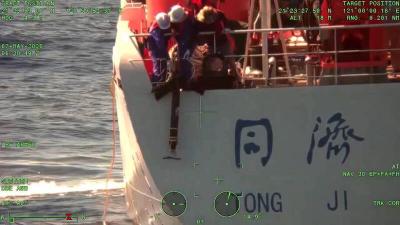
The coast guard today said that it had disrupted "illegal" operations by a Chinese research ship in waters close to the nation and driven it away, part of what Taipei sees a provocative pattern of China's stepped up maritime activities. The coast guard said that it on Thursday last week detected the Chinese ship Tongji (同濟號), which was commissioned only last year, 29 nautical miles (54km) southeast of the southern tip of Taiwan, although just outside restricted waters. The ship was observed lowering ropes into the water, suspected to be the deployment of scientific instruments for "illegal" survey operations, and the coast

A former soldier and an active-duty army officer were yesterday indicted for allegedly selling classified military training materials to a Chinese intelligence operative for a total of NT$79,440. The Taipei District Prosecutors’ Office indicted Chen Tai-yin (陳泰尹) and Lee Chun-ta (李俊達) for contravening the National Security Act (國家安全法) and the Anti-Corruption Act (貪污治罪條例). Chen left the military in September 2013 after serving alongside then-staff sergeant Lee, now an army lieutenant, at the 21st Artillery Command of the army’s Sixth Corps from 2011 to 2013, according to the indictment. Chen met a Chinese intelligence operative identified as “Wang” (王) through a friend in November


 RSS
RSS