


More than 250,000 people in Taiwan have likely used illegal drugs, while an increasing number of people have tried unknown mixtures of drugs, the Food and Drug Administration (FDA) said yesterday.
The findings came from a FDA-commissioned survey conducted last year by National Taiwan University’s (NTU) College of Public Health, which collected data regarding illegal drug use from 18,262 people aged 12 to 64.
The survey found that 1.29 percent of respondents had used identifiable illegal drugs at least once, which could be extrapolated to about 204,000 people among the entire population of the same age.
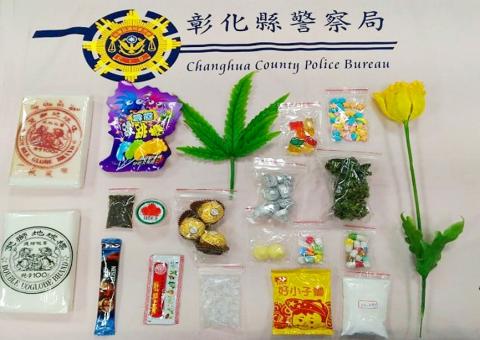
Photo copied by Wu Liang-yi, Taipei Times
Once unknown blends of drugs — also known as “trail mix” — was factored in, the prevalence increased to 1.46 percent, or about 258,000 people, the FDA said.
It was the first time that the agency included “trail mix” drugs in the survey. These mixes are often repackaged to look like coffee sachets, cigarettes, plum powder, candy, chocolate or other snacks.
The five most common types of drugs taken by respondents were amphetamines (0.42 percent), ketamine (0.4 percent), ecstasy (0.36 percent), marijuana (0.32 percent) and “trail mixes” (0.18 percent), NTU professor Chen Wei-jen (陳為堅) said.
“Some young people did not know they were getting illegal drugs and mistook them for snacks or coffee. They could easily have accepted them if they were given by a friend,” FDA Division of Controlled Drugs Director Chu Yu-roo (朱玉如) said.
“Some people tried ‘trail mix’ drugs because they were curious,” Chen said. “However, the source, formula and dosage are often unknown, so they could sometimes damage the body or cause an overdose.”
Studies by forensic scientists have shown that such types of drug mixtures can easily cause acute kidney damage or irregular heartbeat, and they often contain synthetic cathinones, marijuana or ketamine, he said.
Among those who had tried illegal drugs, 70 percent did so “out of curiosity,” while 29.9 percent said that they first tried it at a classmate or friend’s house, Division of Controlled Drugs section chief Hsu Jui (徐睿) said.
While two-and-a-half times more males used single identifiable drugs than females, there was no significant gender difference in “trail mix” drug use, while more females aged 18 to 44 reported having taken drugs than males of the same age, she said.
As drug mixtures are being repackaged to resemble other products, people should be cautious about consuming food from unknown sources, reject drinks or food given by strangers, and try to leave when provided with suspected illegal drugs, Chu said.

Taiwan has received more than US$70 million in royalties as of the end of last year from developing the F-16V jet as countries worldwide purchase or upgrade to this popular model, government and military officials said on Saturday. Taiwan funded the development of the F-16V jet and ended up the sole investor as other countries withdrew from the program. Now the F-16V is increasingly popular and countries must pay Taiwan a percentage in royalties when they purchase new F-16V aircraft or upgrade older F-16 models. The next five years are expected to be the peak for these royalties, with Taiwan potentially earning
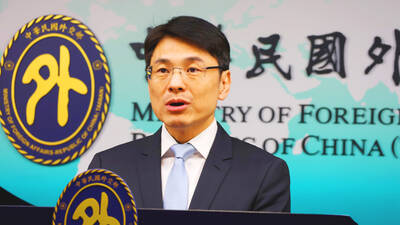
STAY IN YOUR LANE: As the US and Israel attack Iran, the ministry has warned China not to overstep by including Taiwanese citizens in its evacuation orders The Ministry of Foreign Affairs (MOFA) yesterday rebuked a statement by China’s embassy in Israel that it would evacuate Taiwanese holders of Chinese travel documents from Israel amid the latter’s escalating conflict with Iran. Tensions have risen across the Middle East in the wake of US and Israeli airstrikes on Iran beginning Saturday. China subsequently issued an evacuation notice for its citizens. In a news release, the Chinese embassy in Israel said holders of “Taiwan compatriot permits (台胞證)” issued to Taiwanese nationals by Chinese authorities for travel to China — could register for evacuation to Egypt. In Taipei, the ministry yesterday said Taiwan
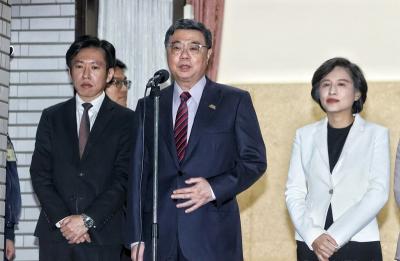
Taiwan is awaiting official notification from the US regarding the status of the Agreement on Reciprocal Trade (ART) after the US Supreme Court ruled US President Donald Trump's global tariffs unconstitutional. Speaking to reporters before a legislative hearing today, Premier Cho Jung-tai (卓榮泰) said that Taiwan's negotiation team remains focused on ensuring that the bilateral trade deal remains intact despite the legal challenge to Trump's tariff policy. "The US has pledged to notify its trade partners once the subsequent administrative and legal processes are finalized, and that certainly includes Taiwan," Cho said when asked about opposition parties’ doubts that the ART was
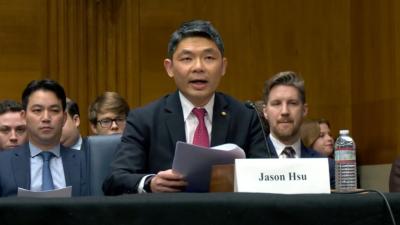
If China chose to invade Taiwan tomorrow, it would only have to sever three undersea fiber-optic cable clusters to cause a data blackout, Jason Hsu (許毓仁), a senior fellow at the Hudson Institute and former Chinese Nationalist Party (KMT) legislator, told a US security panel yesterday. In a Taiwan contingency, cable disruption would be one of the earliest preinvasion actions and the signal that escalation had begun, he said, adding that Taiwan’s current cable repair capabilities are insufficient. The US-China Economic and Security Review Commission (USCC) yesterday held a hearing on US-China Competition Under the Sea, with Hsu speaking on


 RSS
RSS