


The Taiwan Railways Administration (TRA) yesterday said it would raise the overall availability of its equipment to improve train punctuality.
The railway operator issued the statement after the Chinese-language United Daily News published an investigative report on the punctuality rate of TRA trains, saying that the high-speed rail system and the Taipei Mass Rapid Transit (MRT) system are more punctual.
The TRA plans to maintain its average train punctuality rate, which is 94 percent, Transportation Department chief Chang Ching-song (張錦松) said, adding that its rate in May was 91.3 percent, up from 87.9 percent in October last year.
“The TRA is not a closed railway system, but is subject to external factors, such as vehicles and pedestrians trespassing on railway crossings. Another critical factor is the overall availability of equipment, including train carriages and signals,” Chang said, referring to factors affecting train punctuality.
Delays are caused by malfunctions — train carriages (18.1 percent), signals (14.9 percent), electric cables (9.4 percent), automatic train protection (ATP) systems (6.5 percent) and railway tracks (0.8 percent) — as well as natural disasters (14.5 percent), derailments (12.5 percent), construction or other reasons requiring reduced speeds (10 percent), deaths and injuries caused by vehicles and pedestrians trespassing on railway crossings (9.4 percent) and objects blocking tracks (3.9 percent), Chang said, citing TRA statistics.
Malfunctions of train carriages, signals, electric cables, ATP systems and railway tracks account for nearly 50 percent of delays, he added.
The TRA is implementing a six-year safe railway plan to improve the train punctuality rate, as well as buying 600 carriages for intercity trains and 520 carriages for local trains, Chang said, adding that the changes would upgrade the TRA’s equipment.
“We will revise the training manuals and augment the technical training for maintenance workers, standardize maintenance procedures and review the purchasing procedures for train components,” he said.
Chang said that as construction can also cause trains to slow down, the TRA would monitor building projects to ensure that there were no construction delays.
The maximum speed allowed for sections of track undergoing construction would be raised occasionally to minimize the effects on train operations, he said.
The TRA installed its train timetable on computers, which allows it to run simulations and store more data, Chang said, adding that the timetable is also linked to the TRA’s new ticketing system, which allows it to analyze demand.
The TRA in 2014 launched an awareness campaign in stations to encourage waiting passengers to yield to alighting passengers, which helped speed up the boarding process, Chang said, adding that 69 train stations have lines drawn on the platforms to show where to line up before boarding.
Slope monitors and alert systems have been installed in high-risk sections and drills are conducted to increase the TRA’s ability to respond to emergency situations, Chang added.
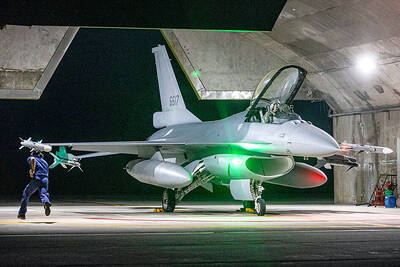
Taiwan has received more than US$70 million in royalties as of the end of last year from developing the F-16V jet as countries worldwide purchase or upgrade to this popular model, government and military officials said on Saturday. Taiwan funded the development of the F-16V jet and ended up the sole investor as other countries withdrew from the program. Now the F-16V is increasingly popular and countries must pay Taiwan a percentage in royalties when they purchase new F-16V aircraft or upgrade older F-16 models. The next five years are expected to be the peak for these royalties, with Taiwan potentially earning
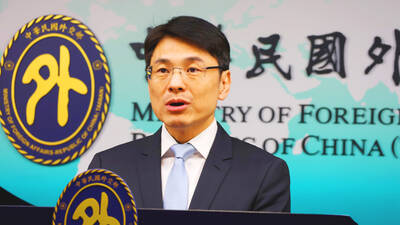
STAY IN YOUR LANE: As the US and Israel attack Iran, the ministry has warned China not to overstep by including Taiwanese citizens in its evacuation orders The Ministry of Foreign Affairs (MOFA) yesterday rebuked a statement by China’s embassy in Israel that it would evacuate Taiwanese holders of Chinese travel documents from Israel amid the latter’s escalating conflict with Iran. Tensions have risen across the Middle East in the wake of US and Israeli airstrikes on Iran beginning Saturday. China subsequently issued an evacuation notice for its citizens. In a news release, the Chinese embassy in Israel said holders of “Taiwan compatriot permits (台胞證)” issued to Taiwanese nationals by Chinese authorities for travel to China — could register for evacuation to Egypt. In Taipei, the ministry yesterday said Taiwan
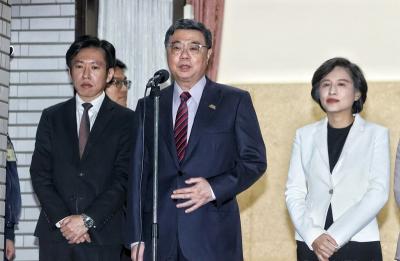
Taiwan is awaiting official notification from the US regarding the status of the Agreement on Reciprocal Trade (ART) after the US Supreme Court ruled US President Donald Trump's global tariffs unconstitutional. Speaking to reporters before a legislative hearing today, Premier Cho Jung-tai (卓榮泰) said that Taiwan's negotiation team remains focused on ensuring that the bilateral trade deal remains intact despite the legal challenge to Trump's tariff policy. "The US has pledged to notify its trade partners once the subsequent administrative and legal processes are finalized, and that certainly includes Taiwan," Cho said when asked about opposition parties’ doubts that the ART was
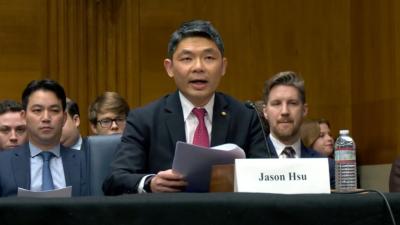
If China chose to invade Taiwan tomorrow, it would only have to sever three undersea fiber-optic cable clusters to cause a data blackout, Jason Hsu (許毓仁), a senior fellow at the Hudson Institute and former Chinese Nationalist Party (KMT) legislator, told a US security panel yesterday. In a Taiwan contingency, cable disruption would be one of the earliest preinvasion actions and the signal that escalation had begun, he said, adding that Taiwan’s current cable repair capabilities are insufficient. The US-China Economic and Security Review Commission (USCC) yesterday held a hearing on US-China Competition Under the Sea, with Hsu speaking on


 RSS
RSS