


Law enforcement officials yesterday said that Chen Hung-tsung (陳宏宗), a wanted fugitive, was killed in a gunfight in a rural area in Chiayi County after he refused to surrender to police.
An initial assessment of Chen’s body showed that he sustained two bullet wounds, with a fatal wound to the head and another to the left calf, Criminal Investigation Bureau (CIB) Deputy Commissioner Chu Tsung-tai (朱宗泰) said.
Chen, 58, remained in hiding for three years, and was considered dangerous after being listed as a wanted criminal for illegal firearms possession and attempted murder.
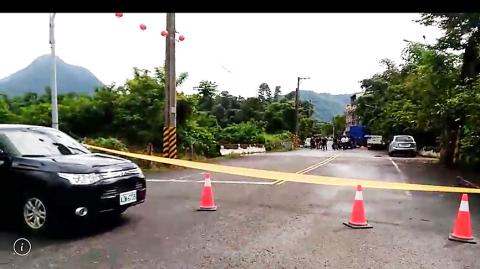
Photo copied by Tsai Tsung-hsun, Taipei Times
He was involved in a shooting in 2016 in Yunlin County and in 2017 fired at Tainan County police officers.
Police tracked down Chen’s movements and followed him to a mountain road in Chiayi’s Dapu Township (大埔), Chu said.
When ordered to surrender, Chen fired three shots from his handgun and police officers returned fire with three shots, Chu told a news conference.
The officers from the National Police Agency Special Operations Group pulled Chen out of his vehicle and put handcuffs on him as he struggled, despite bleeding from his head, he said.
However, Chen had lost all vital signs when paramedics arrived 10 minutes later, he added.
One of the bullets fired by Chen penetrated a police cruiser’s windshield and scraped the driver’s forehead, while the other two bullets hit another officer’s protective shield, Chu said.
Police found two modified handguns with 27 bullets in Chen’s vehicle, he said.
Officers from the CIB’s Sixth Brigade over the past few months traced Chen’s movements in the mountainous areas in southern Taiwan, where he reportedly hid in several locations stocked with provisions and had accomplices helping him.
The officers decided to follow Chen after learning that he would drive to Dapu area yesterday morning.
The Sixth Brigade and the Special Operations Group led the operation, with police units from Chiayi, Tainan and Yunlin counties providing backup for a total of 36 officers in police cruisers and two police trucks, Chu said.
An autopsy was being performed on Chen’s body as of press time last night to determine whether he was killed by a police bullet or had committed suicide to avoid capture.
Police also took in a man for questioning on suspicion of helping Chen run supplies and get in contact with the outside.
In related news, Tainan prosecutors on Tuesday dropped charges against police officer Yen Li-cheng (顏利丞) in the shooting death last year of a wanted criminal who ignored Yen’s order to stop and hit two other officers with his vehicle.
Yen, 23, fired four shots into the vehicle driven by Weng Kuo-ming (翁國銘), 55, on April 16 in Tainan, fatally wounding him in the chest.
Weng’s family accused Yen of using excessive force and filed a case against him on charges of professional negligence leading to death.
Prosecutors on Tuesday said that the officers were performing their duty to arrest Weng, who had a criminal record for burglary, involvement in narcotic drugs and gang-related activities.
Yen opened fire to save a fellow officer’s life who was caught in a door of Weng’s vehicle and was being dragged away, they said.
The officers had shown their police IDs to Weng to question him, but he ignored them discharging their duties and attempted to flee, the prosecutors said.
Yen had reasons to fire to stop Weng’s vehicle, as he posed a serious risk of causing injury or death to other police officers and passersby, they said.
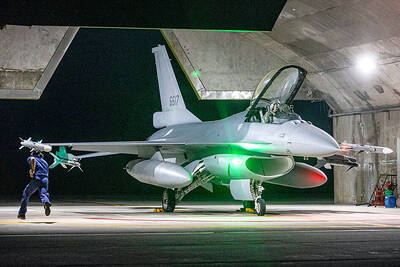
Taiwan has received more than US$70 million in royalties as of the end of last year from developing the F-16V jet as countries worldwide purchase or upgrade to this popular model, government and military officials said on Saturday. Taiwan funded the development of the F-16V jet and ended up the sole investor as other countries withdrew from the program. Now the F-16V is increasingly popular and countries must pay Taiwan a percentage in royalties when they purchase new F-16V aircraft or upgrade older F-16 models. The next five years are expected to be the peak for these royalties, with Taiwan potentially earning
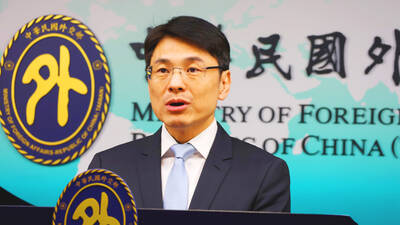
STAY IN YOUR LANE: As the US and Israel attack Iran, the ministry has warned China not to overstep by including Taiwanese citizens in its evacuation orders The Ministry of Foreign Affairs (MOFA) yesterday rebuked a statement by China’s embassy in Israel that it would evacuate Taiwanese holders of Chinese travel documents from Israel amid the latter’s escalating conflict with Iran. Tensions have risen across the Middle East in the wake of US and Israeli airstrikes on Iran beginning Saturday. China subsequently issued an evacuation notice for its citizens. In a news release, the Chinese embassy in Israel said holders of “Taiwan compatriot permits (台胞證)” issued to Taiwanese nationals by Chinese authorities for travel to China — could register for evacuation to Egypt. In Taipei, the ministry yesterday said Taiwan
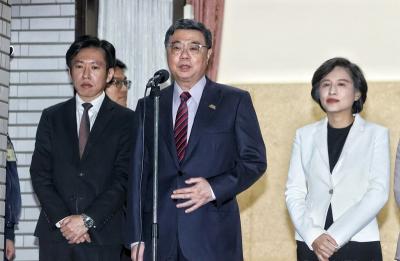
Taiwan is awaiting official notification from the US regarding the status of the Agreement on Reciprocal Trade (ART) after the US Supreme Court ruled US President Donald Trump's global tariffs unconstitutional. Speaking to reporters before a legislative hearing today, Premier Cho Jung-tai (卓榮泰) said that Taiwan's negotiation team remains focused on ensuring that the bilateral trade deal remains intact despite the legal challenge to Trump's tariff policy. "The US has pledged to notify its trade partners once the subsequent administrative and legal processes are finalized, and that certainly includes Taiwan," Cho said when asked about opposition parties’ doubts that the ART was
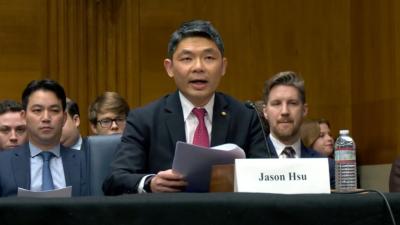
If China chose to invade Taiwan tomorrow, it would only have to sever three undersea fiber-optic cable clusters to cause a data blackout, Jason Hsu (許毓仁), a senior fellow at the Hudson Institute and former Chinese Nationalist Party (KMT) legislator, told a US security panel yesterday. In a Taiwan contingency, cable disruption would be one of the earliest preinvasion actions and the signal that escalation had begun, he said, adding that Taiwan’s current cable repair capabilities are insufficient. The US-China Economic and Security Review Commission (USCC) yesterday held a hearing on US-China Competition Under the Sea, with Hsu speaking on


 RSS
RSS