


Actress Patty Wu (吳可熙) has never been raped by an all-powerful movie mogul — as happens in her striking new movie at the Cannes Film Festival — but the Taiwanese star knows what it is to be humiliated by a director drunk on his own power.
She said she would never forget being repeatedly slapped in the face during the shoot for an advertisement for a mahjong video game early in her career.
Wu was publicly punished for having the temerity to ask the director a question.

Photo courtesy of Seashore Image Productions
“I just wanted to know whether a shot would be a closeup or in long shot so I could prepare myself,” the actress said in Cannes, France, where Nina Wu (灼人祕密) — which she wrote and stars in — is in the official section.
“The director asked the whole crew to collect all the banknotes they were using in the advert and to bring to him. He made a fan out of them. Then he asked another actor to slap me in the face with them about 30 times,” she said. “It went on and on, him shooting it all in closeup. Everyone was shocked. This wasn’t in the script.”
It was a punishment for speaking out of turn, Wu said.
Hers was only a bit part and “someone who is so low-class didn’t have the right to ask a question,” she said. “For the rest of the shoot everyone was stunned.”
Then an odd thing happened. Wu, 36, noticed that the crew began shunning her.
“They had to choose which side they were going to be on I guess, and nobody wants to get fired,” she said.
“So they started bullying me too. After that experience I went home and for two weeks I had flashbacks of being slapped in the face,” Wu said.
“I had nightmares and the director’s voice was in my head all the time. I would experience this humiliation over and over again. I would open the fridge to get something, but I wasn’t there. I was on the set getting slapped. I wanted to cry all the time,” she said.
“She had a kind of PTSD [post-traumatic stress disorder],” said the film’s Myanmar-born director Chao Te-yin (趙德胤), better known as Midi Z, with whom Wu has worked on the acclaimed Ice Poison and The Road to Mandalay.
“What happened to me was not very serious,” the actress added, but it got her thinking: “What would women or men who suffer really bad things go through?”
The specter of Harvey Weinstein hangs heavily over the film, the story of a failing actress so desperate to grab her one chance of fame that she is prepared to put herself through anything.
Wu, who began as a hip-hop dancer and endured “some crazy years” before her own career took off, started writing the film after the Hollywood mogul’s fall.
As scandal after scandal broke in Hollywood, South Korea and Japan, “I kept wondering what happened in those rooms. I was so shocked and curious,” she said.
One of Taiwan’s most acclaimed directors, Chang Tso-chi (張作驥), was already behind bars for raping a scriptwriter, and in February, another major industry player, actor-director Doze Niu (鈕承澤), was charged with sexual assault.
However, it was the appalling cases of a series of South Korean actress that really haunted Wu. In particular that of Jang Ja-yeon, whose suicide in 2009 after she was abused by the head of her studio was initially covered up.
What chilled Wu was that some actresses were attempting suicide 10 years or more after being abused.
“You would think that surely when the thing is finished that would be it, but no, it went on tormenting them for all those years — that’s the thing with PTSD — and that’s what made them decide to kill themselves such a long time after,” she said.
Chao said Asia’s film industry is probably no better or worse in terms of abuse than anywhere else.
“People tend to be polite,” yet if something did happen, there is not much of a culture of speaking out, he said.
“This is not based on anybody — it is a fiction, a drama — but the feelings are real,” he said. “I wanted the audience to be right in the character’s head and to feel what she does, all the subtle sounds like the [film producer’s] boiling kettle that stick in people’s heads.”
“If that freaks people out, then I’m happy,” he added.
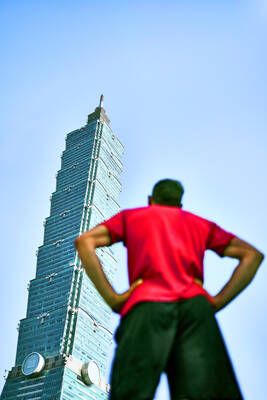
US climber Alex Honnold is to attempt to scale Taipei 101 without a rope and harness in a live Netflix special on Jan. 24, the streaming platform announced on Wednesday. Accounting for the time difference, the two-hour broadcast of Honnold’s climb, called Skyscraper Live, is to air on Jan. 23 in the US, Netflix said in a statement. Honnold, 40, was the first person ever to free solo climb the 900m El Capitan rock formation in Yosemite National Park — a feat that was recorded and later made into the 2018 documentary film Free Solo. Netflix previewed Skyscraper Live in October, after videos

Starting on Jan. 1, YouBike riders must have insurance to use the service, and a six-month trial of NT$5 coupons under certain conditions would be implemented to balance bike shortages, a joint statement from transportation departments across Taipei, New Taipei City and Taoyuan announced yesterday. The rental bike system operator said that coupons would be offered to riders to rent bikes from full stations, for riders who take out an electric-assisted bike from a full station, and for riders who return a bike to an empty station. All riders with YouBike accounts are automatically eligible for the program, and each membership account

A classified Pentagon-produced, multiyear assessment — the Overmatch brief — highlighted unreported Chinese capabilities to destroy US military assets and identified US supply chain choke points, painting a disturbing picture of waning US military might, a New York Times editorial published on Monday said. US Secretary of Defense Pete Hegseth’s comments in November last year that “we lose every time” in Pentagon-conducted war games pitting the US against China further highlighted the uncertainty about the US’ capability to intervene in the event of a Chinese invasion of Taiwan. “It shows the Pentagon’s overreliance on expensive, vulnerable weapons as adversaries field cheap, technologically
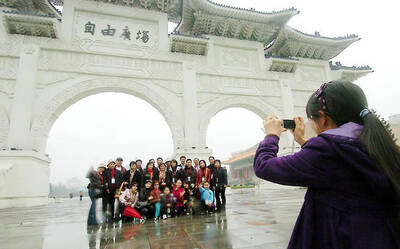
NUMBERs IMBALANCE: More than 4 million Taiwanese have visited China this year, while only about half a million Chinese have visited here Beijing has yet to respond to Taiwan’s requests for negotiation over matters related to the recovery of cross-strait tourism, the Tourism Administration said yesterday. Taiwan’s tourism authority issued the statement after Chinese-language daily the China Times reported yesterday that the government’s policy of banning group tours to China does not stop Taiwanese from visiting the country. As of October, more than 4.2 million had traveled to China this year, exceeding last year. Beijing estimated the number of Taiwanese tourists in China could reach 4.5 million this year. By contrast, only 500,000 Chinese tourists are expected in Taiwan, the report said. The report


 RSS
RSS