

Artificial intelligence (AI) research is changing focus from the quantity to the quality of data, Minister of Science and Technology Chen Liang-gee (陳良基) said yesterday.
Chen made the remarks at a news conference in Taipei, where the team leaders of the Taiwanese exhibitors who attended the CES gadget show in Las Vegas, Nevada, earlier this month shared their experience of pitching their products.
It was the second time that the ministry has led a delegation to the show and some of the exhibitors received purchase orders totaling NT$5.5 billion (US$178 million), NT2.5 billion more than last year, Chen said.
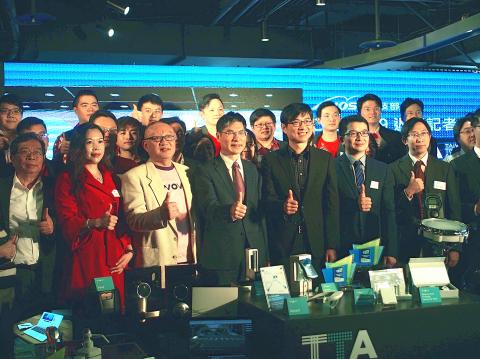
Photo: Chien Hui-ju, Taipei Times
Ten of the nation’s 44 exhibitors were academic groups, he said, adding that some of them have founded their own firms or plan to, which proves that entrepreneurship is booming in local academia and basic research breakthroughs pave the way for industry.
While the ministry last year set up AI research centers at four universities, it withdrew funding for six of the 66 research teams, as they failed to meet their own development goals, he said, adding that the funding has been redirected to 20 humanities and data science research teams.
Instead of collecting as much big data as possible, many researchers say that the key to AI technology is more in-depth analysis of smaller volumes of data, Chen said.
Ganzin Technology (見臻科技) founder Chien Shao-yi (簡韶逸), who is also a professor at National Taiwan University’s Department of Electrical Engineering, has developed an eye-tracking module that is small enough to be installed on eyeglasses.
Reuters selected the device as one of the best inventions at this year’s CES, he said.
Students are better motivated to do research when they are engaged in the development of new ideas, Chien said, encouraging start-ups to explore uncharted territory.
National Chiao Tung University biological science associate professor Chen Wen-liang (陳文亮), who developed a crop management system called AgriTalk with his students, said that Japanese, Singaporean and German developers have shown an interest in their system, and they plan to found a firm later this year.
Educators should be able to ignite a passion for learning in their students, Chen Wen-liang said, adding that he would leave the firm for his students to run once its operations stabilize.

The National Police Agency’s Third Special Police Corps yesterday said that from May to July, it intercepted five smuggling operations from China, seizing more than 70,000 counterfeit Beyblades with an estimated infringement value of NT$34.45 million (US$1.08 million). It added that any bootleg unit that reached the local market could present hidden health hazards to players. Beyblades, a line of spinning toy tops used in competitive gaming and developed in Japan by toy company Takara Tomy, have become popular in Taiwan, making them a target for fraudsters. The Third Special Police Corps, dedicated to safeguarding maritime borders and trade lines,
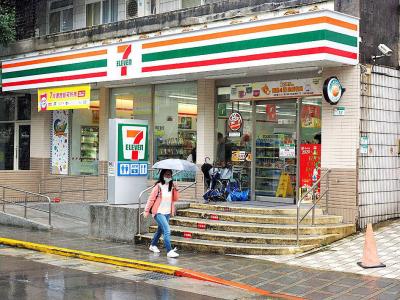
Five customers who made purchases at 7-Eleven stores across Taiwan won the top NT$10 million (US$313,716) special prize in the July-August uniform invoice lottery, including one who spent just NT$27 on photocopying, the convenience store chain said today. The five special prize winners made their purchases at stores in Taoyuan, Taipei, Taichung and Kaohsiung, 7-Eleven operator President Chain Store Corp said. The five winning purchases included NT$29 spent on snacks at a store in Taoyuan's Zhongli District (中壢), NT$27 on photocopying at a store in Taipei's Zhongzheng District (中正), NT$139 on City Cafe coffee and daily necessities at a store in Taipei's
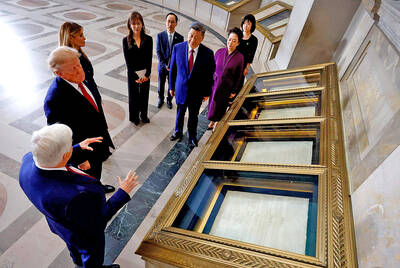
Chinese President Xi Jinping (習近平) reportedly cut short his visit to the National Archives in Washington after the Chinese delegation objected to plans to view the Treaty of San Francisco, sources in Washington’s media circles said. Xi and his wife, Peng Liyuan (彭麗媛), concluded their three-day state visit to the US on Friday after having tea with US President Donald Trump and first lady Melania Trump at the White House and visiting the archives. Chinese democracy advocates and members of pro-China groups gathered outside the venue during Xi’s visit, with the two groups exchanging competing slogans while police kept them separated. The US
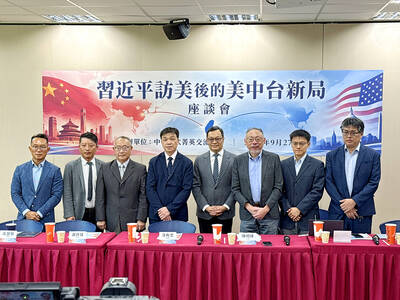
TRICKY ISSUE: Taiwan’s defense of the ROC in WWII could conflict with the government’s narrative on Taiwanese history and identity, an academic said Chinese President Xi Jinping (習近平) had no standing to discuss US-China relations in World War II (WWII), as the People’s Republic of China did not exist at that time, Mainland Affairs Council (MAC) Deputy Minister Shen Yu-chung (沈有忠) said yesterday. Taipei would ensure that Washington has a clear understanding that it was the Republic of China (ROC), not the People’s Republic of China (PRC), that was a steadfast ally of the US in WWII, Shen said. Shen was referring to a White House fact sheet released on Friday about Xi’s meeting with US President Donald Trump in Washington. It said that “the two


 RSS
RSS