


Emboldened by its triumph at the polls last month, the Chinese Nationalist Party (KMT) caucus yesterday said that the party “does not rule out” initiating referendums to repeal the Transitional Justice Commission in the 2020 presidential election.
The commission on Monday recommended that public institutions remove statues, portraits and other likeness of Chiang Kai-shek (蔣介石), including those displayed in military bases and on banknotes and coinage.
Lashing out at the commission, KMT lawmakers accused the Executive Yuan agency of vindictiveness and illegitimacy.
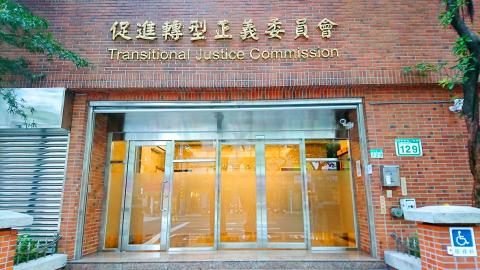
Photo: Chen Yu-fu, Taipei Times
KMT Legislator Alex Fai (費鴻泰) said he is organizing referendums coinciding with the presidential election that would repeal the Act on Promoting Transitional Justice (促進轉型正義條例) and the commission.
Commission Acting Chairwoman “Yang Tsui (楊翠) is filled with hate,” he said, adding that her brand of transitional justice is an excuse for revenge and the commission is an unconstitutional organization that breaches the separation of powers and fails to follow due process.
Yang is the granddaughter of Yang Kui (楊逵), a prominent novelist jailed for 12 years for publishing “The Declaration of Peace” in 1949, in which he called for freedom of speech and urged the government to free political prisoners.
Fai said the KMT’s criticism of the commission is supported by evidence, with then-deputy chairman Chang Tien-chin (張天欽) referring to the commission as Dong Chang (東廠), a Ming Dynasty secret police and spy agency, during a closed-door meeting.
“The KMT cannot bear to see the nation being torn apart by the constant political strife and neglect of economic development,” he said.
The caucus demanded a complete overhaul of the commission before resuming its work, and that the central bank follow an April 2 resolution by the legislature’s Finance Committee to report to the committee on proposed changes to banknotes before talking to the commission.
The commission would not have any credibility until it is reconstituted, KMT caucus secretary-general William Tseng (曾銘宗) said.
KMT Legislator Lai Shyh-bao (賴士葆) said he would propose amendments to three laws — the transitional justice act, the February 28 Incident Disposition and Compensation Act (22八事件處理及賠償條例) and the Archives Act (檔案法) — which if passed would repeal the commission, but the work to compensate victims and identify perpetrators would continue.
“Taiwanese want economic development,” Lai said.
“Yang is still living in the old days of political conflict. She should have mercy on the public,” he said.
The KMT represents the will of the people, who do not want the transitional justice commission, he said, adding that the commission’s recommendation should be “trashed.”
The Legislative Yuan’s Procedure Committee yesterday unanimously put into motion the transitional justice repeal bill, putting the proposal on the agenda of the Judiciary and Organic Laws and Statutes Committee as early as next week.
The bill was sponsored by 24 KMT lawmakers, including Lai, who said during deliberations that the constitutionality of the transitional justice act is controversial and accused the commission of doing hatchet jobs for the Democratic Progressive Party (DPP).
Repealing the law is in the interest of maintaining the credibility of the government and reining in abuses of authority, he said.
Criticizing the KMT’s action, New Power Party Legislator Hsu Yung-ming (徐永明) said: “The KMT should not let its election win go to its head.”
The KMT had supported the transitional justice act, Hsu added.
“We are not going to put up with this attitude,” he said.
DDP whip Ker Chien-ming (柯建銘) said that KMT lawmakers are within their rights to submit bills, but they should not expect cooperation from the DPP.
Additional reporting by Peng Wan-hsin

AGING: While Japan has 22 submarines, Taiwan only operates four, two of which were commissioned by the US in 1945 and 1946, and transferred to Taiwan in 1973 Taiwan would need at least 12 submarines to reach modern fleet capabilities, CSBC Corp, Taiwan chairman Chen Cheng-hung (陳政宏) said in an interview broadcast on Friday, citing a US assessment. CSBC is testing the nation’s first indigenous defense submarine, the Hai Kun (海鯤, Narwhal), which is scheduled to be delivered to the navy next month or in July. The Hai Kun has completed torpedo-firing tests and is scheduled to undergo overnight sea trials, Chen said on an SET TV military affairs program. Taiwan would require at least 12 submarines to establish a modern submarine force after assessing the nation’s operational environment and defense

A white king snake that frightened passengers and caused a stir on a Taipei MRT train on Friday evening has been claimed by its owner, who would be fined, Taipei Rapid Transit Corp (TRTC) said yesterday. A person on Threads posted that he thought he was lucky to find an empty row of seats on Friday after boarding a train on the Bannan (Blue) Line, only to spot a white snake with black stripes after sitting down. Startled, he jumped up, he wrote, describing the encounter as “terrifying.” “Taipei’s rat control plan: Release snakes on the metro,” one person wrote in reply, referring

The coast guard today said that it had disrupted "illegal" operations by a Chinese research ship in waters close to the nation and driven it away, part of what Taipei sees a provocative pattern of China's stepped up maritime activities. The coast guard said that it on Thursday last week detected the Chinese ship Tongji (同濟號), which was commissioned only last year, 29 nautical miles (54km) southeast of the southern tip of Taiwan, although just outside restricted waters. The ship was observed lowering ropes into the water, suspected to be the deployment of scientific instruments for "illegal" survey operations, and the coast
Taiwan’s two cases of hantavirus so far this year are on par with previous years’ case numbers, and the government is coordinating rat extermination work, so there should not be any outbreaks, Centers for Disease Control (CDC) Director-General Philip Lo (羅一鈞) said today in an interview with the Liberty Times (the Taipei Times’ sister newspaper). An increase in rat sightings in Taipei and New Taipei City has raised concerns about the spread of hantavirus, as rats can carry the disease. In January, a man in his 70s who lived in Taipei’s Daan District (大安) tested positive posthumously for hantavirus, Taiwan’s


 RSS
RSS