


Researchers yesterday said that they have identified a bacterium extracted from medicinal mushrooms that might help prevent diet-induced obesity and inflammation-related diseases.
The team led by Chang Gung University professor Lai Hsin-chih (賴信志) found that Parabacteroides goldsteinii, which exists in limited quantities in the human digestive track, proliferates in lingzhi mushrooms and Ophiocordyceps sinensis due to their polysaccharides, Lai told a news conference at the Ministry of Science and Technology in Taipei.
“I began to study Chinese herbal medicines about 10 years ago after I attended many seminars in Western countries and realized that it was an almost uncharted research territory,” Lai said.
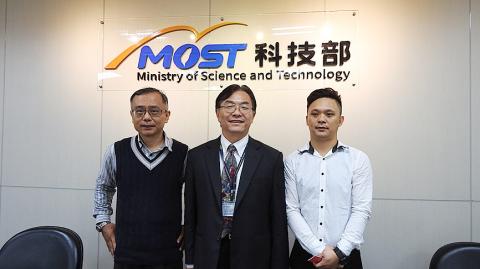
Photo courtesy of the Ministry of Science and Technology
The conditions of the gastrointestinal microbiome — the ensemble of microorganisms in the intestines — are related to metabolic disorders such as obesity, respiratory tract diseases and inflammation-related diseases such as dementia and depression, he said.
Using mice on high-fat diets for their experiments, Lai’s team found that P goldsteinii can effectively curb weight gain by 20 to 30 percent, saying that the mice did not develop any inflammation after taking the probiotic.
As it is conducive to the development of precision medicine, the bacterium can be used to make health foods, Lai said, adding that more time might be needed to make medicines.
The team has applied for a patent for the probiotic and plans to begin human testing and to seek collaboration with domestic biotechnology firms, whose larger fermentation tanks could help with cultivation of the bacteria, he said.
The team’s work on lingzhi mushrooms was published in 2015, while a study on O sinensis by Wu Tsung-ru (吳宗儒), who was Lai’s student and is now a postdoctoral fellow at Academia Sinica’s Institute of Biomedical Sciencies, was published in the journal Gut in July.
The researchers have a “geographical advantage” to conduct their work, as the fungi are mostly found in Asia, Wu said, adding that other scientists might have different results if they experiment with other fungi.
In addition to helping people lose weight, the findings should be regarded as a “platform” to guide other researchers in identifying new dietary supplements to treat brain-related disorders, such as dementia, ministry Department of Life Sciences Director-General Chuang Woei-jer (莊偉哲) said.

Considering that most countries issue more than five denominations of banknotes, the central bank has decided to redesign all five denominations, the bank said as it prepares for the first major overhaul of the banknotes in more than 24 years. Central bank Governor Yang Chin-lung (楊金龍) is expected to report to the Legislative Yuan today on the bank’s operations and the redesign’s progress. The bank in a report sent to the legislature ahead of today’s meeting said it had commissioned a survey on the public’s preferences. Survey results showed that NT$100 and NT$1,000 banknotes are the most commonly used, while NT$200 and NT$2,000

The Centers for Disease Control (CDC) yesterday reported the first case of a new COVID-19 subvariant — BA.3.2 — in a 10-year-old Singaporean girl who had a fever upon arrival in Taiwan and tested positive for the disease. The girl left Taiwan on March 20 and the case did not have a direct impact on the local community, it said. The WHO added the BA.3.2 strain to its list of Variants Under Monitoring in December last year, but this was the first imported case of the COVID-19 variant in Taiwan, CDC Deputy Director-General Lin Ming-cheng (林明誠) said. The girl arrived in Taiwan on

South Korea is planning to revise its controversial electronic arrival card, a step Taiwanese officials said prompted them to hold off on planned retaliatory measures, a South Korean media report said yesterday. A Yonhap News Agency report said that the South Korean Ministry of Foreign Affairs is planning to remove the “previous departure place” and “next destination” fields from its e-arrival card system. The plan, reached after interagency consultations, is under review and aims to simplify entry procedures and align the electronic form with the paper version, a South Korean ministry official said. The fields — which appeared only on the electronic form

The Ministry of Foreign Affairs (MOFA) is suspending retaliation measures against South Korea that were set to take effect tomorrow, after Seoul said it is updating its e-arrival system, MOFA said today. The measures were to be a new round of retaliation after Taiwan on March 1 changed South Korea's designation on government-issued alien resident certificates held by South Korean nationals to "South Korea” from the "Republic of Korea," the country’s official name. The move came after months of protests to Seoul over its listing of Taiwan as "China (Taiwan)" in dropdown menus on its new online immigration entry system. MOFA last week


 RSS
RSS