


The Supreme Administrative Court on Thursday upheld the heritage status of an old movie theater in Changhua County, ending a three-year legal battle between the county’s Cultural Affairs Bureau and the Peitou Township Office, which had sought to build on the site.
“Although Peitou (北斗) is a historied township, the town’s former class 3 heritage site, the Tienan Temple, was demolished. If the old theater was also demolished, the culture, history and shared memory of Peitou residents would utterly vanish,” the court said in its ruling.
The Far Eastern Theater is 65 years old and was built on land that was once the private gardens of a clan of local gentry surnamed Hsu (許).
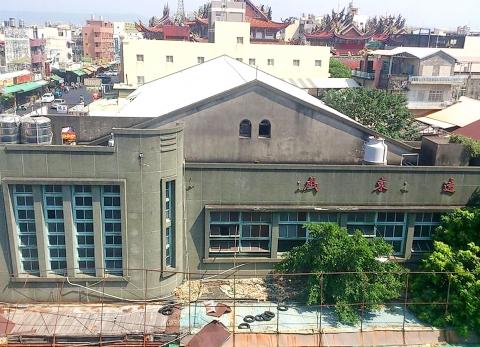
Photo courtesy of the Peitou Township Office
Hsu Tsung-lung (許從龍) built the township’s private academy, the Magpie House (鵲館), in the ancestral garden after passing Qing imperial exams as a xiucai (秀才) civil servant. It played an important role in educating local elites.
In 1895, Prince Kitashirakawa Yoshihisa quartered Japanese troops at Magpie House during the First Sino-Japanese War, turning the academy into the seat of the regional colonial government.
After World War II, Magpie House became a township memorial park and the township office built the Far Eastern Theater on the site in 1956. The project was 20 percent funded by the township and the remainder was funded by private investors.
For a time, the Far Eastern Theater was the only cinema in the county, but closed its doors in 1997 due to a decline in the movie theater industry.
In response to the township’s plan to knock down the theater for redevelopment, locals in 2014 applied for the site to be awarded heritage status, which the bureau granted two years later.
Disagreeing with the bureau’s decision, the Peitou Township Office that year filed an administrative lawsuit and gathered 10,000 signatures for a petition against the theater’s preservation.
During the first trial, the High Administrative Court ruled against the township and the Supreme Administrative Court dismissed the township’s appeal during the second trial.
The township filed its last appeal in February.
In court documents, the township said that a fire had destroyed much of the theater’s interior and there is nothing special about it, as it is a concrete-and-pebble-finish structure.
The Hsu garden and academy no longer exist. Had they survived, the privately owned structures were not connected to prominent historical figures and therefore held no special significance, it said.
The Supreme Administrative Court rejected the township’s appeal, saying that it had failed to support its arguments with testimony from academics.
The courts had already stated the reasons for ruling against the township, and it did not present new factual or legal issues at the third trial, it said.
Although the Qing Dynasty estate no longer exists, the preservation of the theater as a heritage site would enable county authorities to commemorate its historical relevance, the court said.
Peitou Township Mayor Yang Li-hsiang (楊麗香) said the township has to accept the court’s judgement and the responsibility of utilizing the site now falls on the county government.
“There are no winners or losers in cultural heritage preservation,” bureau director Chou Fu-i (周馥儀) said.
The bureau is to begin deliberations on how to refurbish the theater. Options include an arts and culture center or a theater for elderly people, she said, adding that the bureau will involve the local community fully before making a decision.

Taiwan has received more than US$70 million in royalties as of the end of last year from developing the F-16V jet as countries worldwide purchase or upgrade to this popular model, government and military officials said on Saturday. Taiwan funded the development of the F-16V jet and ended up the sole investor as other countries withdrew from the program. Now the F-16V is increasingly popular and countries must pay Taiwan a percentage in royalties when they purchase new F-16V aircraft or upgrade older F-16 models. The next five years are expected to be the peak for these royalties, with Taiwan potentially earning
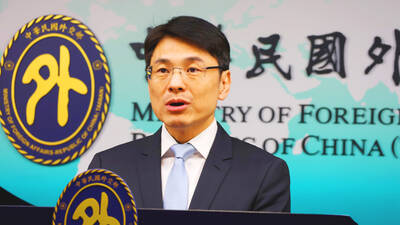
STAY IN YOUR LANE: As the US and Israel attack Iran, the ministry has warned China not to overstep by including Taiwanese citizens in its evacuation orders The Ministry of Foreign Affairs (MOFA) yesterday rebuked a statement by China’s embassy in Israel that it would evacuate Taiwanese holders of Chinese travel documents from Israel amid the latter’s escalating conflict with Iran. Tensions have risen across the Middle East in the wake of US and Israeli airstrikes on Iran beginning Saturday. China subsequently issued an evacuation notice for its citizens. In a news release, the Chinese embassy in Israel said holders of “Taiwan compatriot permits (台胞證)” issued to Taiwanese nationals by Chinese authorities for travel to China — could register for evacuation to Egypt. In Taipei, the ministry yesterday said Taiwan
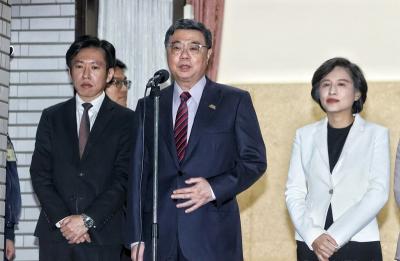
Taiwan is awaiting official notification from the US regarding the status of the Agreement on Reciprocal Trade (ART) after the US Supreme Court ruled US President Donald Trump's global tariffs unconstitutional. Speaking to reporters before a legislative hearing today, Premier Cho Jung-tai (卓榮泰) said that Taiwan's negotiation team remains focused on ensuring that the bilateral trade deal remains intact despite the legal challenge to Trump's tariff policy. "The US has pledged to notify its trade partners once the subsequent administrative and legal processes are finalized, and that certainly includes Taiwan," Cho said when asked about opposition parties’ doubts that the ART was
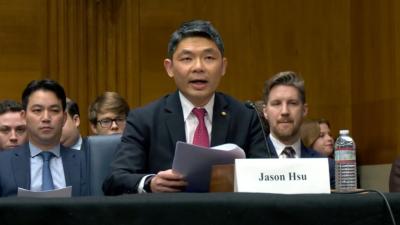
If China chose to invade Taiwan tomorrow, it would only have to sever three undersea fiber-optic cable clusters to cause a data blackout, Jason Hsu (許毓仁), a senior fellow at the Hudson Institute and former Chinese Nationalist Party (KMT) legislator, told a US security panel yesterday. In a Taiwan contingency, cable disruption would be one of the earliest preinvasion actions and the signal that escalation had begun, he said, adding that Taiwan’s current cable repair capabilities are insufficient. The US-China Economic and Security Review Commission (USCC) yesterday held a hearing on US-China Competition Under the Sea, with Hsu speaking on


 RSS
RSS