


The US Department of State on Wednesday urged Taiwan and China to engage in constructive dialogue and seek a peaceful resolution to their differences.
A spokesperson at the State Department made the statement in response to the Double Ten National Day address by President Tsai Ing-wen (蔡英文), in which she identified China’s diplomatic offensive and military coercion as a serious challenge to cross-strait peace and stability.
The US has a deep and abiding interest in cross-strait peace and stability and it is important that both sides of the Taiwan Strait understand the significance of related benefits and work to establish a basis for continued peace and stability, the spokesperson said.
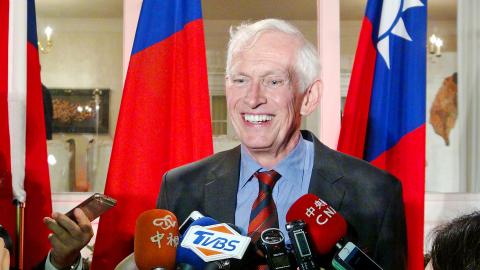
Photo: CNA
“We encourage authorities in Beijing and Taipei to engage in constructive dialogue that seeks a peaceful resolution of differences acceptable to the people of both sides of the Taiwan Strait,” the spokesperson said.
The spokesperson also quoted remarks made by US Vice President Mike Pence last week that while the US would “continue to respect the US’ ‘one China’ policy, as reflected in the three joint communiques and the Taiwan Relations Act, America will always believe Taiwan’s embrace of democracy shows a better path for all the Chinese people.”
In her speech, Tsai said China’s unilateral diplomatic offensive and military coercion have not only harmed cross-strait relations, but also seriously challenged the “status quo” of peace and stability in the Taiwan Strait.
Tsai said that the more dramatically things change, the more Taiwan has to maintain stability, remain composed to reduce pressure and calmly find its survival niche.
American Institute in Taiwan (AIT) Chairman James Moriarty said the most significant aspect of Tsai’s address was her commitment to a pragmatic and peaceful cross-strait policy.
Tsai tried to strike a very positive and yet reserved tone, a tone that could open doors, but yet indicated that Taiwan would stick to its principles, he said.
“Here is a call all the time for a constructive, creative and flexible approach” to cross-strait relations, he told reporters at a party in Washington to celebrate Double Ten National Day.
Moriarty said the US wants to see dialogue between the two sides of the Taiwan Strait and he thinks Tsai on her side is trying to do that.
“I have not seen much response yet from the other side,” he said. “I have not seen the creative, flexible [approach] that all we would like to see.”
He suggested that in a bid to facilitate or initiate dialogue with China, Taiwan should keep the door open and try to make it clear that it would welcome constructive talks.
“If we leave the door open, at some point perhaps China would be willing to go through it and start constructive dialogue,” he said, but added that neither Taiwan nor the US could predict China’s reaction.
Former AIT chairman Richard Bush said that Tsai’s remarks reflected the complex situation she is in concerning cross-strait relations, with China pushing on one side and Taiwanese political forces on the other.
“Her approach has been to try to balance these two, and her remarks reflect a continuation of that approach,” Bush said, adding that he believes the US government appreciates Tsai’s moderate and balanced approach.
Tsai’s address summarized a sensible approach not to try to exploit enhanced tensions between Washington and Beijing, which he said historically tend to inflict damage on Taipei more than the other two, former AIT director Douglas Paal said
Paal also described a possible effort outlined by Tsai to exploit opportunities in the changing supply chain world as “smart.”
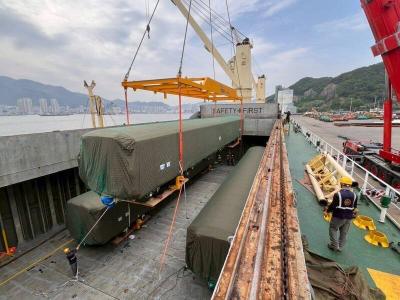
The first of 10 new high-capacity trains purchased from South Korea’s Hyundai Rotem arrived at the Port of Taipei yesterday to meet the demands of an expanding metro network, Taipei Rapid Transit Corp (TRTC) said yesterday. The train completed a three-day, 1,200km voyage from the Port of Masan in South Korea, the company said. Costing NT$590 million (US$18.79 million) each, the new six-carriage trains feature a redesigned interior based on "human-centric" transportation concepts, TRTC said. The design utilizes continuous longitudinal seating to widen the aisles and optimize passenger flow, while also upgrading passenger information displays and driving control systems for a more comfortable
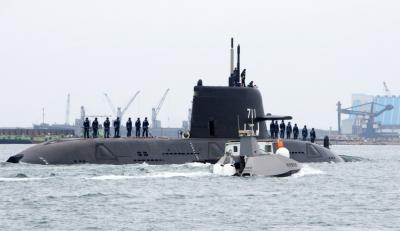
Taiwan's first indigenous defense submarine, the SS-711 Hai Kun (海鯤, or Narwhal), departed for its 13th sea trial at 7am today, marking its seventh submerged test, with delivery to the navy scheduled for July. The outing also marked its first sea deployment since President William Lai (賴清德) boarded the submarine for an inspection on March 19, drawing a crowd of military enthusiasts who gathered to show support. The submarine this morning departed port accompanied by CSBC Corp’s Endeavor Manta (奮進魔鬼魚號) uncrewed surface vessel and a navy M109 assault boat. Amid public interest in key milestones such as torpedo-launching operations and overnight submerged trials,
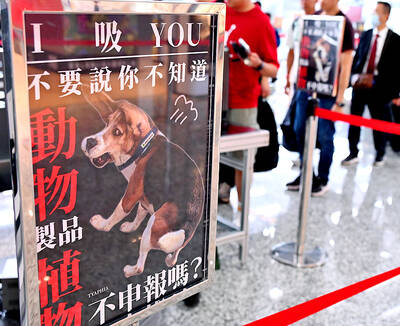
Quarantine awareness posters at Taiwan Taoyuan International Airport have gone viral for their use of wordplay. Issued by the airport branch of the Animal and Plant Health Inspection Agency, the posters feature sniffer dogs making a range of facial expressions, paired with advisory messages built around homophones. “We update the messages for holidays and campaign needs, periodically refreshing materials to attract people’s attention,” quarantine officials said. “The aim is to use the dogs’ appeal to draw focus to quarantine regulations.” A Japanese traveler visiting Taiwan has posted a photo on X of a poster showing a quarantine dog with a

Taiwan’s coffee community has launched a “one-person-one-e-mail” campaign, calling for people to send a protest-e-mail to the World Coffee Championships (WCC) urging it to redesignate Taiwanese competitors as from “Taiwan,” rather than “Chinese Taipei.” The call followed sudden action last week after the WCC changed all references to Taiwanese competitors from “Taiwan” to “Chinese Taipei,” including recent World Latte Art champion Bala (林紹興), who won the World Latte Art Championship in San Diego earlier this month. When Bala received the trophy, he was referred to as representing Taiwan, as well as in the announcement on the WCC’s Web site, until it


 RSS
RSS