


Several additions to the Patient Right to Autonomy Act (病人自主權利法) would make patients the main subject of informed consent, the Ministry of Health and Welfare announced on Wednesday
The act gives patients the right to refuse life-sustaining treatments if they are terminally ill, are in an irreversible coma or a permanent vegetative state, have advanced dementia or meet other conditions announced by authorities.
It is to be promulgated on Jan. 6 next year.

Photo: Su Chin-fong, Taipei Times
The ministry on Wednesday released the Enforcement Rules for the Patient Right to Autonomy Act (病人自主權利法施行細則) and the Regulations Governing Healthcare Facilities that Provide Advance Care Planning (提供預立醫療照護諮商之醫療機構管理辦法), which aim to complement existing rules, and clarify terms and execution requirements.
It also released a legally binding advance-decision form, or living will, which people who are still capable of making and communicating healthcare decisions could use to write down their decision in advance.
The form allows people who meet the conditions to choose four options in regard to life-sustaining treatment, artificial nutrition and hydration: accept; refuse; have a healthcare agent decide when they are unconscious or incapable of clearly expressing their will; and stopping treatment after a certain period.
The complementary regulations emphasize that any advance decision about treatment should be made with the patient’s consent, and they can decide what permissions to give different healthcare agents and in what order, Department of Medical Affairs Director-General Shih Chung-liang (石崇良) said.
An advance-decision form is to be filled out when the person is still capable of making decisions, and scanned and stored as an electronic file, he said.
The regulations clearly define the five conditions under which a living will can be drafted and stipulate that if a healthcare facility or doctor is unwilling to abide by the patient’s decision, the patient should be referred to another hospital to ensure their rights, Shih said.
The rules require local authorities to select accredited hospitals with more than 200 beds to provide advance care planning services.

The military has spotted two Chinese warships operating in waters near Penghu County in the Taiwan Strait and sent its own naval and air forces to monitor the vessels, the Ministry of National Defense (MND) said. Beijing sends warships and warplanes into the waters and skies around Taiwan on an almost daily basis, drawing condemnation from Taipei. While the ministry offers daily updates on the locations of Chinese military aircraft, it only rarely gives details of where Chinese warships are operating, generally only when it detects aircraft carriers, as happened last week. A Chinese destroyer and a frigate entered waters to the southwest

The eastern extension of the Taipei MRT Red Line could begin operations as early as late June, the Taipei Department of Rapid Transit Systems said yesterday. Taipei Rapid Transit Corp said it is considering offering one month of free rides on the new section to mark its opening. Construction progress on the 1.4km extension, which is to run from the current terminal Xiangshan Station to a new eastern terminal, Guangci/Fengtian Temple Station, was 90.6 percent complete by the end of last month, the department said in a report to the Taipei City Council's Transportation Committee. While construction began in October 2016 with an
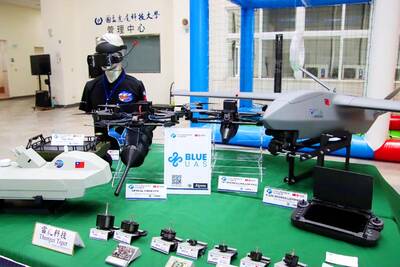
NON-RED SUPPLY: Boosting the nation’s drone industry is becoming increasingly urgent as China’s UAV dominance could become an issue in a crisis, an analyst said Taiwan’s drone exports to Europe grew 41.7-fold from 2024 to last year, with demand from Ukraine’s fight against Russian aggression the most likely driver of growth, a study showed. The Institute for Democracy, Society and Emerging Technology (DSET) in a statement on Wednesday said it found that many of Taiwan’s uncrewed aerial vehicle (UAV) sales were from Poland and the Czech Republic. These countries likely transferred the drones to Ukraine to aid it in its fight against the Russian invasion that started in 2022, it said. Despite the gains, Taiwan is not the dominant drone exporter to these markets, ranking second and fourth

Japanese Prime Minister Sanae Takaichi’s comment last year on Tokyo’s potential reaction to a Taiwan-China conflict has forced Beijing to rewrite its invasion plans, a retired Japanese general said. Takaichi told the Diet on Nov. 7 last year that a Chinese naval blockade or military attack on Taiwan could constitute a “survival-threatening situation” for Japan, potentially allowing Tokyo to exercise its right to collective self-defense. Former Japan Ground Self-Defense Force general Kiyofumi Ogawa said in a recent speech that the remark has been interpreted as meaning Japan could intervene in the early stages of a Taiwan Strait conflict, undermining China’s previous assumptions


 RSS
RSS