


Democratic nations must stand up to China in defense of democracy, as Beijing demands international companies adhere to its “one China” principle, Michael Mazza, a visiting fellow in foreign and defense policy studies at the American Enterprise Institute (AEI) think tank, said in an opinion piece published on Tuesday.
China’s demand that foreign companies outside of China follow Beijing’s political policy on Taiwan is an attack on democracy that should not be tolerated, he said in the piece, published on the Nikkei Asian Review’s Web site, titled “China’s airline censorship over Taiwan must not fly.”
Failing to counter these attacks would bring the war on democracy to the front door of the US, Japan and other like-minded nations, Mazza said.
Beijing’s pressure on Taiwan has been the result of President Tsai Ing-wen (蔡英文) refusing to discuss the cross-strait relationship in terms acceptable to Beijing — by refusing to refer to both sides of the Taiwan Strait as “one China” — and demanding that international companies to refer to Taiwan in Beijing-specified terms is one of a number of ways in which China has been trying to isolate Taiwan and push it out of the international sphere, he said.
However, criticizing companies for capitulating to China’s demands is not the solution, as companies must answer to their shareholders, Mazza said, adding that governments must do more.
Despite welcome comments from US senators and White House spokeswoman Sarah Huckabee Sanders, who called China’s demands “Orwellian nonsense” and “part of a growing trend by the Chinese Communist Party to impose its political views on American citizens and private companies,” these comments have not coincided with official US policy, he said.
Beijing knows that airlines are concerned about revenue, and in the absence of a strong official policy compelling it to back off, China will continue to pressure companies to kowtow in exchange for access to the Chinese market, he added.
China is seeking to “compel speech” in democracies around the world and there is already evidence of individuals and corporations self-censoring to stay on Beijing’s good side, Mazza said.
“Beijing seeks to shape a world that is safe for the Chinese Communist Party. Weakening foreign democracies is, perhaps, the best way to do so,” he said.
Beijing has proven that it can censor speech in the US without incurring any real cost, he said.
Beijing hopes that its actions toward foreign countries and companies on the Taiwan issue over the past two years would eventually “create a world in which Taiwan’s de facto independence is no longer appreciated and in which Beijing’s ‘one China’ principle goes unquestioned,” he said.
Such a situation would make it unlikely that a foreign power would intervene in a military conflict between China and Taiwan, as the outcome would jeopardize regional stability and affect the US’ Asia-Pacific allies, Mazza added.

SECURITY: Starlink owner Elon Musk has taken pro-Beijing positions, and allowing pro-China companies to control Taiwan’s critical infrastructure is risky, a legislator said Starlink was reluctant to offer services in Taiwan because of the nation’s extremely high penetration rates in 4G and 5G services, the Ministry of Digital Affairs said yesterday. The ministry made the comments at a meeting of the legislature’s Transportation Committee, which reviewed amendments to Article 36 of the Telecommunications Management Act (電信管理法). Article 36 bans foreigners from holding more than 49 percent of shares in public telecommunications networks, while shares foreigners directly and indirectly hold are also capped at 60 percent of the total, unless specified otherwise by law. The amendments, sponsored by Chinese Nationalist Party (KMT) Legislator Ko

The military has spotted two Chinese warships operating in waters near Penghu County in the Taiwan Strait and sent its own naval and air forces to monitor the vessels, the Ministry of National Defense (MND) said. Beijing sends warships and warplanes into the waters and skies around Taiwan on an almost daily basis, drawing condemnation from Taipei. While the ministry offers daily updates on the locations of Chinese military aircraft, it only rarely gives details of where Chinese warships are operating, generally only when it detects aircraft carriers, as happened last week. A Chinese destroyer and a frigate entered waters to the southwest
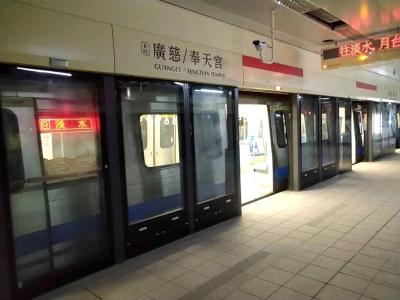
The eastern extension of the Taipei MRT Red Line could begin operations as early as late June, the Taipei Department of Rapid Transit Systems said yesterday. Taipei Rapid Transit Corp said it is considering offering one month of free rides on the new section to mark its opening. Construction progress on the 1.4km extension, which is to run from the current terminal Xiangshan Station to a new eastern terminal, Guangci/Fengtian Temple Station, was 90.6 percent complete by the end of last month, the department said in a report to the Taipei City Council's Transportation Committee. While construction began in October 2016 with an
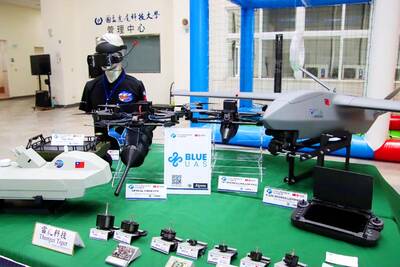
NON-RED SUPPLY: Boosting the nation’s drone industry is becoming increasingly urgent as China’s UAV dominance could become an issue in a crisis, an analyst said Taiwan’s drone exports to Europe grew 41.7-fold from 2024 to last year, with demand from Ukraine’s fight against Russian aggression the most likely driver of growth, a study showed. The Institute for Democracy, Society and Emerging Technology (DSET) in a statement on Wednesday said it found that many of Taiwan’s uncrewed aerial vehicle (UAV) sales were from Poland and the Czech Republic. These countries likely transferred the drones to Ukraine to aid it in its fight against the Russian invasion that started in 2022, it said. Despite the gains, Taiwan is not the dominant drone exporter to these markets, ranking second and fourth


 RSS
RSS