


The New Power Party (NPP) and civic group representatives yesterday called for rules requiring companies to disclose their beneficial owners and allowing minority shareholders to bring direct actions against board members ahead of a legislative review of draft amendments to the Company Act (公司法) planned for today.
While the Ministry of Economic Affairs has described the bill as an effort to meet international standards against money laundering ahead of a visit by the Asia/Pacific Group on Money Laundering (APG) in November, it could be more than that, NPP Executive Chairman Huang Kuo-chang (黃國昌) told a news conference in Taipei.
“This is an opportunity for Taiwan to build a new legal framework that is in line with global standards — one that is transparent, fair and beneficial to corporate governance, with better mechanisms to protect the rights of shareholders,” Huang said.
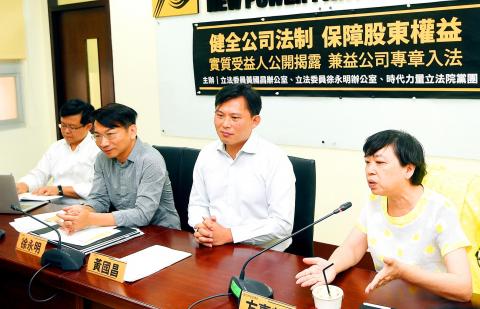
Photo: Fang Pin-chao, Taipei Times
Ensuring greater transparency about beneficial ownership is an important step toward achieving market transparency, which would allow the government to uncover illegal business operations, said National Chengchi University College of Law professor Faung Kai-lin (方嘉麟), who has been advocating reform of the act for nearly two years in cooperation with civic groups.
The Democratic Progressive Party (DPP) has refused to tighten rules on beneficial ownership, saying that it does not want to create “unnecessary trouble” for companies, but for 99 percent of companies, registering their beneficial owner would take only five seconds, he said.
“The remaining 1 percent that deliberately try to conceal their beneficial owner would complain about the additional hassle, but without greater transparency about beneficial ownership, Taiwan will probably not pass the APG evaluation,” he added
The draft amendments should also allow minority shareholders to bring direct actions against board members who have violated regulations or encroached upon their rights, National Taipei University law professor Chen Yen-liang (陳彥良) said.
That would not only improve protection of minority shareholders’ rights, but also allow them to act as watchdogs alongside independent directors, he said.
The legislature should use the opportunity of reviewing the act to push for more comprehensive reform, as such opportunities are rare, NPP caucus convener Hsu Yung-ming (徐永明) said, adding that lawmakers should not take half measures.
While the Chinese Nationalist Party (KMT) respects the NPP’s proposals, legislators must distinguish between ideals and reality, KMT caucus secretary-general Lee Yen-hsiu (李彥秀) said.
During the review, the KMT would seek a reasonable balance between government supervision and business practice, she said, urging other parties to also handle the bill with caution.
The DPP supports the draft amendments proposed by the Executive Yuan, but would make minor adjustments based on the results of cross-caucus negotiations, DPP caucus secretary-general Hsu Chih-chieh (許智傑) said.
Additional reporting by CNA

AGING: While Japan has 22 submarines, Taiwan only operates four, two of which were commissioned by the US in 1945 and 1946, and transferred to Taiwan in 1973 Taiwan would need at least 12 submarines to reach modern fleet capabilities, CSBC Corp, Taiwan chairman Chen Cheng-hung (陳政宏) said in an interview broadcast on Friday, citing a US assessment. CSBC is testing the nation’s first indigenous defense submarine, the Hai Kun (海鯤, Narwhal), which is scheduled to be delivered to the navy next month or in July. The Hai Kun has completed torpedo-firing tests and is scheduled to undergo overnight sea trials, Chen said on an SET TV military affairs program. Taiwan would require at least 12 submarines to establish a modern submarine force after assessing the nation’s operational environment and defense

A white king snake that frightened passengers and caused a stir on a Taipei MRT train on Friday evening has been claimed by its owner, who would be fined, Taipei Rapid Transit Corp (TRTC) said yesterday. A person on Threads posted that he thought he was lucky to find an empty row of seats on Friday after boarding a train on the Bannan (Blue) Line, only to spot a white snake with black stripes after sitting down. Startled, he jumped up, he wrote, describing the encounter as “terrifying.” “Taipei’s rat control plan: Release snakes on the metro,” one person wrote in reply, referring

The coast guard today said that it had disrupted "illegal" operations by a Chinese research ship in waters close to the nation and driven it away, part of what Taipei sees a provocative pattern of China's stepped up maritime activities. The coast guard said that it on Thursday last week detected the Chinese ship Tongji (同濟號), which was commissioned only last year, 29 nautical miles (54km) southeast of the southern tip of Taiwan, although just outside restricted waters. The ship was observed lowering ropes into the water, suspected to be the deployment of scientific instruments for "illegal" survey operations, and the coast
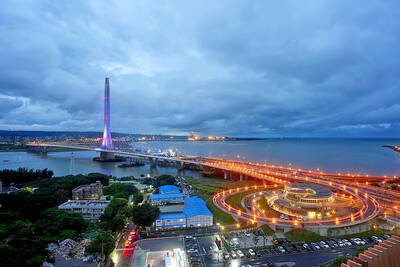
An inauguration ceremony was held yesterday for the Danjiang Bridge, the world’s longest single-mast asymmetric cable-stayed bridge, ahead of its official opening to traffic on Tuesday, marking a major milestone after nearly three decades of planning and construction. At the ceremony in New Taipei City attended by President William Lai (賴清德), Premier Cho Jung-tai (卓榮泰), Minister of Transportation and Communications Chen Shih-kai (陳世凱) and New Taipei City Mayor Hou Yu-ih (侯友宜), the bridge was hailed as both an engineering landmark and a long-awaited regional transport link connecting Tamsui (淡水) and Bali (八里)


 RSS
RSS