


A semi-official meeting between US and Chinese representatives earlier this month exposed how wide the gap is in how they gauge developments in cross-strait relations, the conference report released on Thursday showed.
During the annual Forum on Asia-Pacific Security, which is held by the National Committee on American Foreign Policy, experts from the two countries had different takes on who is responsible for the gridlock in ties between Taiwan and China over the past two years.
Several Chinese speakers at the meeting in New York on June 4 and June 5 said that the fundamental cause of rising cross-strait tensions was that President Tsai Ing-wen (蔡英文) has “damaged the political basis” of the relationship that existed under former president Ma Ying-jeou (馬英九).
China believes that the Democratic Progressive Party (DPP) is still determined to achieve formal independence, the Chinese speakers said, adding that pro-independence forces in Taiwan have become even “more brazen” of late.
US experts recommended that Beijing find a way to resume dialogue to prevent further deterioration in cross-strait relations.
However, Chinese participants said that Taiwan’s acceptance of a “constitutional one China” formula is not enough to satisfy Beijing.
Tsai will need to start by at least indicating in some way that cross-strait relations are “not state-to-state” relations, they said.
With respect to new formulas or “off-ramps” to reopen talks, they added that such negotiations would have to be conducted by unofficial, but authoritative persons through secret channels.
However, no one knows whether such channels remain, they said.
Chinese participants also said that Tsai appears unable and unwilling to re-establish cross-strait dialogue.
Tsai has been promoting formal independence not only through her words, but also through her actions, they said, citing her appointment in September last year of Premier William Lai (賴清德), who has told the Legislative Yuan that he is a “pro-independence worker.”
The Chinese also voiced concerns about the US’ deepening ties with Taiwan, including proposing measures to strengthen military cooperation and promote high-level exchanges with Taiwan.
The US is sending the wrong signal to Taiwan and emboldening its pro-independence forces, they said, adding that such actions would harm not only US-China relations, but also the interests of Taiwan.
US speakers said that Washington’s latest measures have been relatively restrained and “not as significant as China sees them.”
China’s aggressive military and diplomatic actions have strengthened the DPP’s position, they said.
Those moves include more frequent aerial and naval patrols in closer proximity to Taiwan, and pushing five of Taiwan’s diplomatic allies to switch recognition to Beijing over the past two years.
Such actions have influenced views in Taiwan, but also in the US, where they are viewed as “unreasonable” and “bullying,” US participants said.
The US sees Tsai as pragmatic and committed to maintaining the “status quo,” even though Beijing might see her as a “committed separatist,” they said.
The meeting was attended by senior officials, including US Department of State Office of Taiwan Coordination Director James Heller and China’s Taiwan Affairs Office Vice Minister Chen Yuanfeng (陳元豐).
On the non-governmental side, participants included Pacific Century Institute president Raymond Burghardt and Peking University School of International Studies dean Jia Qingguo (賈慶國).

The military has spotted two Chinese warships operating in waters near Penghu County in the Taiwan Strait and sent its own naval and air forces to monitor the vessels, the Ministry of National Defense (MND) said. Beijing sends warships and warplanes into the waters and skies around Taiwan on an almost daily basis, drawing condemnation from Taipei. While the ministry offers daily updates on the locations of Chinese military aircraft, it only rarely gives details of where Chinese warships are operating, generally only when it detects aircraft carriers, as happened last week. A Chinese destroyer and a frigate entered waters to the southwest

A magnitude 6.1 earthquake struck off the coast of Yilan County at 8:39pm tonight, the Central Weather Administration (CWA) said, with no immediate reports of damage or injuries. The epicenter was 38.7km east-northeast of Yilan County Hall at a focal depth of 98.3km, the CWA’s Seismological Center said. The quake’s maximum intensity, which gauges the actual physical effect of a seismic event, was a level 4 on Taiwan’s 7-tier intensity scale, the center said. That intensity level was recorded in Yilan County’s Nanao Township (南澳), Hsinchu County’s Guansi Township (關西), Nantou County’s Hehuanshan (合歡山) and Hualien County’s Yanliao (鹽寮). An intensity of 3 was

Instead of focusing solely on the threat of a full-scale military invasion, the US and its allies must prepare for a potential Chinese “quarantine” of Taiwan enforced through customs inspections, Stanford University Hoover fellow Eyck Freymann said in a Foreign Affairs article published on Wednesday. China could use various “gray zone” tactics in “reconfiguring the regional and ultimately the global economic order without a war,” said Freymann, who is also a nonresident research fellow at the US Naval War College. China might seize control of Taiwan’s links to the outside world by requiring all flights and ships entering or leaving Taiwan
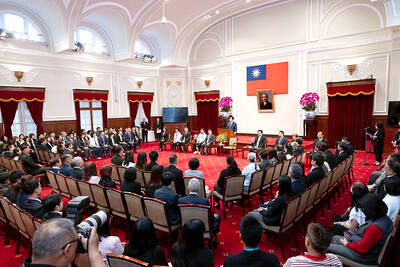
The next minimum wage hike is expected to exceed NT$30,000, President William Lai (賴清德) said yesterday during an award ceremony honoring “model workers,” including migrant workers, at the Presidential Office ahead of Workers’ Day today. Lai said he wished to thank the awardees on behalf of the nation and extend his most sincere respect for their hard work, on which Taiwan’s prosperity has been built. Lai specifically thanked 10 migrant workers selected for the award, saying that although they left their home countries to further their own goals, their efforts have benefited Taiwan as well. The nation’s industrial sector and small businesses lay


 RSS
RSS