


Chinese Nationalist Party (KMT) Chairman Wu Den-yih (吳敦義) yesterday fueled uncertainty over his party’s planned forum with the Chinese Communist Party (CCP), saying he would not attend the annual meeting unless both parties could agree on an agenda.
Wu made the remarks on the sidelines of a get-together with members of the KMT’s Huang Fu-hsing (黃復興) military veterans branch in Taipei yesterday, about a week after the party announced that this year’s KMT-CCP forum has been scheduled for next month in China.
“[My attendance] hinges on the achievement of a general consensus between the two sides on the agenda and discussion topics. I also hope that preliminary conclusions could be reached beforehand,” Wu said.
“If I went and ended up walking away empty-handed, why should I bother to make the trip?” he said.
The consensuses he hopes to achieve with Beijing are ones that are conducive to the peaceful and stable development of cross-strait relations, which could help the government break the current stalemate across the Taiwan Strait, he said.
“Unless these preconditions are met, I will not arrange to travel to China,” Wu added.
According to a statement issued by the KMT on Tuesday last week, this year’s forum is to focus on issues concerning China-based Taiwanese businesspeople, as well as Chinese tourists and students visiting Taiwan.
The KMT-CCP forums began in 2006, when the Democratic Progressive Party was in power, and a year after former vice president and then-KMT chairman Lien Chan (連戰) visited China in April 2005.
It was originally called the Cross-Strait Economic, Trade and Culture Forum, but in November 2016 then-KMT chairwoman Hung Hsiu-chu (洪秀柱) changed the name to the Cross-Strait Peaceful Development Forum “in response to the new situations across the Taiwan Strait.”
If Wu attends, it would be the first such forum he has participated in since taking over the KMT in August last year.
There is also the possibility of him meeting Chinese President Xi Jinping (習近平), as his predecessors, New Taipei City Mayor Eric Chu (朱立倫) and Hung Hsiu-chu (洪秀柱) did in 2015 and 2016 respectively.
However, as a former vice president, Wu is required by the Classified National Security Information Protection Act (國家機密保護法) to apply for permission from the government to travel overseas in the first three years after leaving office.

SECURITY: Starlink owner Elon Musk has taken pro-Beijing positions, and allowing pro-China companies to control Taiwan’s critical infrastructure is risky, a legislator said Starlink was reluctant to offer services in Taiwan because of the nation’s extremely high penetration rates in 4G and 5G services, the Ministry of Digital Affairs said yesterday. The ministry made the comments at a meeting of the legislature’s Transportation Committee, which reviewed amendments to Article 36 of the Telecommunications Management Act (電信管理法). Article 36 bans foreigners from holding more than 49 percent of shares in public telecommunications networks, while shares foreigners directly and indirectly hold are also capped at 60 percent of the total, unless specified otherwise by law. The amendments, sponsored by Chinese Nationalist Party (KMT) Legislator Ko
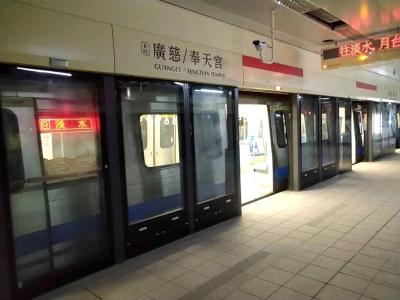
The eastern extension of the Taipei MRT Red Line could begin operations as early as late June, the Taipei Department of Rapid Transit Systems said yesterday. Taipei Rapid Transit Corp said it is considering offering one month of free rides on the new section to mark its opening. Construction progress on the 1.4km extension, which is to run from the current terminal Xiangshan Station to a new eastern terminal, Guangci/Fengtian Temple Station, was 90.6 percent complete by the end of last month, the department said in a report to the Taipei City Council's Transportation Committee. While construction began in October 2016 with an
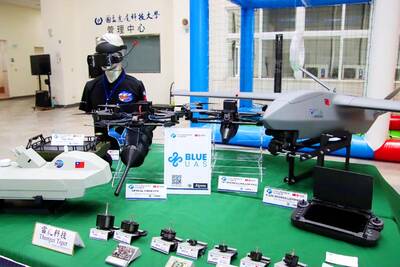
NON-RED SUPPLY: Boosting the nation’s drone industry is becoming increasingly urgent as China’s UAV dominance could become an issue in a crisis, an analyst said Taiwan’s drone exports to Europe grew 41.7-fold from 2024 to last year, with demand from Ukraine’s fight against Russian aggression the most likely driver of growth, a study showed. The Institute for Democracy, Society and Emerging Technology (DSET) in a statement on Wednesday said it found that many of Taiwan’s uncrewed aerial vehicle (UAV) sales were from Poland and the Czech Republic. These countries likely transferred the drones to Ukraine to aid it in its fight against the Russian invasion that started in 2022, it said. Despite the gains, Taiwan is not the dominant drone exporter to these markets, ranking second and fourth

Japanese Prime Minister Sanae Takaichi’s comment last year on Tokyo’s potential reaction to a Taiwan-China conflict has forced Beijing to rewrite its invasion plans, a retired Japanese general said. Takaichi told the Diet on Nov. 7 last year that a Chinese naval blockade or military attack on Taiwan could constitute a “survival-threatening situation” for Japan, potentially allowing Tokyo to exercise its right to collective self-defense. Former Japan Ground Self-Defense Force general Kiyofumi Ogawa said in a recent speech that the remark has been interpreted as meaning Japan could intervene in the early stages of a Taiwan Strait conflict, undermining China’s previous assumptions


 RSS
RSS