


The Cabinet has sent more than NT$929 million (US$31.74 million) to the Hualien County Government to be used in disaster relief and restoration work in the wake of a deadly earthquake that struck the county on Feb. 6, Premier William Lai (賴清德) said yesterday during a visit to Hualien.
The Cabinet said that NT$300 million came from central tax revenue, NT$500 million from a special fund for the county government and NT$129 million from a fund for local administrative units of the county government.
Hualien County Commissioner Fu Kun-chi (傅崐萁) said that former premier Simon Chang’s (張善政) government sent NT$20 billion to the Tainan City Government following a major earthquake in 2016 that killed 116 people, while the city government also received NT$4.3 billion in donations.
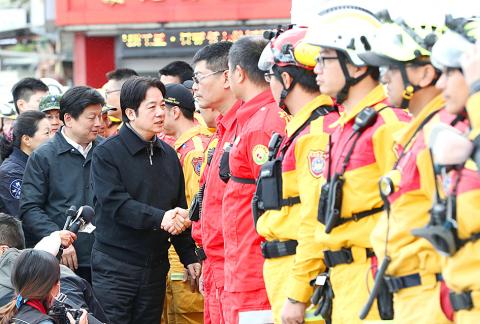
Photo: CNA
After last week’s earthquake that killed 17 people, the Hualien County Government only received NT$300 million from the Cabinet and NT$595 million in public donations, Fu said, urging the central government to direct more resources to the county.
Lai, who was in Hualien to pay his respects to quake victims and their families, and thank search-and-rescue personnel, said that the central government would give as much support to the county as it did to Tainan.
However, Tainan did not receive any more than NT$90 million from the central government, Lai added.
Lai, a former Tainan mayor, said that the city government did not receive NT$20 billion from the Cabinet, and instead used its own funds and donations to carry out reconstruction efforts.
While the Cabinet gave the city NT$90 million, it was used to conduct strength assessment tests on about 1,000 buildings in the city that might be affected by soil liquefaction, Lai said.
“Any mayor or county commissioner would be reasonably anxious when faced with an earthquake of this magnitude. I want the public to give more support to Commissioner Fu and the county government,” Lai said.
The Hualien earthquake was not the first major earthquake to hit Taiwan, Lai said, adding that the nation experienced the Tainan earthquake in 2016 and the 921 Earthquake in 1999, and that the government has developed a response system to quickly and consistently send support to disaster areas.
“The government did not give special favors to Tainan or ignore Hualien. It will not happen. With more experience and technological improvements [in disaster relief], Hualien would eventually receive more public and government support than Tainan,” Lai said.
Lai also ordered Taiwan Water Corp to repair damaged facilities and resume water supply to earthquake-hit areas within three days to allow Hualien residents to observe the Lunar New Year, adding that the Cabinet has formed a task force led by Minister Without Portfolio Chen Mei-ling (陳美伶) to speed up reconstruction efforts.

The military has spotted two Chinese warships operating in waters near Penghu County in the Taiwan Strait and sent its own naval and air forces to monitor the vessels, the Ministry of National Defense (MND) said. Beijing sends warships and warplanes into the waters and skies around Taiwan on an almost daily basis, drawing condemnation from Taipei. While the ministry offers daily updates on the locations of Chinese military aircraft, it only rarely gives details of where Chinese warships are operating, generally only when it detects aircraft carriers, as happened last week. A Chinese destroyer and a frigate entered waters to the southwest

A magnitude 6.1 earthquake struck off the coast of Yilan County at 8:39pm tonight, the Central Weather Administration (CWA) said, with no immediate reports of damage or injuries. The epicenter was 38.7km east-northeast of Yilan County Hall at a focal depth of 98.3km, the CWA’s Seismological Center said. The quake’s maximum intensity, which gauges the actual physical effect of a seismic event, was a level 4 on Taiwan’s 7-tier intensity scale, the center said. That intensity level was recorded in Yilan County’s Nanao Township (南澳), Hsinchu County’s Guansi Township (關西), Nantou County’s Hehuanshan (合歡山) and Hualien County’s Yanliao (鹽寮). An intensity of 3 was

Japanese Prime Minister Sanae Takaichi’s comment last year on Tokyo’s potential reaction to a Taiwan-China conflict has forced Beijing to rewrite its invasion plans, a retired Japanese general said. Takaichi told the Diet on Nov. 7 last year that a Chinese naval blockade or military attack on Taiwan could constitute a “survival-threatening situation” for Japan, potentially allowing Tokyo to exercise its right to collective self-defense. Former Japan Ground Self-Defense Force general Kiyofumi Ogawa said in a recent speech that the remark has been interpreted as meaning Japan could intervene in the early stages of a Taiwan Strait conflict, undermining China’s previous assumptions
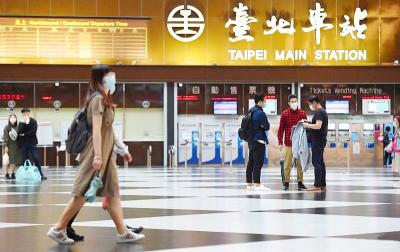
Taiwan Railways Corp (TRC) today announced that Shin Kong Mitsukoshi has been selected as the preferred bidder to operate the Taipei Railway Station shopping mall, replacing the current operator, Breeze Development Co Ltd. Among eight qualified firms that delivered presentations and were evaluated by a review committee, Shin Kong Mitsukoshi was ranked first, while Breeze was named the runner-up, the rail company said in a statement. Contract negotiations are to proceed in accordance with regulations, it said, adding that if negotiations with the top bidder fail, it could invite the second-ranked applicant to enter talks. Breeze in a statement today expressed doubts over


 RSS
RSS