


Legal experts yesterday said they suspected former president Ma Ying-jeou (馬英九) had an ulterior motive after he gave a public talk after filing complaints against Taipei prosecutors, accusing them of leaks and violating the confidentiality of a case under investigation.
Ma on Wednesday filed a lawsuit against Taipei Chief Prosecutor Shing Tai-chao (邢泰釗) and Taipei Head Prosecutor Wang Hsin-chien (王鑫健) for allegedly leaking details from a case under investigation, after media reports that prosecutors have a recording allegedly implicating Ma in financial irregularities arising from the sale of Chinese Nationalist Party (KMT) assets more than a decade ago.
Attorney Chou Wu-jung (周武榮) said Ma’s filing was motivated by several factors, among them the opportunity to speak publicly, sending his message via the media that he wanted “to warn those involved in the case not to talk in the wrong way.”
“It is also possible that it was a ploy to send a message to the other people involved in the case that they should collude on evidence and testimony,” Chou said.
Another likely motive was to muddle information and drag the case onto the political front line, perhaps because he feels the investigation was heading in an unfavorable direction, Chou added.
“Ma applied to transfer the investigation to another jurisdiction which could create the impression of political interference in the affairs of the Taipei District Prosecutors’ Office,” he said.
“Ma is paving the way for the future so he can claim that he has been wronged and received unfair treatment, and could then denounce the prosecution process,” he added.
Chou said that Ma’s accusation that Taipei prosecutors “leaked information” was inaccurate and the basic premise of Ma’s accusation is contradictory.
“If Ma admitted that the media reports were accurate information, only then it could be considered a ‘leak.’ If the information was not correct, then there could not be a leak,” he said.
Chou said that if the information in the media reports was incorrect, “then Ma should sue the media outlets for libel. Ma’s legal move shows that he has ulterior motives in mind.”
“Ma’s legal move was clearly an attempt to cover up his tracks, as he knows the investigation is closing in on him and he had to take up damage control,” lawyer Kao Yung-cheng (高涌誠) said.
Ma’s application to transfer the case to another jurisdiction would likely not succeed, as it would be seen as subverting the justice system, Kao added.
“Asking for the case to be transfered to other prosecutors, just because the judicial investigation seems to have Ma cornered in an unfavorable position, could be seen as a subversion of justice,” Kao said.
Attorney Huang Di-ying (黃帝穎), an executive member of the Taiwan Jury Association, said if it was true what Ma said “then let us make a concession for them,” during meetings with KMT officials about the NT$480 million (US$16 million at the current exchange rate) price difference on the sale of China Television Co, then it would suggest that Ma was the main decisionmaker in the KMT’s transactions that gave financial favors to the buyers and which adversely damaged the interests of the company’s shareholders.

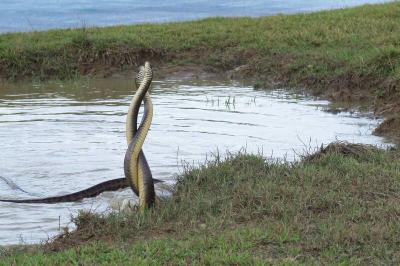
Kenting National Park service technician Yang Jien-fon (楊政峰) won a silver award in World Grand Prix Photography Awards Spring Season for his photograph of two male rat snakes intertwined in combat. Yang’s colleagues at Kenting National Park said he is a master of nature photography who has been held back by his job in civil service. The awards accept entries in all four seasons across six categories: architectural and urban photography, black-and-white and fine art photography, commercial and fashion photography, documentary and people photography, nature and experimental photography, and mobile photography. Awards are ranked according to scores and divided into platinum, gold and
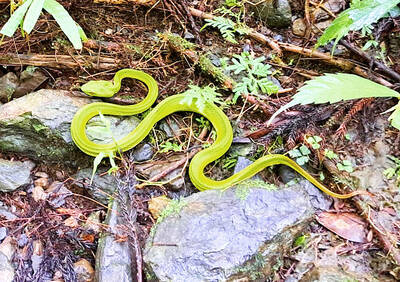
More than half of the bamboo vipers captured in Tainan in the past few years were found in the city’s Sinhua District (新化), while other districts had smaller catches or none at all. Every year, Tainan captures about 6,000 snakes which have made their way into people’s homes. Of the six major venomous snakes in Taiwan, the cobra, the many-banded krait, the brown-spotted pit viper and the bamboo viper are the most frequently captured. The high concentration of bamboo vipers captured in Sinhua District is puzzling. Tainan Agriculture Bureau Forestry and Nature Conservation Division head Chu Chien-ming (朱健明) earlier this week said that the
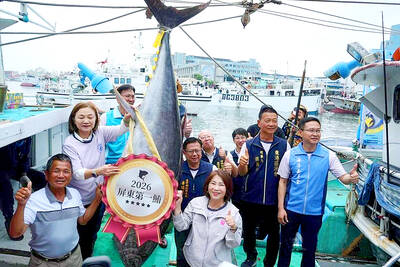
The first bluefin tuna of the season, brought to shore in Pingtung County and weighing 190kg, was yesterday auctioned for NT$10,600 (US$333.5) per kilogram, setting a record high for the local market. The auction was held at the fish market in Donggang Fishing Harbor, where the Siaoliouciou Island-registered fishing vessel Fu Yu Ching No. 2 delivered the “Pingtung First Tuna” it had caught for bidding. Bidding was intense, and the tuna was ultimately jointly purchased by a local restaurant and a local company for NT$10,600 per kilogram — NT$300 ,more than last year — for a total of NT$2.014 million. The 67-year-old skipper
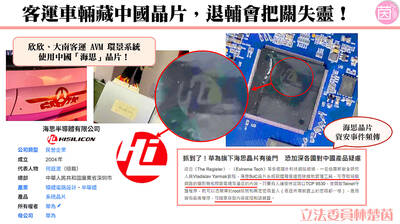
BREACH OF CONTRACT: The bus operators would seek compensation and have demanded that the manufacturer replace the chips with ones that meet regulations Two bus operators found to be using buses with China-made chips are to demand that the original manufacturers replace the systems and provide compensation for breach of contract, the Veterans Affairs Council said yesterday. Democratic Progressive Party Legislator Michelle Lin (林楚茵) yesterday said that Da Nan Bus Co and Shin-Shin Bus Co Ltd have fielded a total of 82 buses that are using Chinese chips. The bus models were made by Tron-E, while the systems provider was CYE Electronics, Lin said. Lin alleged that the buses were using chips manufactured by Huawei subsidiary HiSilicon Co, which presents a national security risk if the


 RSS
RSS