


Taichung’s Rainbow Village, created by amateur artist Huang Yung-fu (黃永阜), was one of two Taiwanese destinations listed in Lonely Planet’s Secret Marvels of the World guidebook last month.
The village, known for its vibrant colors, received international recognition from two other sources this year.
It ranked third in an online survey by Japanese travel agency H.I.S. asking Japanese netizens to rank photo-worthy destinations in Taiwan that they wanted to visit the most.
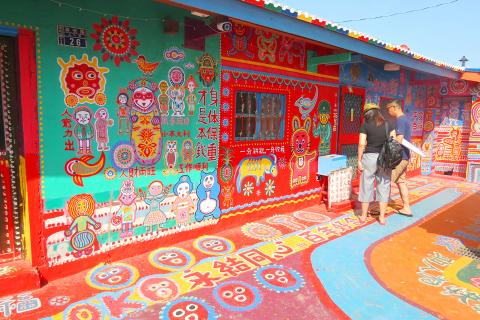
Photo: Su Meng-chuan, Taipei Times
British lifestyle Web site Culture Trip included the Rainbow Village in its “10 Most Instagrammable Spots in Taiwan.”
In response to his sudden rise to fame, 95-year-old veteran Huang, nicknamed the “Rainbow Grandfather,” said that he never imagined such a thing would happen, adding that he found it a little baffling.
“I am being watched by others, but I am watching others, too,” he said.
Huang said he enjoys other people’s company, especially the joy and laughter of his audience.
In 2008, Huang painted on the walls and floors of his self-built residence inside an old veterans’ village in Taichung’s Nantun District (南屯).
Two years later, when his house was listed for land readjustment by the government, Huang said the public started a campaign to save the Rainbow Village.
Letters flooded the mayor’s mailbox and the Taichung City Government made an exception allowing him to keep his house, he added.
Last year, more than 1.25 million people visited the Rainbow Village, the city government said.
Huang said that as long as his health allows, he almost always greets his visitors and that he still begins working at 4am almost every day.
The self-taught artist said he draws whatever comes to mind, including animals, puppets and even childhood memories.
He was hospitalized for a week early last month due to pneumonia after a cold, Huang said, adding that after checking out of hospital, he put his painting on pause to allow his body to rest and readjust.
He wanted to recover quickly so that he could continue painting, Huang said, adding that his energy has recovered and he has resumed painting.
“There are already a lot of images in my head and I want to paint all of them,” Huang said.

AGING: While Japan has 22 submarines, Taiwan only operates four, two of which were commissioned by the US in 1945 and 1946, and transferred to Taiwan in 1973 Taiwan would need at least 12 submarines to reach modern fleet capabilities, CSBC Corp, Taiwan chairman Chen Cheng-hung (陳政宏) said in an interview broadcast on Friday, citing a US assessment. CSBC is testing the nation’s first indigenous defense submarine, the Hai Kun (海鯤, Narwhal), which is scheduled to be delivered to the navy next month or in July. The Hai Kun has completed torpedo-firing tests and is scheduled to undergo overnight sea trials, Chen said on an SET TV military affairs program. Taiwan would require at least 12 submarines to establish a modern submarine force after assessing the nation’s operational environment and defense
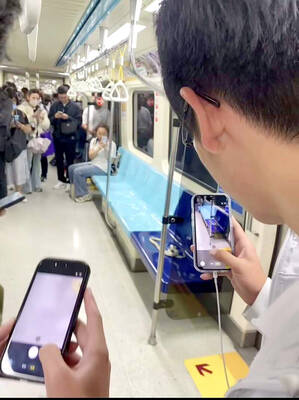
A white king snake that frightened passengers and caused a stir on a Taipei MRT train on Friday evening has been claimed by its owner, who would be fined, Taipei Rapid Transit Corp (TRTC) said yesterday. A person on Threads posted that he thought he was lucky to find an empty row of seats on Friday after boarding a train on the Bannan (Blue) Line, only to spot a white snake with black stripes after sitting down. Startled, he jumped up, he wrote, describing the encounter as “terrifying.” “Taipei’s rat control plan: Release snakes on the metro,” one person wrote in reply, referring
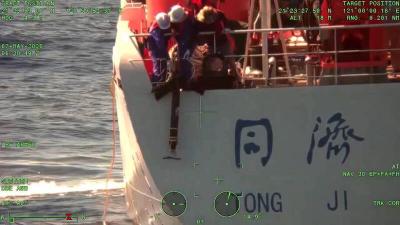
The coast guard today said that it had disrupted "illegal" operations by a Chinese research ship in waters close to the nation and driven it away, part of what Taipei sees a provocative pattern of China's stepped up maritime activities. The coast guard said that it on Thursday last week detected the Chinese ship Tongji (同濟號), which was commissioned only last year, 29 nautical miles (54km) southeast of the southern tip of Taiwan, although just outside restricted waters. The ship was observed lowering ropes into the water, suspected to be the deployment of scientific instruments for "illegal" survey operations, and the coast
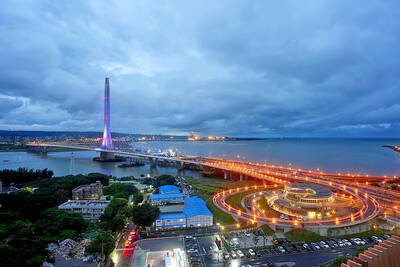
An inauguration ceremony was held yesterday for the Danjiang Bridge, the world’s longest single-mast asymmetric cable-stayed bridge, ahead of its official opening to traffic on Tuesday, marking a major milestone after nearly three decades of planning and construction. At the ceremony in New Taipei City attended by President William Lai (賴清德), Premier Cho Jung-tai (卓榮泰), Minister of Transportation and Communications Chen Shih-kai (陳世凱) and New Taipei City Mayor Hou Yu-ih (侯友宜), the bridge was hailed as both an engineering landmark and a long-awaited regional transport link connecting Tamsui (淡水) and Bali (八里)


 RSS
RSS