


President Tsai Ing-wen’s (蔡英文) cross-strait policy is not conducive to stability in the Taiwan Strait, according to respondents to a pan-blue think tank poll published yesterday, with most having greater trust in the Chinese Nationalist Party (KMT).
The survey was conducted from Thursday to Saturday by the Taiwan Real Survey Co at the behest of the National Policy Foundation, which was founded in 2000 as a KMT think tank and is headed by KMT Chairman Wu Den-yih (吳敦義).
It came on the heels of a poll released by the Cross-Strait Policy Association on Oct. 30, which showed that most respondents, or 44.8 percent, approved of Tsai’s cross-strait policy, followed by that of independent Taipei Mayor Ko Wen-je (柯文哲) at 28 percent and Wu at 18.3 percent.
The poll met with fierce criticism from the KMT, which called it a “fake survey” designed to make the public view the Democratic Progressive Party (DPP) administration through rose-tinted glasses.
The KMT also cast doubt on the relationship between the association and the DPP, saying leadership roles were occupied by green-leaning individuals in the past.
In yesterday’s poll, 46.6 percent of respondents did not believe Tsai’s cross-strait policy would be helpful to maintaining cross-strait peace and stability, compared with 22.2 percent who thought otherwise.
Asked which of the two major parties’ China policy could better safeguard Taiwanese safety and interests, 36.8 percent said the KMT and 19.9 percent said the DPP.
About 13 percent said neither and 3 percent said both.
The survey also tried to draw a parallel between Tsai’s cross-strait policy and that of Premier William Lai (賴清德), who has described himself as a Taiwanese independence pragmatist and has publicly stated his support for Taiwanese independence.
Tsai has repeatedly reiterated her determination to maintain the cross-strait “status quo,” vowing not to change her promises and goodwill, or return to the old path of confrontation.
However, she has said that her administration would not succumb to pressure.
Respondents seemed divided on the matter, with 16.9 percent saying Tsai’s and Lai’s cross-strait policy was contradictory, followed by 16.6 percent who believed their stances were consistent, and 16.5 percent who suspected they were playing a two-handed strategy.
Tamkang University’s College of International Studies dean Wang Kao-cheng (王高成) said that a cross-analysis of the poll found not even younger respondents — those aged between 20 and 29 — thought Tsai’s cross-strait policy is conducive to peace and stability across the Taiwan Strait, citing statistics showing 47.7 percent of them expressed such a view against 22.7 percent who said otherwise.
Wang said, in a sarcastic tone, that the main supporter group of the president’s policy seems to be those with only primary-school education, adding that 58.7 percent of them expressed support for her policy.
The poll collected 1,072 samples and has a margin of error of 2.99 percentage points.
In response, DPP spokesman Wang Min-sheng (王閔生) said the KMT think tank’s survey seemed to have been conducted in a “parallel universe,” urging the KMT to ensure that its cross-strait rhetoric conforms with mainstream public opinion despite Chinese pressure.
Citing a survey published by the Mainland Affairs Council last week, Wang Min-sheng said that 85.2 percent of respondents supported maintaining the “status quo” in a broad sense, and that 81.8 percent supported the DPP administration’s effort to safeguard Taiwan’s sovereignty and dignity while maintaining cross-strait peace and stability.
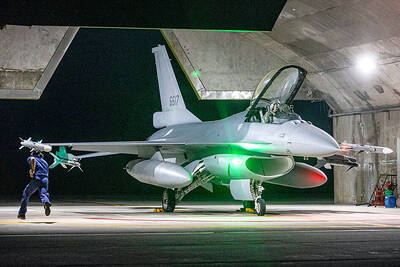
Taiwan has received more than US$70 million in royalties as of the end of last year from developing the F-16V jet as countries worldwide purchase or upgrade to this popular model, government and military officials said on Saturday. Taiwan funded the development of the F-16V jet and ended up the sole investor as other countries withdrew from the program. Now the F-16V is increasingly popular and countries must pay Taiwan a percentage in royalties when they purchase new F-16V aircraft or upgrade older F-16 models. The next five years are expected to be the peak for these royalties, with Taiwan potentially earning
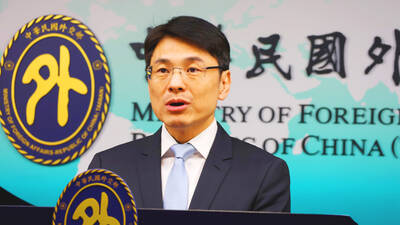
STAY IN YOUR LANE: As the US and Israel attack Iran, the ministry has warned China not to overstep by including Taiwanese citizens in its evacuation orders The Ministry of Foreign Affairs (MOFA) yesterday rebuked a statement by China’s embassy in Israel that it would evacuate Taiwanese holders of Chinese travel documents from Israel amid the latter’s escalating conflict with Iran. Tensions have risen across the Middle East in the wake of US and Israeli airstrikes on Iran beginning Saturday. China subsequently issued an evacuation notice for its citizens. In a news release, the Chinese embassy in Israel said holders of “Taiwan compatriot permits (台胞證)” issued to Taiwanese nationals by Chinese authorities for travel to China — could register for evacuation to Egypt. In Taipei, the ministry yesterday said Taiwan
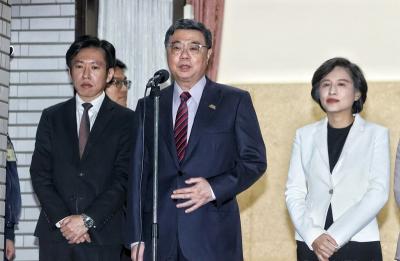
Taiwan is awaiting official notification from the US regarding the status of the Agreement on Reciprocal Trade (ART) after the US Supreme Court ruled US President Donald Trump's global tariffs unconstitutional. Speaking to reporters before a legislative hearing today, Premier Cho Jung-tai (卓榮泰) said that Taiwan's negotiation team remains focused on ensuring that the bilateral trade deal remains intact despite the legal challenge to Trump's tariff policy. "The US has pledged to notify its trade partners once the subsequent administrative and legal processes are finalized, and that certainly includes Taiwan," Cho said when asked about opposition parties’ doubts that the ART was
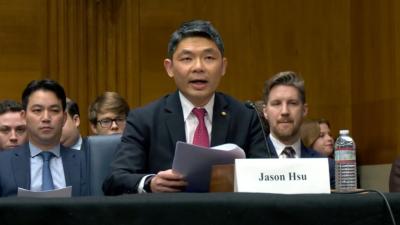
If China chose to invade Taiwan tomorrow, it would only have to sever three undersea fiber-optic cable clusters to cause a data blackout, Jason Hsu (許毓仁), a senior fellow at the Hudson Institute and former Chinese Nationalist Party (KMT) legislator, told a US security panel yesterday. In a Taiwan contingency, cable disruption would be one of the earliest preinvasion actions and the signal that escalation had begun, he said, adding that Taiwan’s current cable repair capabilities are insufficient. The US-China Economic and Security Review Commission (USCC) yesterday held a hearing on US-China Competition Under the Sea, with Hsu speaking on


 RSS
RSS