


Government agencies have failed to comply with regulations by refusing to allow the installation of cellphone base stations on their properties, leading to slow mobile Internet nationwide, members of the legislature’s Transportation Committee said yesterday.
The main reason mobile Internet connection speeds remain slow is because government officials refuse to allow base stations to be installed on their properties, Democratic Progressive Party (DPP) Legislator Chen Ou-po (陳歐珀) said.
Telecoms between 2014 and August filed 6,515 applications to build base stations on government-owned property, but only 503 applications have been approved, he said.
“I just cannot agree with the National Communications Commission’s report that government agencies have been helpful in facilitating the construction of base stations on government property,” he said.
Article 32 of the Telecommunications Act (電信法) states that government authorities shall not reject requests to use public land or buildings for the establishment of conduit infrastructure and terminal equipment, Chen said.
Not only have government agencies refused to cooperate, but their refusal will not lead to any penalties and the commission will not condemn them, Chen said.
The commission should be more active in coordinating with other government agencies and disclose a list of agencies that are refusing to cooperate, Chen said.
Independent Legislator Chao Cheng-yu (趙正宇) said he agrees that government agencies should be leading efforts to increase the number of base stations, but questioned the propriety of installing stations on the properties of public elderly care centers, where they might intimidate the residents.
In response, commission Chairwoman Nicole Chan (詹婷怡) said that it has stepped up efforts to communicate with government agencies.
“Our position is that all government agencies must comply, but we need to consider how people feel about the presence of base station on some properties, even though their effect might be minimal,” she said.
Meanwhile, Democratic Progressive Party (DPP) legislators Lee Kun-tse (李昆澤) and Yeh Yi-jin (葉宜津) were concerned about the nation’s progress in the development of fifth-generation (5G) telecom service.
South Korea and Japan aim to launch 5G commercial operations by 2019 and 2020 respectively, Lee said.
The government should reserve some of the unlicensed bands to encourage the creation of innovative services, as 5G service would offer faster and more efficient Internet connections, Yeh added.
Chan said that the commission aims to have the frequency bands needed for the development of 5G service ready by 2020, regardless of whether the nation can launch the service by then.

Taiwan has received more than US$70 million in royalties as of the end of last year from developing the F-16V jet as countries worldwide purchase or upgrade to this popular model, government and military officials said on Saturday. Taiwan funded the development of the F-16V jet and ended up the sole investor as other countries withdrew from the program. Now the F-16V is increasingly popular and countries must pay Taiwan a percentage in royalties when they purchase new F-16V aircraft or upgrade older F-16 models. The next five years are expected to be the peak for these royalties, with Taiwan potentially earning

STAY IN YOUR LANE: As the US and Israel attack Iran, the ministry has warned China not to overstep by including Taiwanese citizens in its evacuation orders The Ministry of Foreign Affairs (MOFA) yesterday rebuked a statement by China’s embassy in Israel that it would evacuate Taiwanese holders of Chinese travel documents from Israel amid the latter’s escalating conflict with Iran. Tensions have risen across the Middle East in the wake of US and Israeli airstrikes on Iran beginning Saturday. China subsequently issued an evacuation notice for its citizens. In a news release, the Chinese embassy in Israel said holders of “Taiwan compatriot permits (台胞證)” issued to Taiwanese nationals by Chinese authorities for travel to China — could register for evacuation to Egypt. In Taipei, the ministry yesterday said Taiwan
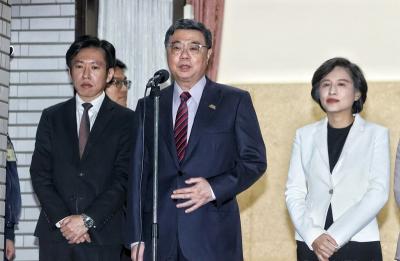
Taiwan is awaiting official notification from the US regarding the status of the Agreement on Reciprocal Trade (ART) after the US Supreme Court ruled US President Donald Trump's global tariffs unconstitutional. Speaking to reporters before a legislative hearing today, Premier Cho Jung-tai (卓榮泰) said that Taiwan's negotiation team remains focused on ensuring that the bilateral trade deal remains intact despite the legal challenge to Trump's tariff policy. "The US has pledged to notify its trade partners once the subsequent administrative and legal processes are finalized, and that certainly includes Taiwan," Cho said when asked about opposition parties’ doubts that the ART was
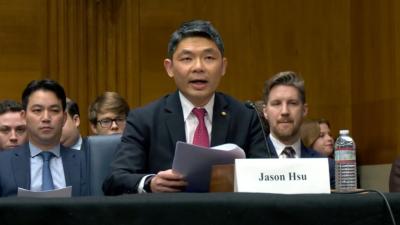
If China chose to invade Taiwan tomorrow, it would only have to sever three undersea fiber-optic cable clusters to cause a data blackout, Jason Hsu (許毓仁), a senior fellow at the Hudson Institute and former Chinese Nationalist Party (KMT) legislator, told a US security panel yesterday. In a Taiwan contingency, cable disruption would be one of the earliest preinvasion actions and the signal that escalation had begun, he said, adding that Taiwan’s current cable repair capabilities are insufficient. The US-China Economic and Security Review Commission (USCC) yesterday held a hearing on US-China Competition Under the Sea, with Hsu speaking on


 RSS
RSS