


A Double Ten National Day celebration yesterday organized by the Chinese Nationalist Party (KMT) highlighted the significance and widespread presence of the national flag, and affirmed the existence of the Republic of China (ROC).
The Democratic Progressive Party (DPP) government has been accused by critics of deliberately minimizing imagery associated with China by removing the ROC flag from the invitations for the official Double Ten National Day ceremony and dinner, as well as not mentioning the ROC.
However, Legislative Speaker Su Jia-chyuan (蘇嘉全), whose job includes the role of National Day Celebration Organizing Committee chairman, said the national flag “lives in our hearts,” adding that the flags were displayed at the ceremony and dinner.
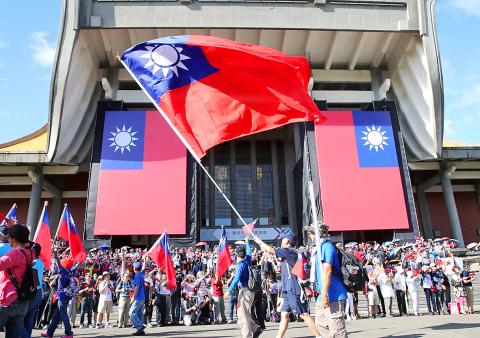
Photo: CNA
The invitation to a celebration hosted by the KMT at Sun Yat-sen Memorial Hall in Taipei featured a national flag on one side and the portraits of Sun Yat-sen (孫中山) and Chiang Kai-shek (蔣介石) on the other.
The ceremony began with marching bands carrying national flags and portraits of Sun and Chiang, which were followed by a group of veterans bearing a huge national flag.
In his speech to the ceremony, former president Ma Ying-jeou (馬英九) highlighted the differences between it and the national celebrations, saying that the number of national flags he saw in the afternoon far exceeded that of the official ceremony in the morning, which he had also attended.
“This is what a National Day celebration should look like. This flag has borne the ideas, feelings, struggles, humility and dignity of millions of Chinese people over the past 100 years. It has become the symbol recognized, affirmed and supported by 23 million people in Taiwan as well. Surely we should bring our national flags out and raise them high at important occasions like National Day celebrations,” Ma said.
Former KMT chairwoman Hung Hsiu-chu (洪秀柱) said “our love for the national flag and our use of the ROC as the name of the nation should not be hidden inside.”
“To us, addressing our nation as the ROC and respecting our flag is just as natural as facing the sun and walking on the land. We neither have to fabricate nor hide those feelings,” she said.
Former representative to the US Shen Lyu-shun (沈呂巡) said that he was invited to attend the pan-blue event because during his time in Washington the ROC flag was raised at Twin Oaks — the estate owned by the ROC government and used for official receptions —for the first time in 2015, 37 years after the US and Taiwan severed diplomatic ties.
KMT Chairman Wu Den-yih (吳敦義) said that seeing the national flag should strengthen the faith and reignite the hope of party supporters that the KMT would soon rule the nation again.
Wu asked KMT supporters to unite and work together to help it to win next year’s “nine-in-one” elections for special municipality mayors, county commissioners and city and county councils.
“Let our flags fly in more cities and counties than they do now. If we make significant progress next year, it would open up a chance for us return to power,” he said.
Ma said that he was deeply concerned with the direction in which the DPP administration is heading.
The KMT needs to seize any opportunity it can to convince the public that it has the most effective solution to achieve cross-strait peace and prosperity, he said.
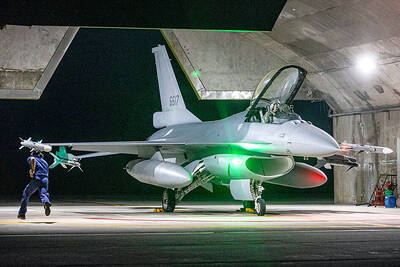
Taiwan has received more than US$70 million in royalties as of the end of last year from developing the F-16V jet as countries worldwide purchase or upgrade to this popular model, government and military officials said on Saturday. Taiwan funded the development of the F-16V jet and ended up the sole investor as other countries withdrew from the program. Now the F-16V is increasingly popular and countries must pay Taiwan a percentage in royalties when they purchase new F-16V aircraft or upgrade older F-16 models. The next five years are expected to be the peak for these royalties, with Taiwan potentially earning
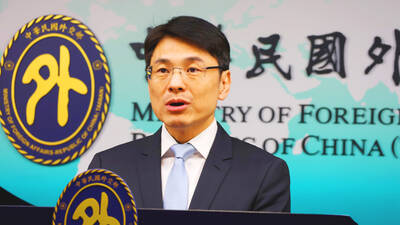
STAY IN YOUR LANE: As the US and Israel attack Iran, the ministry has warned China not to overstep by including Taiwanese citizens in its evacuation orders The Ministry of Foreign Affairs (MOFA) yesterday rebuked a statement by China’s embassy in Israel that it would evacuate Taiwanese holders of Chinese travel documents from Israel amid the latter’s escalating conflict with Iran. Tensions have risen across the Middle East in the wake of US and Israeli airstrikes on Iran beginning Saturday. China subsequently issued an evacuation notice for its citizens. In a news release, the Chinese embassy in Israel said holders of “Taiwan compatriot permits (台胞證)” issued to Taiwanese nationals by Chinese authorities for travel to China — could register for evacuation to Egypt. In Taipei, the ministry yesterday said Taiwan
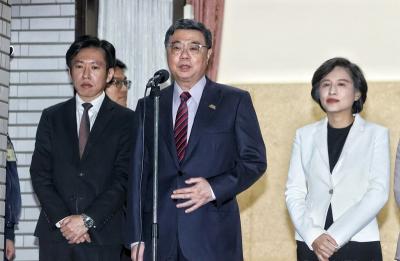
Taiwan is awaiting official notification from the US regarding the status of the Agreement on Reciprocal Trade (ART) after the US Supreme Court ruled US President Donald Trump's global tariffs unconstitutional. Speaking to reporters before a legislative hearing today, Premier Cho Jung-tai (卓榮泰) said that Taiwan's negotiation team remains focused on ensuring that the bilateral trade deal remains intact despite the legal challenge to Trump's tariff policy. "The US has pledged to notify its trade partners once the subsequent administrative and legal processes are finalized, and that certainly includes Taiwan," Cho said when asked about opposition parties’ doubts that the ART was
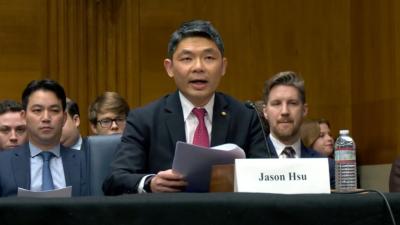
If China chose to invade Taiwan tomorrow, it would only have to sever three undersea fiber-optic cable clusters to cause a data blackout, Jason Hsu (許毓仁), a senior fellow at the Hudson Institute and former Chinese Nationalist Party (KMT) legislator, told a US security panel yesterday. In a Taiwan contingency, cable disruption would be one of the earliest preinvasion actions and the signal that escalation had begun, he said, adding that Taiwan’s current cable repair capabilities are insufficient. The US-China Economic and Security Review Commission (USCC) yesterday held a hearing on US-China Competition Under the Sea, with Hsu speaking on


 RSS
RSS