


The Chinese Nationalist Party (KMT) pays high rents to affiliated companies for its branch offices, even as it complains it lacks the money to pay its employees, Democratic Progressive Party (DPP) Legislator Tsai Yi-yu (蔡易餘) said.
As a result of action taken against the party as part of the government’s investigation into ill-gotten party assets, the KMT said it lacks the financial resources to pay its workers’ salaries because it has to pay its rents first.
A report on KMT expenditures from January to September provided by the party to the Ill-gotten Party Assets Settlement Committee showed that it paid NT$378 million (US$12 million) in rent over a five-year period — NT$6.3 million per month — for more than 160 party offices rented from Central Investment Co (中央投資公司) and other firms the committee has said are linked to the party.
The KMT has denied the alleged links.
“It is like the money is going from their left pocket into their right pocket,” Tsai said.
“The KMT is using the guise of paying rent to a so-called third party in what looks suspiciously like the dumping of assets and dodging of liability,” he said.
Tsai questioned whether the high rents the KMT paid to the alleged affiliated companies was an attempt to hide funds from the committee.
The KMT has a “staggering number” of divisional offices nationwide, as well as its main offices in each of the six special municipalities, and the 160 properties the party rents all belong to KMT-associated businesses, Tsai said.
Citing information from the Department of Land Administration, Tsai said that a number of KMT offices in Taipei; New Taipei City’s Sansia (三峽), Sinjhuang (新莊) and Jhonghe (中和) districts; and Taoyuan’s Jhongli (中壢), Bade (八德) and Lujhu (蘆竹) districts are leased from Hsinkuanghua Co (欣光華公司).
The KMT’s office in Taichung’s West District (西區) is owned by Yuhua Co (昱華公司), several branch offices in Tainan are rented from Yutai Development Co (裕台開發公司) and offices in seven of Kaohsiung’s districts, including Siaogang (小港) and Ciaotou (橋頭), are rented from Hsinkuanghua and Yutai, the DPP lawmaker said.
All the companies are suspected of being KMT-affiliated organizations, Tsai said.
“It is clear that the party is not without money,” he said.
However, KMT Culture and Communications Committee deputy director Hu Wen-chi (胡文琦) said the KMT is a legally formed party, Central Investment is a legally formed company and the party’s branch offices are legally rented.
“Everything has been handled according to the law,” Hu said.
KMT branch offices are rented at market value, Hu said, adding that the party has relocated some of its offices due to high rents, proving that the KMT and Central Investment are unaffiliated.
“It is not an affiliated organization like the committee says,” Hu said.

The military has spotted two Chinese warships operating in waters near Penghu County in the Taiwan Strait and sent its own naval and air forces to monitor the vessels, the Ministry of National Defense (MND) said. Beijing sends warships and warplanes into the waters and skies around Taiwan on an almost daily basis, drawing condemnation from Taipei. While the ministry offers daily updates on the locations of Chinese military aircraft, it only rarely gives details of where Chinese warships are operating, generally only when it detects aircraft carriers, as happened last week. A Chinese destroyer and a frigate entered waters to the southwest
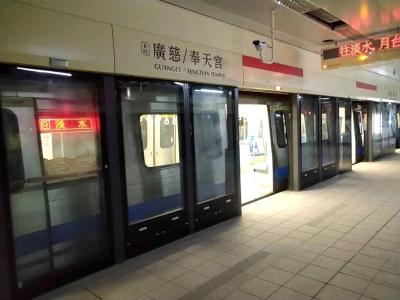
The eastern extension of the Taipei MRT Red Line could begin operations as early as late June, the Taipei Department of Rapid Transit Systems said yesterday. Taipei Rapid Transit Corp said it is considering offering one month of free rides on the new section to mark its opening. Construction progress on the 1.4km extension, which is to run from the current terminal Xiangshan Station to a new eastern terminal, Guangci/Fengtian Temple Station, was 90.6 percent complete by the end of last month, the department said in a report to the Taipei City Council's Transportation Committee. While construction began in October 2016 with an
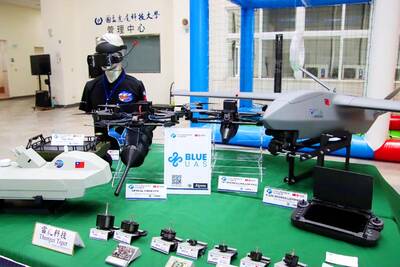
NON-RED SUPPLY: Boosting the nation’s drone industry is becoming increasingly urgent as China’s UAV dominance could become an issue in a crisis, an analyst said Taiwan’s drone exports to Europe grew 41.7-fold from 2024 to last year, with demand from Ukraine’s fight against Russian aggression the most likely driver of growth, a study showed. The Institute for Democracy, Society and Emerging Technology (DSET) in a statement on Wednesday said it found that many of Taiwan’s uncrewed aerial vehicle (UAV) sales were from Poland and the Czech Republic. These countries likely transferred the drones to Ukraine to aid it in its fight against the Russian invasion that started in 2022, it said. Despite the gains, Taiwan is not the dominant drone exporter to these markets, ranking second and fourth

Japanese Prime Minister Sanae Takaichi’s comment last year on Tokyo’s potential reaction to a Taiwan-China conflict has forced Beijing to rewrite its invasion plans, a retired Japanese general said. Takaichi told the Diet on Nov. 7 last year that a Chinese naval blockade or military attack on Taiwan could constitute a “survival-threatening situation” for Japan, potentially allowing Tokyo to exercise its right to collective self-defense. Former Japan Ground Self-Defense Force general Kiyofumi Ogawa said in a recent speech that the remark has been interpreted as meaning Japan could intervene in the early stages of a Taiwan Strait conflict, undermining China’s previous assumptions


 RSS
RSS