


Transitional justice should include the Pingpu people — also known as plains Aborigines — rights advocates said yesterday at a protest outside the Legislative Yuan in Taipei as the government moves to establish an Aboriginal transitional justice commission.
About 20 protesters from several Aboriginal and independence groups called on the government to return the “rightful name” to Pingpu people and identify them as part of transitional justice efforts.
“The government should squarely face the fact of our existence and it has a duty to ensure that our culture continues,” said Central Taiwan Pingpu Indigenous Groups Youth Alliance representative Kaisanan Ahuan, a member of the Taokas people, adding that the committee — which President Tsai Ing-wen (蔡英文) has promised to establish — should include Aboriginal representatives.
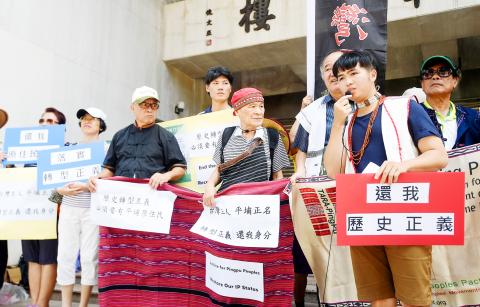
Photo: Fang Pin-chao, Taipei Times
“The Aboriginal transitional justice commission should include our voices, because otherwise, the result will be an external interpretation of our issues,” Ahuan said.
Tsai promised to establish the commission after delivering an official apology to Aborigines, which she is expected to make on Aug. 1.
She promised to push for legal recognition of Pingpu Aborigines as part of her Aboriginal platform during last year’s election campaign.
Pingpu Aborigines claim descent from more than 10 plains Aboriginal groups who faced strong assimilation pressure following the arrival of Chinese immigrants, intermarrying extensively and in most cases losing their ancestral languages.
While activists have fought for decades for “plains” Aborigines to be granted official recognition held by less-assimilated “mountain” groups, only one — the Kavalan — has succeeded, winning official recognition in 2002.
“The Pingpu people are absolutely Aborigines,” said New Power Party Legislator Kawlo Iyun Pacidal, who is of the Amis people.
Self-identity is more important than conformance to an external set of conditions, Pacidal said.
“The fact that language has disappeared is not the fault of Aborigines, it reflects the harm inflicted by the colonial regime,” she said.
“If the government refuses to restore their identity, it is perpetuating colonial thinking and the harm they have suffered,” she said, adding that Pingpu people should be included in the transitional justice process because of abuses they experienced during previous governments.

The military has spotted two Chinese warships operating in waters near Penghu County in the Taiwan Strait and sent its own naval and air forces to monitor the vessels, the Ministry of National Defense (MND) said. Beijing sends warships and warplanes into the waters and skies around Taiwan on an almost daily basis, drawing condemnation from Taipei. While the ministry offers daily updates on the locations of Chinese military aircraft, it only rarely gives details of where Chinese warships are operating, generally only when it detects aircraft carriers, as happened last week. A Chinese destroyer and a frigate entered waters to the southwest

The eastern extension of the Taipei MRT Red Line could begin operations as early as late June, the Taipei Department of Rapid Transit Systems said yesterday. Taipei Rapid Transit Corp said it is considering offering one month of free rides on the new section to mark its opening. Construction progress on the 1.4km extension, which is to run from the current terminal Xiangshan Station to a new eastern terminal, Guangci/Fengtian Temple Station, was 90.6 percent complete by the end of last month, the department said in a report to the Taipei City Council's Transportation Committee. While construction began in October 2016 with an

NON-RED SUPPLY: Boosting the nation’s drone industry is becoming increasingly urgent as China’s UAV dominance could become an issue in a crisis, an analyst said Taiwan’s drone exports to Europe grew 41.7-fold from 2024 to last year, with demand from Ukraine’s fight against Russian aggression the most likely driver of growth, a study showed. The Institute for Democracy, Society and Emerging Technology (DSET) in a statement on Wednesday said it found that many of Taiwan’s uncrewed aerial vehicle (UAV) sales were from Poland and the Czech Republic. These countries likely transferred the drones to Ukraine to aid it in its fight against the Russian invasion that started in 2022, it said. Despite the gains, Taiwan is not the dominant drone exporter to these markets, ranking second and fourth

Japanese Prime Minister Sanae Takaichi’s comment last year on Tokyo’s potential reaction to a Taiwan-China conflict has forced Beijing to rewrite its invasion plans, a retired Japanese general said. Takaichi told the Diet on Nov. 7 last year that a Chinese naval blockade or military attack on Taiwan could constitute a “survival-threatening situation” for Japan, potentially allowing Tokyo to exercise its right to collective self-defense. Former Japan Ground Self-Defense Force general Kiyofumi Ogawa said in a recent speech that the remark has been interpreted as meaning Japan could intervene in the early stages of a Taiwan Strait conflict, undermining China’s previous assumptions


 RSS
RSS