


About a dozen employees of Global Mobile (全球一動), a Worldwide Interoperability Microwave Access (WiMAX) service provider, yesterday accused the National Communications Commission (NCC) of selling the spectrum the company currently uses to another telecom on the cheap in an auction, adding that the firm would not cease operations and fight the commission until the end.
The protest occurred a day after the commission auctioned the frequency spectrum for the use by a telecom using fourth-generation long-term evolution technology.
The D6 frequency block was sold to Far EasTone Telecommunications (FET) for NT$2.18 billion (US$65.99 million).
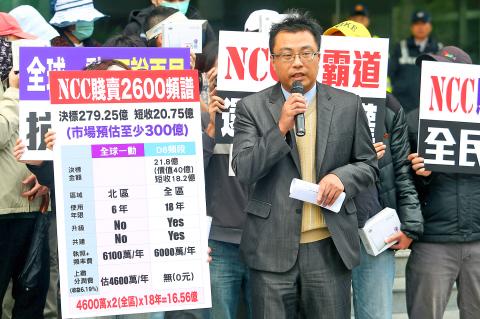
Photo: CNA
The protest also occurred just two days before Global Mobile’s license expires tomorrow. The commission rejected the firm’s license renewal application last month.
The commission also reassigned the phone numbers currently used by Global Mobile subscribers to FET to ensure that subscribers’ interests were protected.
Lo Kai-cheng (羅凱正), an attorney representing Global Mobile, said the company has filed a lawsuit against the commission at the Taipei High Administrative Court, adding that the company was unable to construct the required facilities while the license was still valid because the commission had delayed its review of Global Mobile’s license renewal application by 23 months after repeatedly requesting that it provide additional information.
Lo said the company is seeking an injunction on the sale of the frequency spectrum and it hopes that the court could rule before the license expires tomorrow.
The company said it is also seeking administrative remedy for the financial losses incurred because of the loss of the license.
The company said that although the government received more than NT$27.9 billion from the spectrum auction which closed on Monday, that was much lower than market expectations, with the amount estimated to reach between NT$30 billion and NT$50 billion.
The company said that the D6 frequency block should be worth at least NT$4 billion, given the company has to pay the government an annual fee for accessing the spectrum as well as 6.19 percent of its profits.
Global Mobile added that it had invested more than NT$5 billion in its operations in the past eight years, money which would be wasted because of the commission’s actions.
The company also said that the administrative hearing held to determine whether the company’s license should be renewed was unjust.
In addition, it said the legality of the auction for the D6 frequency block was questionable because the court has yet to rule on its lawsuit pertaining to the commission’s alleged administrative errors.
“The commission will not be protect the rights of Global Mobile customers if it simply allows the service to cease on Thursday,” the company said.
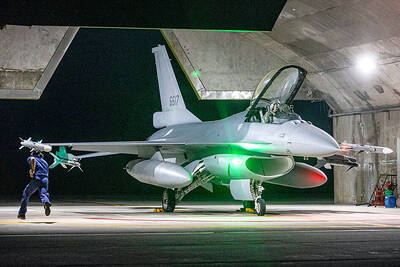
Taiwan has received more than US$70 million in royalties as of the end of last year from developing the F-16V jet as countries worldwide purchase or upgrade to this popular model, government and military officials said on Saturday. Taiwan funded the development of the F-16V jet and ended up the sole investor as other countries withdrew from the program. Now the F-16V is increasingly popular and countries must pay Taiwan a percentage in royalties when they purchase new F-16V aircraft or upgrade older F-16 models. The next five years are expected to be the peak for these royalties, with Taiwan potentially earning

STAY IN YOUR LANE: As the US and Israel attack Iran, the ministry has warned China not to overstep by including Taiwanese citizens in its evacuation orders The Ministry of Foreign Affairs (MOFA) yesterday rebuked a statement by China’s embassy in Israel that it would evacuate Taiwanese holders of Chinese travel documents from Israel amid the latter’s escalating conflict with Iran. Tensions have risen across the Middle East in the wake of US and Israeli airstrikes on Iran beginning Saturday. China subsequently issued an evacuation notice for its citizens. In a news release, the Chinese embassy in Israel said holders of “Taiwan compatriot permits (台胞證)” issued to Taiwanese nationals by Chinese authorities for travel to China — could register for evacuation to Egypt. In Taipei, the ministry yesterday said Taiwan
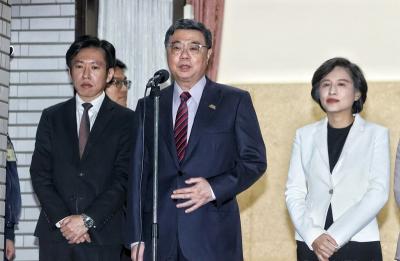
Taiwan is awaiting official notification from the US regarding the status of the Agreement on Reciprocal Trade (ART) after the US Supreme Court ruled US President Donald Trump's global tariffs unconstitutional. Speaking to reporters before a legislative hearing today, Premier Cho Jung-tai (卓榮泰) said that Taiwan's negotiation team remains focused on ensuring that the bilateral trade deal remains intact despite the legal challenge to Trump's tariff policy. "The US has pledged to notify its trade partners once the subsequent administrative and legal processes are finalized, and that certainly includes Taiwan," Cho said when asked about opposition parties’ doubts that the ART was
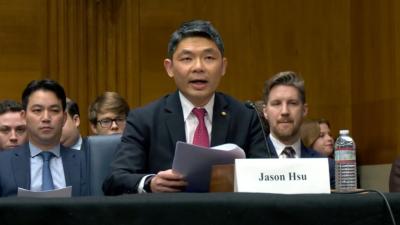
If China chose to invade Taiwan tomorrow, it would only have to sever three undersea fiber-optic cable clusters to cause a data blackout, Jason Hsu (許毓仁), a senior fellow at the Hudson Institute and former Chinese Nationalist Party (KMT) legislator, told a US security panel yesterday. In a Taiwan contingency, cable disruption would be one of the earliest preinvasion actions and the signal that escalation had begun, he said, adding that Taiwan’s current cable repair capabilities are insufficient. The US-China Economic and Security Review Commission (USCC) yesterday held a hearing on US-China Competition Under the Sea, with Hsu speaking on


 RSS
RSS